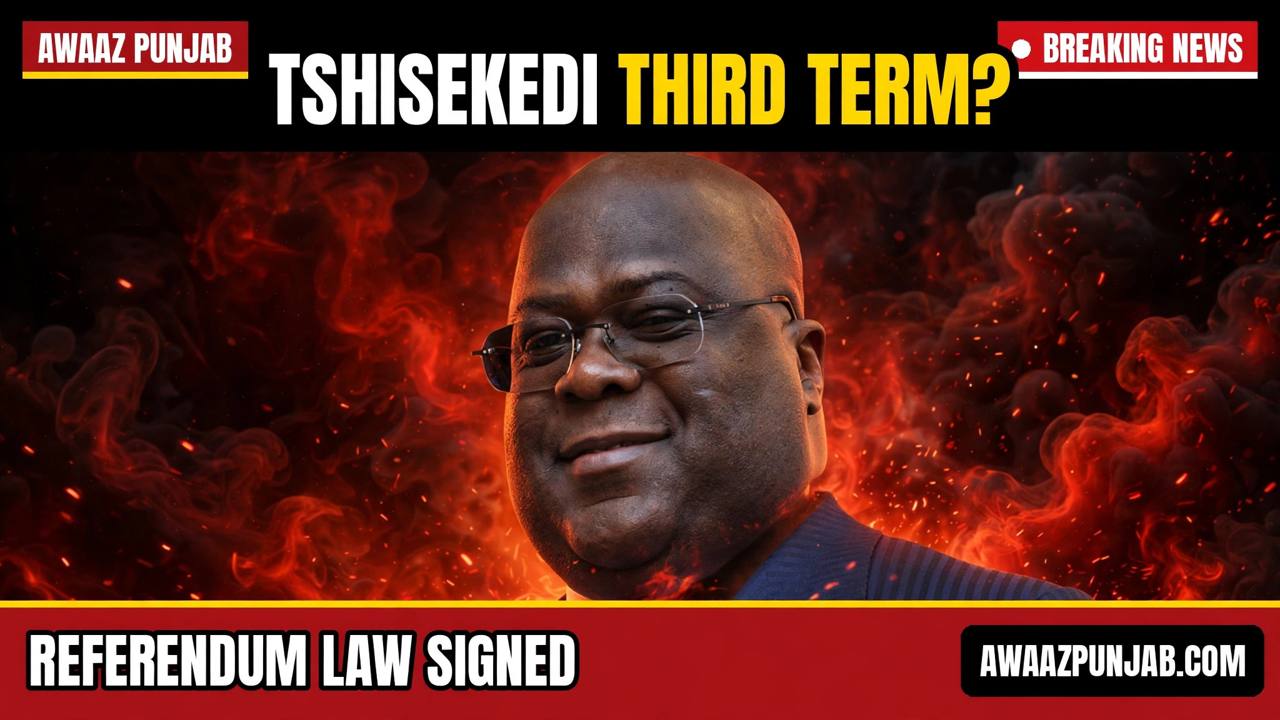
Democratic Republic of Congo President Felix Tshisekedi has enacted a new referendum law that sets out how constitutional changes — and, in cases of what the text calls absolute necessity, a wholly new constitution — can be put to a public vote, a step the opposition condemns as groundwork for a third term in power. The enactment of Law No. 26/045, dated November 9, was announced in an order read on state television overnight from Tuesday to Wednesday, Reuters and AFP reported.
Source: Reuters, Nov 11, 2026
What the law does
The law replaces Congo's referendum law of June 22, 2005, and entered into force immediately. Congo's state news agency ACP said deputy presidential spokesperson Roger Kalenga read out parts of the text on state television, the Associated Press reported via Africanews. The measure runs to eight chapters covering how a referendum is initiated and called, campaign rules, the role of witnesses, observers and journalists, the conduct of the vote, legal disputes and penalties. It governs referendums on constitutional amendments and, in cases of absolute necessity, on a wholly new constitution.
Source: AP via Africanews / QNC News, Nov 11, 2026
Parliament approved the legislation last month. The National Assembly adopted the text on October 23 by 346 votes to 1 and the Senate approved it on November 1 by 78 votes to none, according to Ecofin Agency figures reported by Africa Briefing. Spain's EFE news agency reported that the Constitutional Court had approved an earlier version of the measure in July, a ruling that drew protests in Goma and Bukavu, the eastern cities held by the Rwanda-backed M23 rebel group.
The term-limit wall the law does not remove
Under the current constitution, the path to a third term is blocked twice over. Article 70 limits presidents to two five-year terms, and Article 220 expressly bars any revision of the number or duration of presidential terms. The new law does not itself change either provision, and whether adopting an entirely new constitution could lawfully sidestep Article 220's protection is disputed. No referendum has been called: there is no date, no question and no draft constitution on the table, Reuters reported.
Tshisekedi, 63, has been in power since January 2019 and was re-elected in December 2023, so his second term ends in late 2028. He has denied seeking a third term, but at a rare news conference in early May he said he had not planned to seek one and added: “If people want me to have a third term, I will accept.” In May he also warned that elections due in late 2028 might not go ahead as scheduled if the conflict in the east continues and territories in North and South Kivu remain under rebel control.
Source: Reuters, Nov 11, 2026
Opposition calls it a 'constitutional coup'
Opposition parties have joined forces in recent months in a platform called C64 — the Coalition Article 64 — to stand against constitutional change and any third term, AFP reported. Demonstrations against what the opposition calls a “constitutional coup” were held in June and September in the capital, Kinshasa, and other cities. The United Nations said at least one person was killed at the June protests in Kinshasa, while the opposition said one of its supporters was killed in September. Tshisekedi has offered a national dialogue, but leading opposition parties have rejected the proposal.
Source: AFP, Nov 11, 2026
The fight over the constitution is unfolding alongside the war in Congo's east. AFP reported that the reformed M23 armed group is now led by Tshisekedi's predecessor, former president Joseph Kabila, and that a political front that emerged from M23, the Front for the Refoundation of the Nation, has vowed to challenge Tshisekedi — a claim the article attributes to AFP's reporting; the group's own statements were not independently verified for this report.
Nothing is scheduled yet: no referendum date, question or draft constitution has been announced. The next signals to watch are any move to draft a new constitution, the opposition C64 platform's response, and whether the late-2028 election timetable formally stands as the eastern conflict continues.
What is solid
- Law No. 26/045 was signed by President Tshisekedi and announced on state television overnight November 10–11 (Reuters, AFP, ACP via AP)
- The National Assembly adopted the text 346–1 on October 23 and the Senate approved it 78–0 on November 1
- The current constitution's two-term limit (Article 70) and its bar on revising term number or length (Article 220) are unchanged
- No referendum date, question or draft constitution has been announced
What is only claimed
- Opposition parties say the law is groundwork for a third-term power grab; Tshisekedi denies seeking a third term but says he would accept one if the people asked
- Whether a wholly new constitution adopted by referendum could lawfully sidestep Article 220's protection is disputed