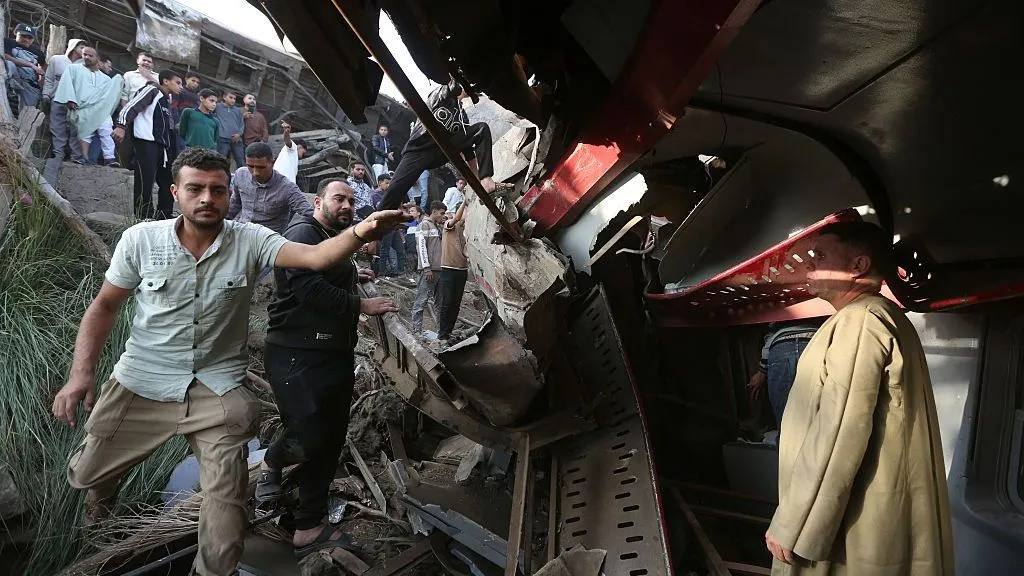
CAIRO — Two passenger trains collided in the Al-Ayyat district of Egypt's Giza province, south of the capital Cairo, on Sunday, November 8, killing at least seven people and injuring more than 100, the country's public prosecutor's office said in a statement reported by the Associated Press and the BBC. Several carriages derailed in the crash, some overturning and falling down an embankment, and images from the scene showed uninjured passengers and passersby searching the wrecked carriages for survivors as a massive emergency response got under way.
Source: BBC News
How the crash happened
Egypt's state railway authority said a train travelling from Giza to Fayoum, in the southwest, crashed into the rear of another service heading south from Cairo to Aswan. The Associated Press, citing the prosecutor's office inspection, reported that the Cairo-Aswan train was stationary on the same track, travelling in the same direction, when the Giza-Fayoum train — identified in Egyptian railway statements as train No. 134, against the Aswan service's No. 2010 — struck its last carriage. The collision occurred between Kafr Ammar and Al-Raqqa stations in Al-Ayyat. The BBC reported that some carriages overturned, with the body of at least one appearing to have split in two.
Source: Reuters
Toll revised up as rescue went on
The health ministry's first count put the toll at four passengers killed and 88 injured, with a train driver among the dead, and said at least 72 ambulances attended the scene; state-owned media had earlier reported 120 people wounded without clarifying the severity of their injuries. The public prosecutor's office later raised the toll to seven killed and more than 100 injured — the train's conductor among those killed, the office said — and warned that the death toll could rise. Health Minister Khaled Abdel Ghaffar said the injured were being treated for broken bones and head injuries, and the government said hospitals across Giza and the neighbouring Beni Suef province had been put on heightened alert.
Source: Associated Press
People living near the crash site were among the first rescuers. Ayman Gamal, a resident of Kafr Girza in Al-Ayyat, told the Associated Press that neighbours rushed to the scene, pulled out survivors and called ambulances, and that he saw around 80 of the injured taken away by ambulance; some passengers trapped inside one carriage of the stationary train were dead when they were pulled out, he said. Emergency teams and cranes were dispatched to clear the wreckage, and train services between Giza and the Upper Egypt region were suspended, the railway authority and the BBC reported.
Source: Associated Press
President orders investigation
President Abdel Fattah al-Sisi said he was following the accident with great concern and had ordered an urgent investigation to hold accountable anyone found to have been negligent, according to statements reported by Reuters and the BBC. Investigators from the public prosecutor's office arrived at the site on Sunday, and emergency crews were clearing the wreckage to restore services on the Cairo-Upper Egypt line, the railway authority said, without indicating how long that would take.
Source: Reuters
A district marked by rail tragedy
Al-Ayyat is the site of Egypt's worst-ever rail disaster: in February 2002 a fire engulfed an overnight passenger train travelling from Cairo to Luxor near the district, and more than 370 people were officially reported killed, with some estimates considerably higher; the train travelled for around nine kilometres before coming to a halt. Two further crashes in the same area in 2009 killed dozens more, the BBC reported. Train derailments and crashes are common in Egypt, where the railway system has a history of mismanagement and poor maintenance, although the government has announced modernisation programmes in recent years; last September, a train driver and his assistant were injured when two freight trains collided in the same district, the Associated Press reported.
Source: BBC News
What happens next: the prosecutor's investigation will establish why the Giza-Fayoum train reached the stationary Aswan service on the same track, the wreckage must be cleared before Cairo-Upper Egypt services resume, and officials have warned the death toll may still rise. There were calls in Egypt on Sunday for the transport minister to resign over the disaster, the BBC reported. Awaaz Punjab will update this story as Egyptian authorities release confirmed findings.
Source: BBC News
What is solid
- Two passenger trains collided in Al-Ayyat, Giza province, on Sunday, November 8 — a Giza-Fayoum train struck the rear of a stationary Cairo-Aswan train between Kafr Ammar and Al-Raqqa stations (railway authority, prosecutor's office)
- The public prosecutor's office put the toll at seven killed and more than 100 injured, up from the health ministry's initial count of four killed and 88 injured
- President Abdel Fattah al-Sisi ordered an urgent investigation and accountability for anyone found negligent
What is only claimed
- The cause of the collision has not been established — investigators were still examining the site on Sunday
- State-owned media earlier reported 120 wounded, a figure officials did not confirm in their later counts