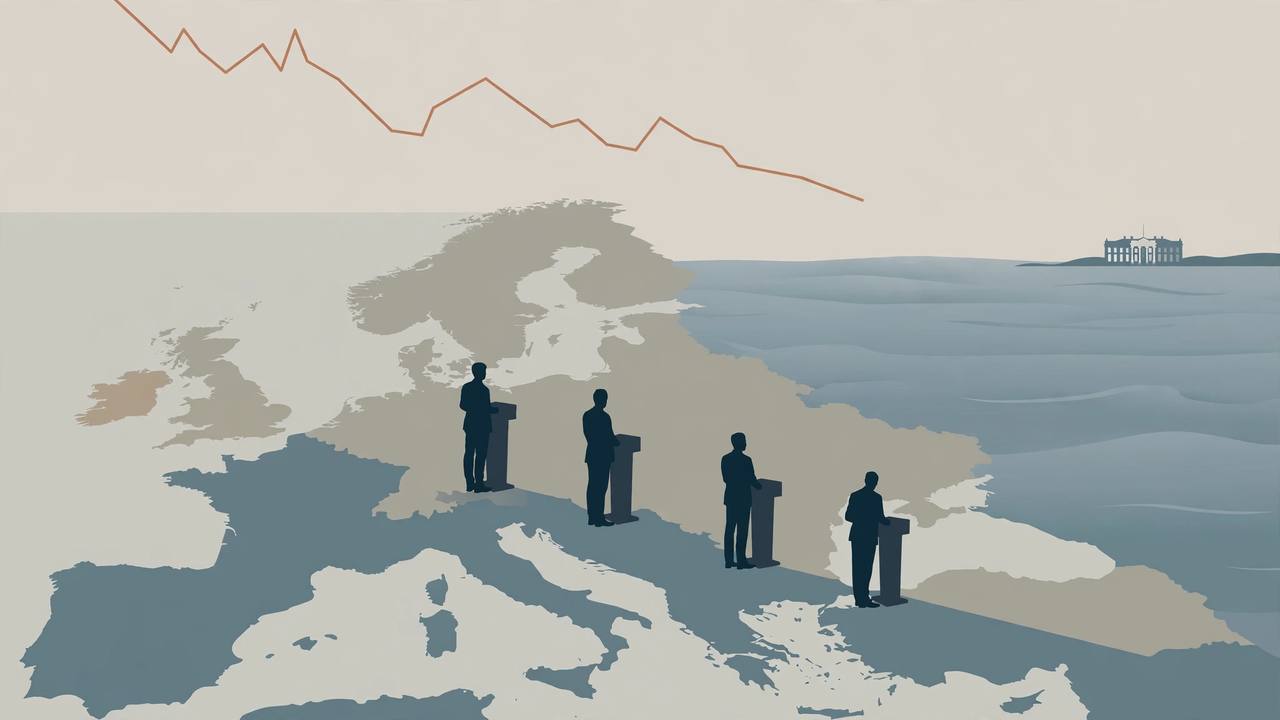
Europe's far-right politicians on Wednesday, November 4 began to distance themselves from Donald Trump following the Democrats' victory in the US midterm elections — blaming the war with Iran for the Republicans' defeat, but mostly avoiding directly criticising the president himself, Reuters reported from London.
Source: Reuters
The realignment is notable because many of these leaders celebrated their ideological ties with Trump after his victory in 2024, with some visiting Washington since then and receiving backing from his billionaire ally Elon Musk. Now, with the Iran war's economic fallout landing on European households too, the association is being quietly re-priced.
Source: Reuters
The distancing follows Vice President JD Vance's own verdict on the defeat inside the Trump administration. Read: "The Reason We Lost Is the War" — Vance blames the Iran war
Bardella: Iran intervention "carries very heavy consequences"
Jordan Bardella, leader of France's National Rally — the party most polls suggest could form the next French government — typified the shift. Trump's second term was less isolationist than his first from 2017 to 2021, Bardella said, and "American intervention regarding Iran carries very heavy consequences" for economies around the world — without mentioning Trump as being behind that intervention. Speaking to RTL, he also suggested the economic fallout may have contributed to the defeat, and stressed the American voters' choice must be respected, Anadolu Agency reported.
Source: Reuters
Weidel: a broken promise that "came back to haunt" Republicans
In Germany, Alice Weidel, co-leader of the far-right Alternative for Germany (AfD), also attributed the loss to Iran. "Trump had promised his voters not to pursue an interventionist foreign policy … This broken promise has now come back to haunt the Republicans," she told the news outlet T-Online.
Source: Reuters
Salvini and Vannacci point to wars and the cost of living
In Italy, Matteo Salvini, leader of the far-right League party, which is part of the ruling coalition, said "the American result was influenced above all by the wars, international tensions and the increase in the cost of living, the consequences of which fall directly on families." He added: "The hope is that this vote can represent an acceleration towards the end of the conflicts and a return to peace."
Source: Reuters
Roberto Vannacci, a former Italian general who leads the far-right Futuro Nazionale party and once expressed admiration for Trump's "America First" politics, went further. "Trump failed to live up to expectations, was unable to bring the war between Russia and Ukraine to an end and launched a war against Iran," Vannacci told the ANSA news agency, arguing the resulting rise in energy prices and economic and stock-market turmoil had hurt the US middle class.
Source: Reuters
Abascal shrugs, Lowe calls the war a "catastrophic mistake"
In Spain, Santiago Abascal, leader of the far-right Vox party, made little attempt to temper his move away from Trump, telling reporters he was "in Spain and not in Michigan": "I care quite little about what happens in other places." In Britain, Rupert Lowe, leader of the Restore Britain party, blamed the decision to attack Iran in a lengthy post on X, calling it a "catastrophic mistake" and asking, "What has this war achieved? Absolutely nothing of worth" — though he did not name the president who launched the war.
Source: Reuters
One of the few to play down the defeat was Dan Dungaciu, vice-president of Romania's hard-right Alliance for Uniting Romanians, who argued reports of Trump's "political death" were "greatly exaggerated": the president, he said, moves from Republican majorities to a system where the executive and Congress check each other much more intensely. France's economy minister Roland Lescure, from the governing camp, similarly said Trump would be weakened on domestic policy but would still control foreign affairs, Anadolu reported.
Source: Reuters / Anadolu Agency
What is solid
- Far-right leaders in France, Germany, Italy, Spain and Britain publicly attributed the Republican defeat wholly or partly to the Iran war and cost-of-living pressures on Wednesday (Reuters, Nov 4).
- Trump himself has acknowledged the Iran war played a role in his party's losses while standing by the decision (Reuters).
What is only claimed
- Analyst Mujtaba Rahman of Eurasia Group said the distancing is driven by 'obvious political advantage' — his assessment, not a stated motive of the leaders.
- Most of the leaders avoided criticising Trump by name; the distancing is a shift in emphasis, not a formal rupture with him.
"An electoral liability" — and what happens next
"His growing unpopularity, particularly over the cost of living, risks turning what was once a political asset into an electoral liability," Mujtaba Rahman, managing director of the political-risk consultancy Eurasia Group, told Reuters. Far-right leaders, he said, appear to want the "ideological momentum of Trumpism" without the "chaos and economic disruption of his presidency" — and the risk is that Trump and his MAGA allies respond by withdrawing their support or turning against them. For Gulf and European households alike, the calculation now runs through oil: as long as the Strait of Hormuz stays shut and fuel prices stay high, the war that cost Republicans Congress will keep costing Trump's European admirers at home too.