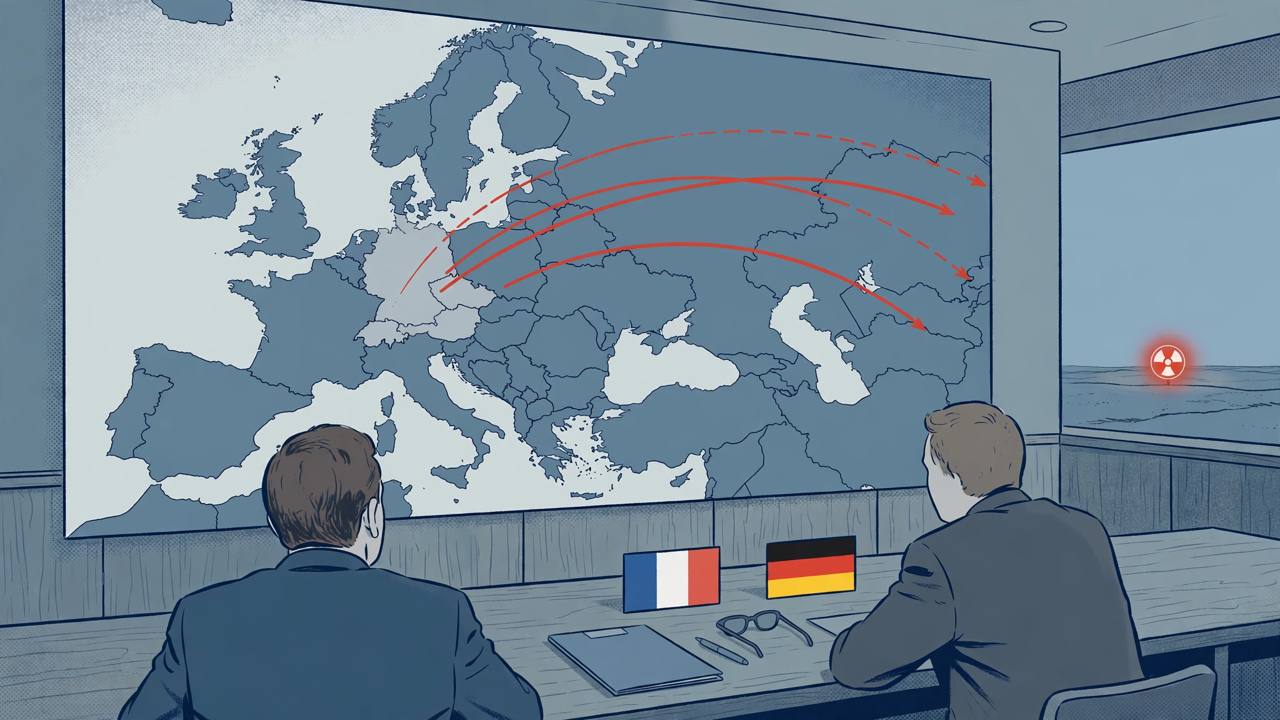
France is demanding that Germany clearly outline under what circumstances Berlin intends to use its new long-range missiles in a conflict with Russia, warning that without agreed rules Europe could be dragged inadvertently toward nuclear war, the Financial Times reported on Wednesday, November 11, citing six people familiar with the discussions. Paris is negotiating with German officials to align Berlin's approach to weapons capable of so-called deep precision strikes (DPS) — strikes deep inside an enemy's territory — with France's nuclear strategy.
Source: Financial Times, via inbox.lv
One French official warned the FT that a Russian target could be struck with a conventional weapon and a "nuclear reaction" could still follow in response. "If the Russians misinterpret the signal, we could reach the nuclear threshold without even realizing it," the official said. Another French representative said France, as a nuclear power, has developed its own "nuclear grammar and lexicon" — unspoken rules built up over decades. "There are habits that we have developed over time. The Germans do not have them. It would be much better to have a clear and sufficiently public doctrine so that the Russians never misunderstand the signals," he added.
Source: Financial Times, via inbox.lv
Why Germany's missile build-up worries Paris
Germany, along with the United Kingdom, Poland and the Nordic and Baltic states, is significantly expanding its long-range arsenal to strengthen deterrence against Moscow after Russia's invasion of Ukraine and amid uncertainty over American commitments to European security under President Donald Trump. Berlin is procuring and developing ground-based missiles with ranges from 500 km to more than 2,000 km, which would let German forces strike targets deep inside Russian territory. Germany's defence ministry has said it is developing deep precision strike capabilities jointly with Britain and is exploring the possibility of including France.
Source: Jammu News Portal, reporting the Financial Times and the German Defence Ministry
The French concern is sharpened by President Emmanuel Macron's "forward deterrence" concept: since March, when Macron opened discussions on how France's nuclear programme could help protect European partners, Paris has been negotiating nuclear doctrine with several European countries, with Germany — Europe's biggest defence spender — the particular focus. French officials fear that if an ally sheltered by that concept struck Russia, Moscow could hold Paris responsible. "If you invite someone into your home, you are responsible if they set it on fire," one official familiar with the discussions told the FT.
Source: Financial Times, via inbox.lv
Berlin says it agrees — and that it started this discussion
A senior German official told the FT that Berlin "cannot disagree" on the need for a "common doctrine and common understanding of the escalation ladder" among European capitals, and said it was Germany that initiated the discussion three years ago on strengthening conventional deterrence against Moscow. "This is not a situation where the French are asking for something, and we are resisting. The acquisition of these capabilities for deep precision strikes must necessarily be accompanied by a common understanding of how to use them. That has been clear from the very beginning," the official said. He added that formal negotiations had stalled over an internal French debate about the future of its nuclear strategy but are now gaining momentum; one possible outcome is a joint statement by Germany, France and the UK defining a common approach, though he warned that is still a long way off.
Source: Financial Times, via inbox.lv
The United Kingdom, Europe's only other nuclear power in NATO, is holding similar talks with Germany under the two countries' 2024 bilateral defence agreement, which covers jointly developed weapons with ranges exceeding 2,000 km, and the two are also discussing France joining the programme, a British representative said. The British official warned of "confusion" around the term deep precision strike: its primary aim, he said, is to weaken an enemy's combat potential by hitting command centres, logistics hubs, ammunition depots or arms factories — not government buildings or nuclear facilities. "We all recognize the need to prevent escalation to the nuclear level," he said.
Source: Financial Times, via inbox.lv
General Ingo Gerhartz of the Bundeswehr, who heads the NATO command responsible for the defence of Central Europe and the alliance's eastern flank, said at the Berlin Security Conference last week that deep-strike decisions must always be taken after consultation with NATO allies, "because anything a single country does regarding Russia will always be attributed to all of NATO," and that such capabilities "must be integrated into the entire alliance's policy." In March, Macron and German Chancellor Friedrich Merz created a high-level Franco-German nuclear steering group to coordinate strategic cooperation — conventional capabilities, missile defence and French nuclear forces — and a July declaration also identified deep precision strikes and managing escalation below the nuclear threshold as areas for cooperation.
Source: Nexus Europa, reporting the Financial Times
What is solid
- France is pressing Germany to clarify the circumstances and rules for using its long-range missiles, and to align deep precision strike doctrine with French nuclear strategy — Financial Times, Nov 11, citing six people familiar with the talks
- Germany is buying and developing ground-launched missiles with ranges from 500 km to more than 2,000 km, and its defence ministry says the deep-strike capability is being developed jointly with Britain, with France possibly included
- A senior German official says Berlin agrees European capitals need a common doctrine and a shared understanding of the escalation ladder
- France and Germany already have a joint nuclear steering group, created by Macron and Merz in March
What is only claimed
- Whether a conventional German strike on Russia would in fact trigger a nuclear response — this is a French officials' warning about misreading signals, attributed as such, not an established fact or a Russian statement
- How close a joint German-French-British doctrine statement is — a German official says talks are gaining momentum but a statement is still a long way off
- Berlin has announced NO plan to strike Russia; the dispute is over doctrine for a future conflict, not an operation under way
What happens next
For now the argument is over rules, written before any crisis: when such missiles could be used, what they could hit, and how Moscow might read them. Vienna-based military analyst Franz-Stefan Gadi told the FT Berlin needs to set target-selection priorities, escalation-management rules and a process for sanctioning strikes, so the new capability deters without inviting misunderstanding. The talks between Paris and Berlin continue, with Britain in parallel discussions — and the question the French are putting to Europe's rising military power is whether the doctrine will be settled before the missiles, expected in service in the 2030s, ever have to speak for themselves.