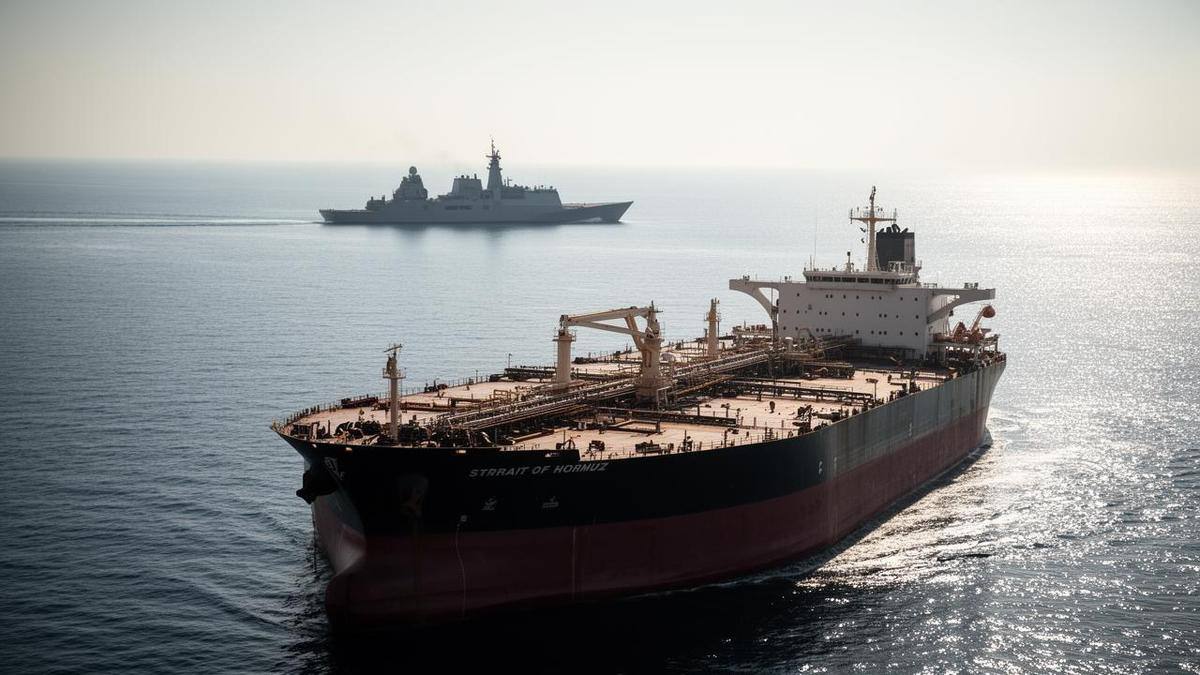
Iran shut the Strait of Hormuz again on Saturday, just a day after announcing it would reopen the waterway to commercial shipping, and Iranian gunboats opened fire on ships trying to pass through, maritime monitors and the Associated Press reported.
Iran's joint military command said on Saturday that “control of the Strait of Hormuz has returned to its previous state ... under strict management and control of the armed forces.” It warned that Tehran would keep blocking transit through the strait for as long as the United States blockade of Iranian ports remained in effect.
Revolutionary Guard gunboats opened fire on a tanker transiting the strait on Saturday, and an unknown projectile hit a container vessel, damaging some of the containers, the British military's United Kingdom Maritime Trade Operations centre (UKMTO) said, without identifying the vessels. UKMTO said the master of a tanker reported being approached by two IRGC gunboats about 20 nautical miles northeast of Oman and then being fired upon; the tanker and its crew were reported safe.
TankerTrackers.com reported that two Indian-flagged vessels were forced to turn around after being fired on by Iran, including a supertanker carrying Iraqi oil. BBC Verify tracked the two ships — the cargo vessel JAG ARNAV and the oil tanker SANMAR HERALD — as they slowed and turned back after passing Larak Island on the agreed shipping route.
The reversal came less than 24 hours after Iran announced on Friday that it was reopening the strait to commercial vessels, following a 10-day truce between Israel and the Iranian-backed Hezbollah movement in Lebanon. The reopening had triggered a fall in oil prices. But US President Donald Trump said the American blockade “will remain in full force” until Tehran reaches a deal with Washington, and Iranian officials called the blockade a violation that would force the strait shut again.
“Americans are risking the international community, risking the global economy through these, I can say, miscalculations,” Iranian Deputy Foreign Minister Saeed Khatibzadeh told the Associated Press on Saturday, after a diplomatic forum in Antalya, Turkey. “Everybody must understand to what extent American side is risking the whole ceasefire package,” he said.
Ebrahim Azizi, head of the Iranian parliament's National Security Commission, said the strait was “returning to the status quo,” which he had earlier described as ships requiring Iranian naval authorisation and toll payment before transiting. Data firm Kpler said movement through the strait remained confined to corridors requiring Iran's approval.
For the United States, the blockade is a key tool to keep pressure on Iran short of resuming bombardment, by cutting off much of Iran's exports and imports. US Central Command said on X that American forces have sent 21 ships back to Iran since the blockade began on Monday. On Friday, Trump said the United States would go into Iran and “get all the nuclear dust,” referring to the enriched uranium believed to be buried under nuclear sites badly damaged by US strikes.
The nuclear question remains the hardest sticking point. Khatibzadeh said Iran would not hand over its stock of 970 pounds (440 kilograms) of enriched uranium to the United States, calling the idea “a non-starter,” though he added: “we are ready to address any concerns.” He also said Iran was not ready for a new round of face-to-face talks with the US because Washington had “not abandoned their maximalist position.”
Pakistan, which brokered the ceasefire, was pushing for progress. Foreign Minister Ishaq Dar told the Antalya forum that Pakistani diplomats were working to “bridge” differences between the US and Iran. Pakistan's army chief met senior Iranian officials in Tehran, while its prime minister held talks in Antalya with Turkey's president and Qatar's emir. Pakistan is expected to host a second round of negotiations between Iran and the US early next week. The current ceasefire is due to run out by mid-next week.
Later on Saturday, Iran's regular navy said a tanker had hit a mine and caught fire in the strait after three vessels entered a restricted zone east of the waterway with their tracking systems switched off. The navy said the tanker was immobilised and the other two ships turned back, and that the strait would remain closed until “Iran's demands are met.” It did not name the vessels or report any casualties, and the claim has not been independently verified.
Oil markets felt the whiplash immediately. Brent crude traded near $96 a barrel on Friday — its highest close since November 6 — as the fighting around the strait pushed prices up, before Friday's reopening announcement pulled them back. The strait carries about a fifth of the world's oil, and any disruption hits fuel prices in India and the Gulf states, where lakhs of Indian and Punjabi workers live and work.
Iran's Supreme Leader, Ayatollah Mojtaba Khamenei, issued defiant remarks on Saturday, saying Iran's navy stood “ready to inflict bitter defeats on its enemies.” He was speaking in a message marking the anniversary of the establishment of Iran's army, and hailed drone strikes that targeted Israel and US interests across the region during the past seven weeks of war. He has not been seen in public since he was elevated to supreme leader after his father, Ayatollah Ali Khamenei, was killed in Israel's opening barrage of the war on February 28.
The war, which began with US and Israeli strikes on February 28, has killed at least 3,000 people in Iran, more than 2,290 in Lebanon, 23 in Israel and more than a dozen in Gulf Arab states, according to the Associated Press. Thirteen US service members have also been killed.
On Friday, President Trump rejected Iran's proposal to reopen the strait within seven days, saying the US blockade would stay until Tehran agreed to American terms. Read the earlier story
On Friday, Iran's Revolutionary Guards said two more tankers had hit mines near the strait — a claim that has not been independently verified. Read the earlier story
What is solid
- Iran announced the strait's reopening on Friday and reversed it on Saturday, its joint military command said
- UKMTO reported gunboats firing on a tanker; two Indian-flagged vessels turned back, according to TankerTrackers.com and BBC Verify
- The US blockade of Iranian ports remains in force, President Trump said
What is only claimed
- Iran's claim that a tanker hit a naval mine late on Saturday — no vessel was named and no independent confirmation exists
- Iran's claim that the US charges ships a toll to transit the strait — US Central Command has denied it