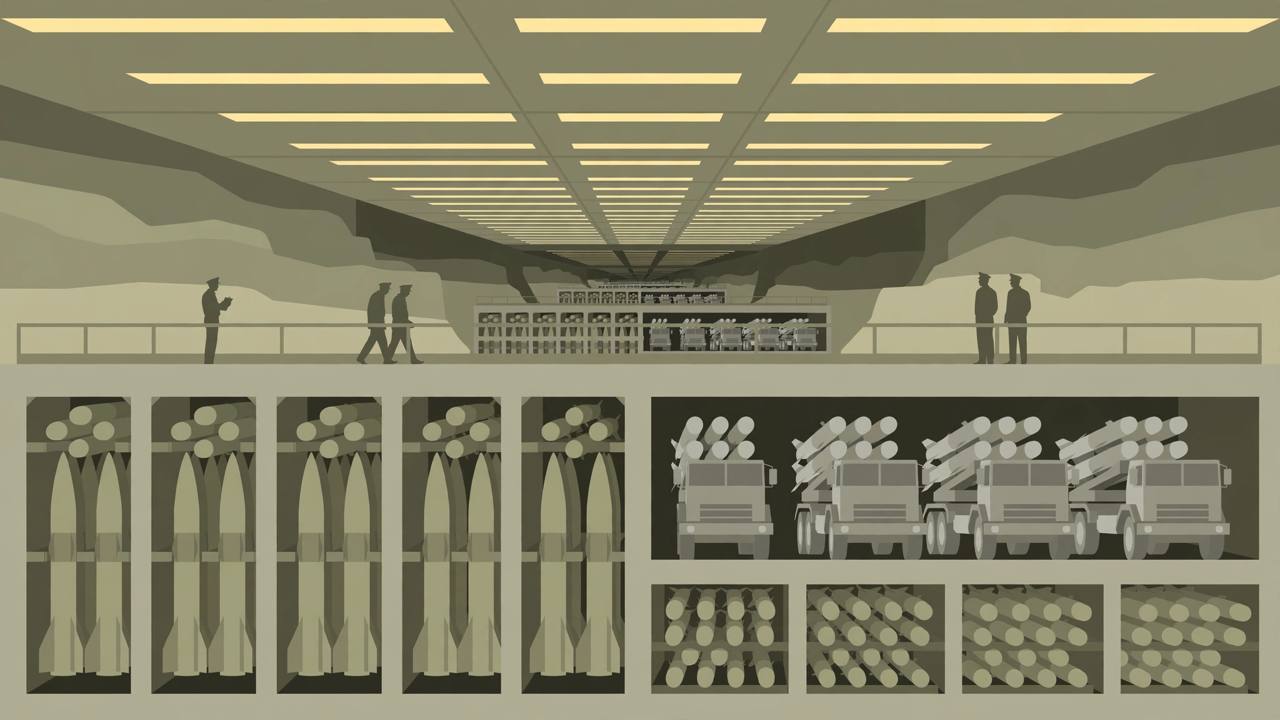
This unveiling is the event the IRGC trailed on Saturday, November 7, when its spokesperson said missile and drone production lines had been moved underground and an underground 'missile city' would be unveiled. Tuesday's ceremony is the first showing of that facility. Read the November 7 report
Iran's Islamic Revolutionary Guard Corps (IRGC) Aerospace Force unveiled a new underground missile city on Tuesday, displaying various ballistic and cruise missiles along with their launchers, the semi-official Tasnim news agency reported from Tehran.
Source: Tasnim News Agency
The unveiling ceremony was attended by Major General Ali Abdollahi, chief of staff of Iran's armed forces, and Brigadier General Seyyed Majid Mousavi, commander of the IRGC Aerospace Force, Tasnim and Iran's Press TV reported. State television broadcast a heavily edited and partially blurred video showing Abdollahi visiting the underground facility; it did not indicate when the visit took place or give any details on the location, the Associated Press reported.
Source: Associated Press
Abdollahi said Israel had failed to defeat Iran in the recent wars and that Israel was instead the 'obvious defeated' side, according to the AP account of the broadcast. The remarks are a claim by Iran's top uniformed officer, made in a military showcase, and are presented here as his statement — not as an independently established assessment of the wars' outcome.
A warning from the aerospace commander
Mousavi, speaking at the unveiling, said Iran was ready to confront threats and would strike its enemies' capabilities beyond the region if need be, Press TV reported. Iranian commanders have used similar language throughout the war that began with US and Israeli strikes on February 28, and Tehran has repeatedly warned Gulf states hosting US forces not to allow their territory to be used for attacks on Iran.
Source: Press TV
One Israeli outlet, JFeed, reported that the facility houses ballistic missiles, cruise missiles and launchers and said Iran possesses more than 1,700 ballistic missiles with the range to reach Israeli territory. That figure is a reported claim carried by that outlet; neither the AP nor Tasnim's own report published a verified inventory, and Awaaz Punjab is reporting the number as a claim, not a confirmed count.
Source: JFeed
Why the timing matters
The showcase came a day after President Donald Trump said the war with Iran was militarily 'effectively over', that renewed large-scale US strikes did not appear necessary, and that he wanted a long-term solution — while also keeping the US naval blockade of Iranian ports in place. Tehran's answer, delivered in steel rather than words, was a filmed reminder that its missile force — the arm it used to strike US bases and Gulf targets throughout the war — is being rebuilt where bombers cannot easily reach it.
On Saturday, IRGC spokesman Hossein Mohebbi said Iran had lifted the limits it previously kept on its missile range, and on November 7 the corps said production lines had been moved underground so output could continue under bombardment. Tuesday's unveiling ties those two threads together: longer-range missiles, produced and stored below ground.
What is solid
- The IRGC Aerospace Force unveiled a new underground missile facility on Tuesday, November 10, and Iranian state-linked media showed ballistic and cruise missiles and launchers (Tasnim).
- Armed forces chief of staff Ali Abdollahi and aerospace commander Seyyed Majid Mousavi attended the unveiling (Tasnim, Press TV).
- The state TV video was heavily edited and partially blurred, and gave no location and no date for the visit it showed (AP).
What is only claimed
- The reported figure of more than 1,700 ballistic missiles able to reach Israel comes from one outlet's reporting of Iranian claims and is not independently verified.
- Abdollahi's statement that Israel is the 'obvious defeated' side is Iran's official claim; Israel and the US describe the wars' outcome very differently.
- Iranian claims about the facility's survivability and readiness cannot be checked from a blurred, edited broadcast.
What it means for the Gulf — and what happens next
For the lakhs of Punjabi and Indian workers across the Gulf, the direct news is what the unveiling did not contain: no new threat against a named Gulf state, no announced test launch and no change to shipping in the Strait of Hormuz was reported alongside it. It was a deterrence message aimed chiefly at Washington and Jerusalem, delivered while Qatar's prime minister carries the Iran file to the G7 in Paris and mediation to end the war continues.
What happens next will be read in Washington's response — whether the Trump administration treats the unveiling as propaganda to ignore or as evidence in its argument that only a negotiated cap on Iran's missile programme can close the war — and in whether Iran follows the showcase with an actual test launch, which would be a materially larger step than a televised tour.