Latest News — Punjab, India, USA and the World
Awaaz Punjab is an independent digital news platform publishing original, source-verified reporting in English, Punjabi and Hindi. Every story below is published with its sources named and dated, and every article is available in all three languages. Our newsroom covers Punjab first — its politics, districts and the road to the 2027 assembly election — along with India, the Punjabi diaspora in the USA and Canada, and world affairs that touch Punjab's people, from the Gulf to North America.
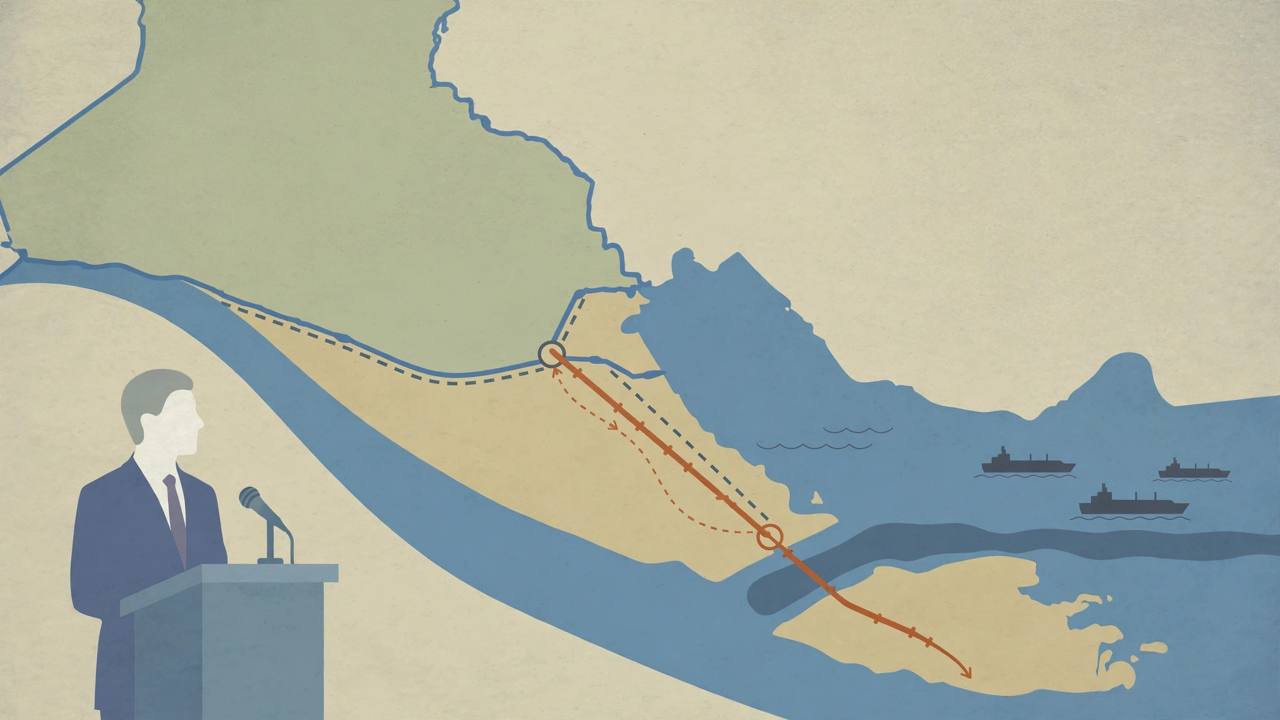
President Donald Trump said on Friday evening that the United States had carried out another round of limited strikes on Iran, destroying a newly built Iranian anti-aircraft installation on Qeshm Island in the Strait of Hormuz in 'about 15 minutes, maybe five' — the first US strikes since the Republicans' heavy defeat in Tuesday's midterm elections. Hours earlier, Iranian media had reported two missiles hitting the island's Suza area, in the report Awaaz Punjab published earlier tonight, when who fired them was not established; the exact connection between those impacts and the operation Trump described has not been independently established, and Iran has released no official damage assessment and no casualties are confirmed.
Published 2026-11-06 · Awaaz Punjab
A 12-year-old walking home from middle school in Silverdale on Monday was allegedly grabbed by a man who told her she was coming with him — she punched him, ran and photographed him. Her father posted the photo, got an address from the community, called 911 at the man's apartment on Wednesday, and Kitsap County deputies arrested Timothy Caldwell, 20, an active-duty Marine now facing attempted-kidnapping and assault charges on $350,000 bail, with NCIS investigating alongside.
Published 2026-11-07 · Awaaz Punjab
Kalyanpur village in Bihar's Munger district lit 11,11,111 earthen lamps on Chhoti Diwali in what organisers called the state's biggest Deepotsav, as Chief Minister Samrat Choudhary lit the first diya and announced that work on an 83-km marine drive between Munger and Bhagalpur would begin within two months.
Published 2026-11-07 · Awaaz Punjab
Four members of the same family were shot and injured in a daylight clash over a land dispute in Hiranandpur village under Didarganj police station in Patna on Saturday afternoon. The injured — Bhola Kumar, Sudhir Kumar, Kaushal Kumar and Dwarika Prasad — were rushed to Nalanda Medical College and Hospital. Police said three people have allegedly been accused of opening fire, and an investigation is under way.
Published 2026-11-07 · Awaaz Punjab
Follow-through on the November 3 trifecta Awaaz Punjab reported on November 4: Friday caucuses in Phoenix made De Los Santos speaker and Sundareshan Senate president, named full leadership teams in both chambers, and pointed straight at ESA voucher reform and water as the first fights of the session opening January 11.
Published 2026-11-07 · Awaaz Punjab
Pope Leo XIV celebrated his first Mass in South America on Saturday before an estimated 40,000 people in Paysandu, western Uruguay — the first Mass of a 12-day, three-nation tour that had been in doubt after his lung cancer surgery on October 13 — urging the faithful in the region's most secular country to build bridges of fraternity and share their faith like the mate tea passed hand to hand, the Associated Press and Al Jazeera reported.
Published 2026-11-07 · Awaaz Punjab
A fire broke out around 8 pm on Saturday at an asbestos-roofed house in Nalipur village of Odisha's Jajpur district, trapping the family inside. Another child was critically injured, and the cause of the blaze is yet to be ascertained.
Published 2026-11-07 · Awaaz Punjab
Atlanta police responded at 8:45 p.m. Friday to 1371 Kimberly Way SW and found an 18-year-old and a child shot — both conscious when taken to hospital — plus a third male with lacerations. Investigators say multiple people were firing and casings were recovered, but no arrests had been announced by Saturday. It is the third child shot at this address since February 2024: a 3-year-old was wounded there in 2024 and a 7-year-old in a drive-by this April.
Published 2026-11-07 · Awaaz Punjab
The Delhi High Court has granted regular bail to former DGHS Director General Dr Vatsala Aggarwal and former Central Procurement Agency head Dr Vinod Kumar Ranga in the alleged Rs 842-crore medical procurement case, holding that their continued custody was not necessary as the investigation had substantially progressed and no money had been traced to either of them.
Published 2026-11-07 · Awaaz Punjab
Mumbai Indians and Punjab Kings have agreed a straight swap of captain Hardik Pandya for fast bowler Arshdeep Singh ahead of IPL 2027, PTI, IANS, India Today and Cricbuzz reported on Saturday. Both players have consented and the franchises have exchanged Expressions of Interest — but BCCI ratification and an official announcement are still awaited.
Published 2026-11-07 · Awaaz Punjab
The State Department has cleared a possible Foreign Military Sale of 11 UH-60M Black Hawks, engines, sensors and support — estimated at $1.075 billion, yaani about 108 crore dollars — to expand Mexico's counter-drug airlift, with Sikorsky as principal contractor.
Published 2026-11-07 · Awaaz Punjab
Two Norristown officers fired on a man holding a large knife who threatened them and advanced in Elmwood Park on Friday night, November 6, the Montgomery County District Attorney's Office said. Police had first been called at about 8 p.m. over reports of a person trying to set cars on fire on Stanbridge Street. The man died at the scene, no officer was hurt, his name is withheld pending family notification, and county detectives are investigating under the county's officer-involved-shooting protocol.
Published 2026-11-07 · Awaaz Punjab
Maharashtra's Food and Drug Administration (FDA) said on Saturday that it had suspended 43 food business licences and seized 17,824 kg of food articles worth Rs 63.09 lakh in a fresh statewide enforcement drive conducted on November 6 and 7 across 73 establishments — the second such Diwali round in three days, after the November 4–5 drive that suspended 105 licences. Mumbai's 125-year-old Orient Club and a Blinkit unit in Wardha are among those facing action, IANS reported.
Published 2026-11-07 · Awaaz Punjab
Three people — two men and a one-and-a-half-year-old girl — were killed and more than six others injured after a Delhi-to-Bihar passenger bus met with an accident at Labaniya Square in Kushinagar district, Uttar Pradesh, ANI reported, quoting Ravindranagar SHO Amit Kumar Singh. Two critically injured passengers were referred to the Medical College in Gorakhpur.
Published 2026-11-07 · Awaaz Punjab
A day after the Infopark police booked a 41-year-old Kochi doctor in a sexual-assault case — a development Awaaz Punjab reported on November 6 — police said on Saturday that his two mobile phones held videos and photographs of several women and that he is suspected of having sexually assaulted more women. The doctor has been absconding since Friday, and an Ernakulam court on Saturday dismissed the bail petitions of actors Athulya Chandran and Bibin Perumpally and their friend Vishnu, who were arrested on the doctor's own assault-and-robbery complaint.
Published 2026-11-07 · Awaaz Punjab
Thousands marched across France for a fourth straight Saturday against the high cost of living, but the interior ministry counted only about 7,000 people at 68 actions outside Paris by 14:00 — a sharp fall since October — as 70,000 police deployed and two organisers were detained near the National Assembly.
Published 2026-11-07 · Awaaz Punjab
Three more accused, including the man investigators say snatched a BSF jawan's service rifle during the November 2 mob attack at Ashabari in Tripura's Sepahijala district, were arrested on Saturday, taking the total to 21. Sepahijala SP Bijoy Debbarma said the two prime accused were brought back after a BSF-BGB flag meeting. This follows the earlier arrests that had taken the total to 18.
Published 2026-11-07 · Awaaz Punjab
Maryland State Police say a 2025 Jeep Gladiator was travelling southbound in the northbound lanes of I-95 at mile marker 44 shortly before 4:30 a.m. on Saturday, November 7, when it hit a Grand Cherokee head-on. Both drivers died at the scene; police believe alcohol and speed may have contributed, and the Crash Team investigation continues.
Published 2026-11-07 · Awaaz Punjab
Maritime rescue services rescued 3,261 people in the first six days of November, with 1,021 brought ashore in a single night, as regional president Fernando Clavijo called the situation on El Hierro “absolutely unsustainable”.
Published 2026-11-07 · Awaaz Punjab
A federal grand jury has indicted Zachary Walker and Mario Bailey of Atlanta for allegedly impersonating Detroit carrier Voyager Express Inc. to obtain eight fuel cards from Coyne Oil & Propane — cards prosecutors say were used to buy fuel in 23 states, leaving $760,320.19 unpaid. Walker made his initial court appearance on Nov. 3 and was released on a $10,000 unsecured bond. The charges are allegations; both men are presumed innocent.
Published 2026-11-07 · Awaaz Punjab
A Murrieta man is in jail on nine counts of identity theft and grand theft after detectives say a data breach at an Oxnard fuel company led them — by surveillance video and plate readers — to a work truck rebuilt as a rolling fuel station. The investigation is still hunting for more suspects.
Published 2026-11-07 · Awaaz Punjab
Police officer Harpal Singh confirmed firing took place during a clash between two groups in Akalgarh Dhapian village under Jandiala police station between 1:30 p.m. and 2 p.m. on Saturday and that Sandeep Singh was injured in the leg by a bullet and by sharp-edged weapons. The victim's family alleges 100 to 150 armed attackers surrounded their house over an old rivalry — an allegation police are still investigating as statements are recorded and an FIR is to follow.
Published 2026-11-07 · Awaaz Punjab
Ukraine's armed forces hit two Russian Iskander ballistic-missile launchers and a Pantsir-S1 air-defence system in Russia's Bryansk region on November 6 and overnight into November 7, the General Staff of the Armed Forces of Ukraine said on Saturday — hours after Russia fired 36 missiles and 172 drones at Kyiv and Ukraine's power grid. The extent of the damage is still being clarified, the General Staff said; the Kyiv Independent noted it could not independently verify the strikes, and there was no Russian confirmation in the reporting.
Published 2026-11-07 · Awaaz Punjab
Antonio Petrosino, 61, posed as a financial professional from 2016 to 2024, took investment funds and mortgage payments, showed one elderly victim forged statements claiming hundreds of thousands in her accounts, and spent the money on personal expenses including gambling and rent, prosecutors say.
Published 2026-11-07 · Awaaz Punjab
Published 2026-11-07 · Awaaz Punjab
Published 2026-11-07 · Awaaz Punjab
Published 2026-11-07 · Awaaz Punjab
Published 2026-11-07 · Awaaz Punjab
Published 2026-11-07 · Awaaz Punjab
Published 2026-11-07 · Awaaz Punjab
Published 2026-11-07 · Awaaz Punjab
Published 2026-11-07 · Awaaz Punjab
Published 2026-11-07 · Awaaz Punjab
Published 2026-11-07 · Awaaz Punjab
Published 2026-11-07 · Awaaz Punjab
Published 2026-11-07 · Awaaz Punjab
Published 2026-11-06 · Awaaz Punjab
Published 2026-11-07 · Awaaz Punjab
Published 2026-11-07 · Awaaz Punjab
Published 2026-11-07 · Awaaz Punjab
Published 2026-11-07 · Awaaz Punjab
Published 2026-11-07 · Awaaz Punjab
Published 2026-11-07 · Awaaz Punjab
Published 2026-11-07 · Awaaz Punjab
Published 2026-11-07 · Awaaz Punjab
Published 2026-11-07 · Awaaz Punjab
Published 2026-11-07 · Awaaz Punjab
Published 2026-11-07 · Awaaz Punjab
Published 2026-11-07 · Awaaz Punjab
Published 2026-10-22 · Awaaz Punjab
Published 2026-10-19 · Awaaz Punjab
Published 2026-10-18 · Awaaz Punjab
Published 2026-10-18 · Awaaz Punjab
Published 2026-10-18 · Awaaz Punjab
Published 2026-10-18 · Awaaz Punjab
More from Awaaz Punjab
Our Editorial Standards
How we work: every story is checked against at least two independent, reputable sources before publication; allegations are labelled as allegations; figures carry the name of the outlet or agency that reported them and the date; corrections are published openly. Read our full verification method on the How We Verify page, our data desks on the School, Podcast and SUNO audio pages, and our numbered original investigations in the Investigations section.
Awaaz Punjab is an independent, trilingual newsroom — for Punjab, by Punjabis. We do not sell aggregated news; we publish investigations that stand on sources, with the outlet and date attached to every claim. Our first beat is Punjab's drug crisis, our second is Punjab politics. From Amritsar to Toronto — wherever a Punjabi lives, Awaaz Punjab reaches.