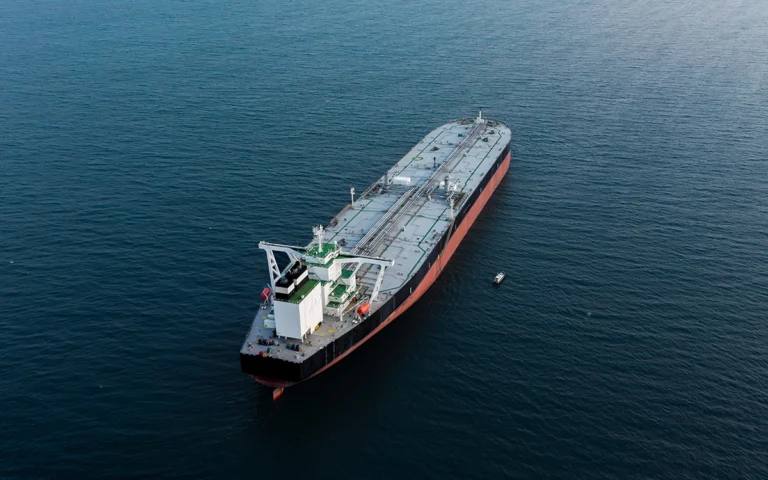
Two oil supertankers were disabled by massive explosions in the Strait of Hormuz on Wednesday night after ignoring warnings against using an "unauthorised route", Iran's Revolutionary Guards Navy said on Thursday, in the latest claimed incident in the eight-month US-Israeli war with Iran.
Source: Reuters via MarineLink, Nov 12, 2026
The two tankers "exploded after hitting naval mines", Iranian state media said later, showing what it said was video footage of the incidents, Reuters reported. The Guards' own statement did not, in the Reuters account, specify the cause of the explosions.
In its statement on Thursday, the IRGC Navy's public relations office said the two tankers had ignored repeated warnings from its Strait of Hormuz traffic control centre about the unauthorised and unsafe southern route, and stopped sailing after a massive explosion.
Source: Press TV, Nov 12, 2026
According to the IRGC statement, both supertankers were carrying a combined cargo of more than four million barrels of oil and were left burning after the blasts. These details — the explosions, the mines, the cargo figure and the fires — are the IRGC's account. They have not been independently confirmed.
What is solid
- The IRGC Navy issued a statement on Thursday, Nov 12, saying two supertankers were disabled in the Strait of Hormuz on Wednesday night — reported by Reuters and Iranian outlets.
- The US-Israeli war with Iran began on February 28, and Iran has since restricted transit through the strait, requiring prior authorisation and directing ships to northern corridors.
- The Strait of Hormuz normally carries about one-fifth of the world's seaborne oil.
What is only claimed
- The IRGC claim that the two tankers hit naval mines and are burning with more than four million barrels of oil aboard — no vessel names, flags or crew details have been released, and no independent confirmation was available at the time of reporting.
- Iranian state media's account of the cause of the explosions, which the IRGC statement itself did not specify in the Reuters report.
No independent confirmation yet
The names, flags and crews of the two tankers had not been publicly identified in the reports available on Thursday morning, and the United Kingdom Maritime Trade Operations agency (UKMTO) had issued no matching statement on this specific incident in those reports. Reuters noted that in several earlier cases UKMTO has said tankers in the strait were struck by unknown projectiles.
Part of a series of claimed tanker incidents
In the earlier months of the war, the IRGC Navy announced it had struck tankers directly. More recently it has reported vessels catching fire after hitting naval mines while using what it describes as an unauthorised route in the southern part of the waterway. Awaaz Punjab has reported similar IRGC claims on November 5, November 7 and November 8, each labelled as claims at the time.
Read the earlier report in this series: the IRGC's November 7 claim that two tankers hit mines off the Hormuz coast. IRGC two-tankers mines claim, Nov 7
Why Hormuz matters
The Strait of Hormuz, between Iran and Oman, is the narrow outlet for Gulf oil and normally carries roughly one-fifth of global seaborne oil supplies. Any disruption there is watched closely by energy markets and by Gulf governments, and it affects shipping crews — including Indian and Punjabi seafarers who work on Gulf routes — though no crew details for these two vessels have been reported.
What happens next
The next facts to watch are whether UKMTO or another maritime authority confirms an incident on Wednesday night, whether the two vessels are identified, and whether Iran or the United States comments further. This report will be updated on the site if a major confirmed development follows; until then, the explosions and their cause remain an IRGC claim, reported as such.