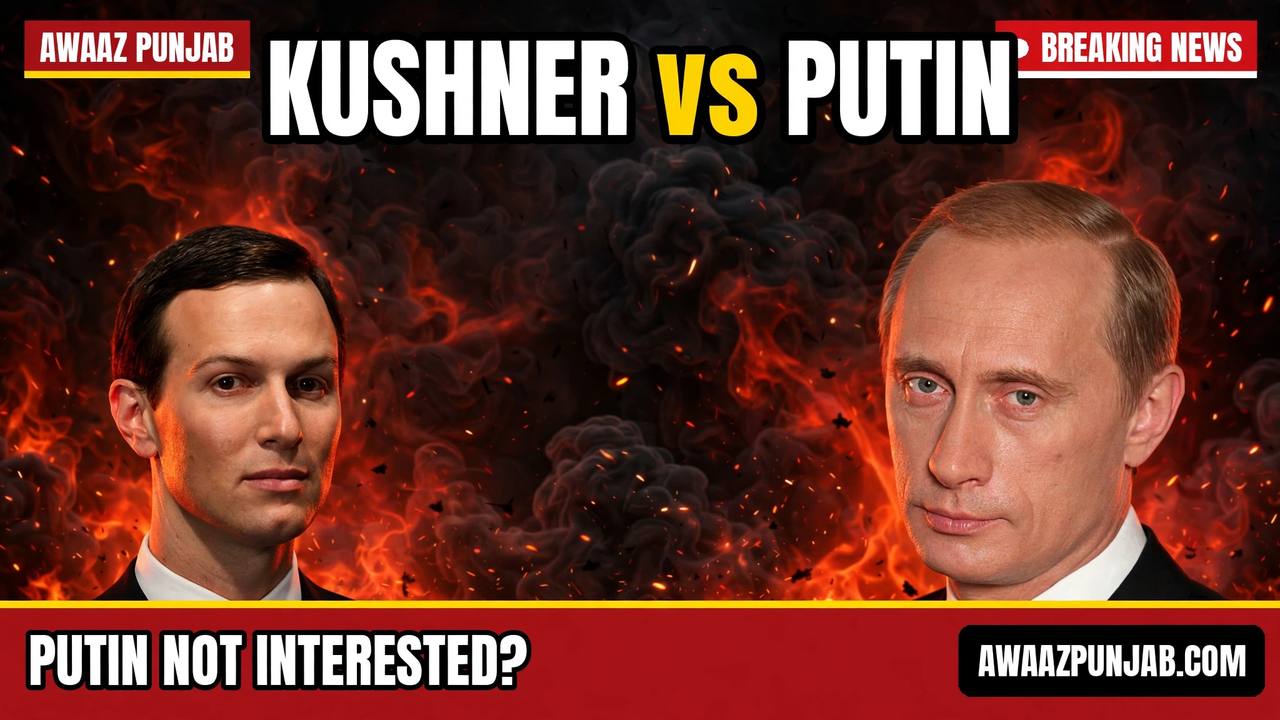
WASHINGTON — Donald Trump's envoy Jared Kushner has said he pressed Vladimir Putin "very hard" to accept a ceasefire in Ukraine before any wider peace talks — but the Russian president "doesn't seem that interested".
Kushner made the remarks in a podcast interview with Mathias Döpfner, the chief executive of Axel Springer, which owns The Telegraph. Kushner, the US president's son-in-law and one of his leading envoys on Ukraine, has met Putin four times this year.
Source: The Telegraph
"Going into the meetings, President Putin is very organised. People can like what he's done, they can not like what he's done, but he's definitely a grand master of politics," Kushner said. "He's a historic figure. He's always very, very well-prepared. He's very thoughtful. He takes a lot of notes when we're speaking, and then he transmits very specifically."
Appearing to side with Putin's position, Kushner argued that negotiators should focus on the post-war period instead of demanding a ceasefire first. "What we should do is focus on the post-war period, which again, I think makes sense for us because you want to get to a peace that's going to last," he said.
"I think once we're able to define that post-war relationship, I think the issue of territory will become much easier to resolve, because right now there's no way to bridge that last issue," Kushner added.
Kushner also challenged Europe directly, saying it had no convincing alternative plan to end the war. "We've asked the Europeans or the Ukrainians if they have a better idea on how to get there, but nobody has presented us with one so far," he said.
He described the war as having effectively become a proxy war in which Europe funds and arms Ukraine against Russia, and claimed that Europe had paid Russia more money during the war than it had given to Ukraine.
Source: TASS via ICBrief
Kushner said Putin had shown restraint by promising not to use nuclear weapons and assuring Washington that he had no plans to do so. He added that his assessment was that Putin not only wanted peace but also wanted to change Russia's relationship with America and see "maybe a way to start a new beginning".
In the interview, Kushner also repeated a Kremlin claim that an alleged Ukrainian attack on Putin's Valdai residence was to blame for a breakdown in the peace talks earlier this year. The claim comes from Moscow; it has not been independently verified.
His praise for Putin drew swift criticism. "Kushner speaks as if he's Putin's spokesman rather than a mediator or a US envoy," said Maria Popova, director of the Jean Monnet Centre in Montreal, who focuses on the Russia-Ukraine war. "He praises Putin, denies Russia is an aggressor, and speaks of Russia's conquest and occupation of Ukraine as 'peace.'"
Europe insists on ceasefire first
Kushner's comments are likely to cause concern among leaders in Europe and Ukraine, who insist a ceasefire must come before any negotiations on post-war arrangements. They have repeatedly warned that Putin is trying to use the peace process to redraw Europe's security arrangements in his favour, and recent Russian demands have included NATO withdrawing troops from Eastern Europe.
Kushner and fellow US envoy Steve Witkoff have in recent weeks supported broadening the talks to cover European security architecture, post-war security guarantees and economic recovery packages, as well as humanitarian agreements. The two Americans negotiated in Berlin in mid-November with German Chancellor Friedrich Merz and representatives of Ukraine.
The talks are stuck on territory. Kushner admitted the negotiators were "somewhat stuck on the territorial issue" after many hours with Putin, and the Americans have appeared more favourable to Russia's insistence that Ukraine hand over the remainder of the eastern Donbas regions that Putin's forces have not been able to capture.
What happens next
The war, which Russia started with its full-scale invasion in February 2022, is approaching its fifth year. Peace efforts this year have included talks in Abu Dhabi, a Berlin summit on security guarantees and a first-ever trilateral meeting between Trump, China's Xi Jinping and Putin in Shenzhen on November 19 — but no ceasefire has been agreed.
With Washington now openly saying the focus should be a post-war framework rather than a ceasefire first, Europe and Ukraine face a difficult choice: accept the American sequencing or keep pressing for a halt to the fighting before talks on territory and security. Fighting meanwhile continues, with Russian strikes on Ukrainian cities reported again this week. No new round of talks has yet been announced.