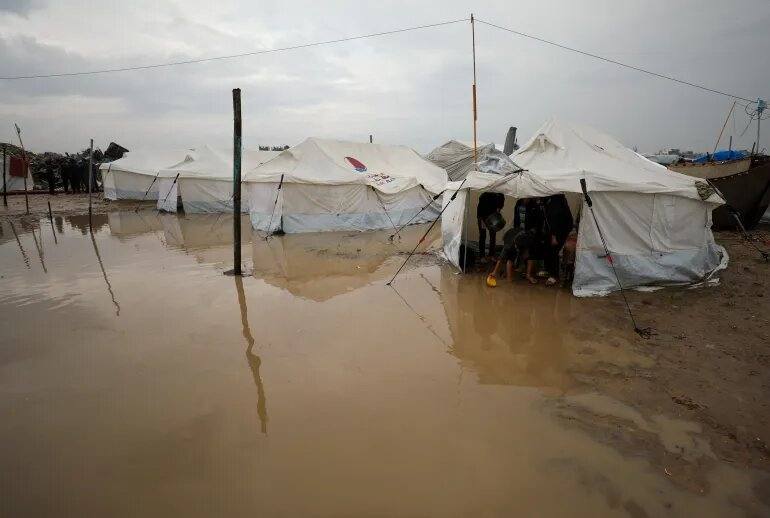
The European Commission said on Wednesday, November 25, that the humanitarian situation in Gaza is "really dire", blaming Israeli restrictions for stopping aid from reaching people who need it — as winter floods swamp the tents where displaced families are living.
Source: European Commission midday briefing, 25/11/2026
"People are living in the tents. The tents are obviously wet. Children are dying of the diseases that are spreading around, and we don't have the possibility to help them because the access is limited by Israel," European Commission spokesperson Eva Hrncirova told reporters in Brussels.
Source: Archynewsy
A political choice, not a shortage
The EU's Commissioner for Equality and Crisis Management, Hadja Lahbib, delivered the same message to the European Parliament in Strasbourg. "The world does not lack humanitarian funding or supplies. Gaza lacks access to them," she said. "This is not a question of humanitarian capacity; it is clearly a political choice. There can be no meaningful humanitarian surge without a change in policy by the Israeli government."
Lahbib said the crisis has deepened since the October 2025 ceasefire, with more than 1,600 people killed in Gaza since then. "Gaza is not recovering. Gaza is surviving," she told MEPs.
The numbers behind the warning
The first winter storm flooded more than 70,000 tents and damaged shelters, affecting over 220,000 people, Lahbib said. More than 150,000 tents procured by humanitarian partners and EU member states were still waiting outside Gaza, unable to cross into the territory. Heavy rain has directly affected at least 106,000 people in recent days, according to UNICEF, with thousands of tents submerged and latrines overflowing into camps.
What the EU is demanding
The EU is urging Israel to reopen all of Gaza's border crossings, allow "immediate, unimpeded access" for aid, and enable the work of the UN, its agencies and humanitarian organisations, including NGOs. The demand repeats the bloc's November 14 statement, in which it also called the recent airstrike on Nasser Hospital "deeply alarming", reaffirmed its commitment to a two-state solution, and called for the full implementation of UN Security Council resolution 2803 — including the decommissioning of Hamas weapons, the full withdrawal of Israeli forces and a civilian transition in Gaza.
Winter rains were already threatening 1,000 shelter sites across Gaza before this week's EU warning — read our earlier report on the flooding. Winter rains threaten 1,000 Gaza shelter sites
A divided Parliament
In the Strasbourg debate, MEPs clashed sharply over the EU's response. German Socialist Udo Bullmann affirmed Israel's right to exist but said it cannot justify letting Palestinian children die, while Green MEP Mounir Satouri accused the bloc of shying away from terms such as apartheid and genocide. Patriots MEP Sebastian Kruis challenged High Representative Kaja Kallas's description of the winter hardships, accusing her of lying, and Renew MEP Abir Al-Sahlani countered that mothers cannot keep children safe from floods amid a lack of water, shelter and aid.
Why the aid is not getting in
Israel has long said restrictions are needed to stop aid being diverted; the EU statement itself recalled that aid should be used solely for peaceful purposes and not diverted by armed groups. But Brussels' position on Wednesday was blunt: the supplies exist, the funding exists, and the tents are already bought — what is missing is access. Lahbib acknowledged the paralysis in the Parliament debate, telling MEPs the discussion remains polarised.
What is solid
- The EU Commission said on November 25 that Gaza's humanitarian situation is 'really dire' and blamed Israeli access restrictions.
- More than 150,000 tents are waiting outside Gaza and at least 950,000 people are in areas facing severe flooding, according to the EU and UNICEF figures cited on Wednesday.
What is only claimed
- Why the restrictions exist: Israel cites security and the risk of diversion; the EU calls the lack of access 'clearly a political choice'.
- The exact death toll from disease and cold in the camps, which is still being counted as winter sets in.
What happens next
With winter setting in and more rain expected, the EU is pressing for a change of policy in Israel before any large-scale aid surge can happen. The 150,000 tents waiting outside Gaza, the flooded camps and the rising disease risk will be the test of whether the warnings in Brussels and Strasbourg turn into access on the ground.