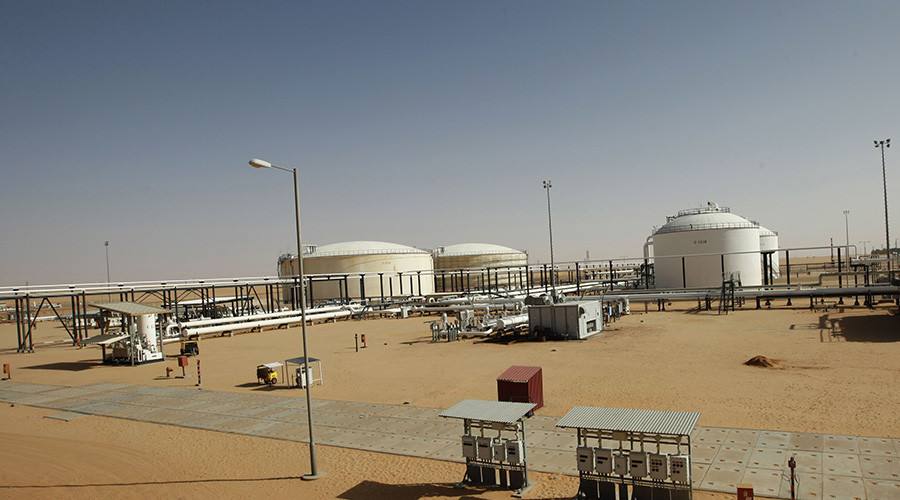
Libya's biggest oil pipeline is flowing again after a brief shutdown that cut about 350,000 barrels a day of production, the country's National Oil Corporation (NOC) said on Monday. An "unlawful group" closed a valve on the line from the Sharara oilfield to the Zawiya terminal on Sunday, but engineers restarted pumping after a shutdown lasting nearly 10 hours.
Source: Reuters
NOC chairman Masoud Suleiman told Reuters and Bloomberg on Monday that crude had begun flowing again into storage tanks at the Akakus facility in Zawiya, on Libya's Mediterranean coast. The Sharara field, in the Murzuq Basin in the country's south-west, is Libya's largest oilfield.
Even with Sharara back online, Libya is still losing about 365,000 barrels a day of production — roughly a quarter of the 1.40 million barrels a day the OPEC member pumped in October. A second pipeline, from the Hamada field to the Zawiya refinery, has been shut for more than three weeks and is still losing about 15,000 barrels a day.
Third disruption since September
The Sharara shutdown is the third disruption to the same western export system in about two months. On September 21, an armed group closed Valve 7 on the Sharara-to-Zawiya line, cutting about 200,000 barrels a day and removing some 950,000 barrels of production worth about $95 million (yaani lagbhag ₹8,800 crore). On October 30, another group closed the Hamada-Zawiya line; by November 21 the NOC counted 302,778 barrels lost and $30.8 million in lost revenue (yaani lagbhag ₹2,860 crore).
The NOC has called on the Petroleum Facilities Guard and the relevant government authorities to protect oil facilities and to reopen both pipelines and resume full production as soon as possible. The company said the forced Hamada closure alone had already cost the country more than $30.8 million at a time when global oil prices are rising and Libya faces a critical economic situation.
What it means for oil markets
The market barely moved on the Sharara news: January Brent traded at about $92.32 a barrel early on Monday, down 0.27% from Friday's settlement, after Brent fell 4% last week and US West Texas Intermediate fell 5%. The International Energy Agency said in its November Oil Market Report that global oil supply has now surpassed demand for the first time since the war in Iran began, and it expects a surplus of 1.7 million barrels a day in the fourth quarter.
Traders are also watching the OPEC+ ministerial meetings on November 29, when the group will decide its production policy for 2027. Libya's repeated pipeline shutdowns underline how fragile supply from the war-scarred OPEC member remains, even as rising global supply keeps a lid on prices.
Sharara is operated by Akakus Oil Operations, an NOC subsidiary whose partners include TotalEnergies, Repsol, Equinor and OMV. The field's crude is a light, sweet grade prized by European refiners, and its outages in past years have repeatedly moved Mediterranean crude prices.
The Hamada pipeline to Zawiya has been shut since October 30, after an armed group closed its valve — the disruption that set up this week's wider losses. Read the earlier report
What happens next: the NOC says engineers are working to restore the Hamada line, while the Petroleum Facilities Guard has been asked to secure both pipelines. If the valve closures resume, Libya's output — and the Mediterranean crude market — will feel it within days; if they hold, the country can return toward its October production level.