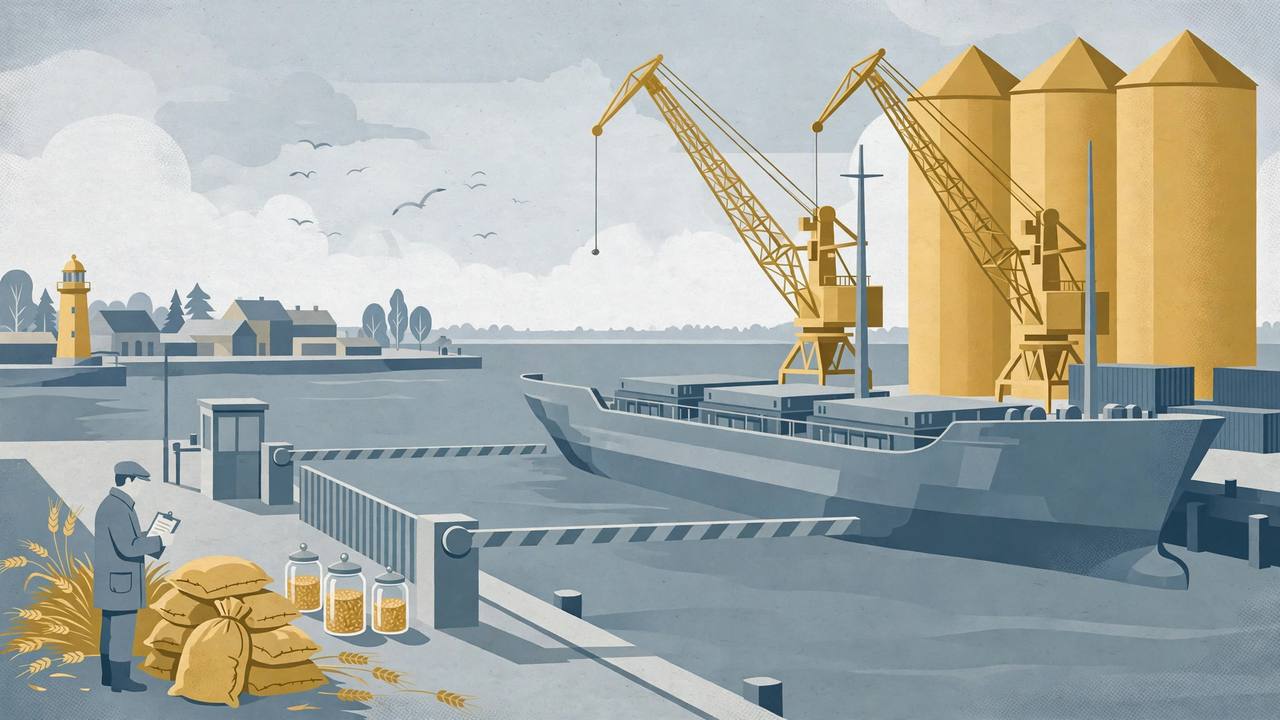
Lithuania's tightened controls on Russian and Belarusian grain took effect on Monday, November 16. Shipments of wheat, barley, maize and sunflower seeds moving in transit through the port of Klaipeda will not clear customs and cannot leave the port until laboratory tests confirm where the grain was grown, the Agriculture Ministry said, in a regime aimed at cargoes suspected of having been harvested in Ukrainian territory occupied by Russia.
Source: Reuters via BytesEU
From Monday, the costs of the laboratory checks fall on the businesses themselves, and until the results arrive the cargo stays put. If the declared origin is found to be fraudulent, the batch must be returned or destroyed, with the exporter bearing the costs of the control, the research, the return or the destruction, the minister's representative Justas Jaskevičius said, according to BNS; the legal acts needed for the tightened system have been agreed and signed. Because Lithuania has no laboratory able to carry out the analyses, samples are sent abroad and the tests can take two months or longer, a ministry official told Reuters.
Source: BNS via Inbox.lv
The new regime hardens checks that began in September, when the State Food and Veterinary Service (SFVS) started verifying the origin of all food and feed grain arriving in transit from Russia and Belarus. The service has taken five samples from two cargoes of unclear origin since September, and their origin is still being verified in foreign laboratories, its representative Aistė Prelgauskaitė said.
Three Baltic states, one direction
Latvia has been sampling transit grain for laboratory research: by October 14, samples from 23 batches of grain of Russian and Belarusian origin had been selected for isotopic analysis and examination of elemental composition — methods that can establish the probable geographical origin of the grain and check whether it was exported from Ukrainian territories occupied by Russia, according to the Latvian Food and Veterinary Service, reported by LETA. The two neighbours have not moved in perfect step: Lithuania's side has criticised Latvia for not checking actively enough, while Vilnius and Riga discuss a common Baltic methodology.
Latvia is now going further on paper: its Foreign Ministry has prepared and submitted to the Cabinet of Ministers a draft resolution banning the transit of Russian and Belarusian grain through the country altogether, Foreign Minister Baiba Braže said, in reporting published on November 15. The ban still requires government approval to take effect. Ukraine's Foreign Minister Andrii Sybiha welcomed the initiative and said Russia had tried to use the Baltic states to transit grain in order to finance its war against Ukraine — his characterisation of Moscow's intent, as reported by UNN.
Source: UNN via BytesEU
Estonia moved first and furthest: in early October it decided to impose national sanctions prohibiting the transit of Russian and Belarusian grain. In October, Lithuania, Latvia and Estonia jointly proposed a Europe-wide ban on the transit of Russian grain, and Lithuania's Prime Minister Mindaugas Sinkevičius said he would propose the ban to the EU along with sanctions on some Russian agricultural oligarchs.
The loophole the three states want closed is simple: EU sanctions prohibit the import of Russian grain into the bloc, but transit of such shipments through EU territory is still allowed. The Baltic states say closing it would keep products of dubious origin out of EU markets and increase economic pressure on Russia.
The push also has a domestic edge. Lithuanian grain producers complained that grain exported from Russia's Kaliningrad region through Baltic ports is offered for transport significantly more cheaply than Lithuanian grain, leaving local harvests sitting idle in warehouses, and farmers pressed the authorities to close the transit, BNS reported. Moscow has not commented on the legal status of grain harvested in regions internationally recognised as Ukrainian, Reuters reported.
What happens next: Latvia's draft ban awaits a Cabinet decision, and an EU-wide transit ban would need agreement among member states. Until then, Russian and Belarusian grain will still move through the Baltic — but from Monday, at Klaipeda, it moves only as fast as a foreign laboratory can prove where it grew.