Latest News — Punjab, India, USA and the World
Awaaz Punjab is an independent digital news platform publishing original, source-verified reporting in English, Punjabi and Hindi. Every story below is published with its sources named and dated, and every article is available in all three languages. Our newsroom covers Punjab first — its politics, districts and the road to the 2027 assembly election — along with India, the Punjabi diaspora in the USA and Canada, and world affairs that touch Punjab's people, from the Gulf to North America.
President Donald Trump said on Friday evening that the United States had carried out another round of limited strikes on Iran, destroying a newly built Iranian anti-aircraft installation on Qeshm Island in the Strait of Hormuz in 'about 15 minutes, maybe five' — the first US strikes since the Republicans' heavy defeat in Tuesday's midterm elections. Hours earlier, Iranian media had reported two missiles hitting the island's Suza area, in the report Awaaz Punjab published earlier tonight, when who fired them was not established; the exact connection between those impacts and the operation Trump described has not been independently established, and Iran has released no official damage assessment and no casualties are confirmed.
Published 2026-11-06 · Awaaz Punjab
An encounter broke out between police and a group of alleged house robbers in the Dadri police station area of Greater Noida, leaving one accused, Ajay, injured in the leg in police firing, the Noida Police said on Saturday, November 7. Another accused, Sameer, was arrested in a combing operation, while two suspects escaped in the darkness and are being searched for, according to the IANS report.
Published 2026-11-07 · Awaaz Punjab
A day after Bengaluru police arrested cab driver Indushekhar for allegedly killing seven members of his wife's family, investigators are examining the possible involvement of his minor daughter, who is currently missing and being searched for, IANS reported. Karnataka Home Minister Priyank Kharge said the accused had reportedly brainwashed the girl, and cautioned against premature conclusions until the probe concludes. All allegations remain unproved.
Published 2026-11-07 · Awaaz Punjab
With rabi sowing running about 46 per cent behind last year after an erratic El Niño monsoon, the government has prepared district-level contingency plans for 225 affected districts, and ICAR is building a dynamic dashboard that blends IMD weekly forecasts with water-body data so officials can revise drought assessments district by district.
Published 2026-11-07 · Awaaz Punjab
Nepal's government and medical education reform campaigner Dr Govinda KC signed a six-point agreement late on Friday night, ending his 25th hunger strike. KC had begun the fast in Ilam in late October and was later airlifted to Kathmandu as his health worsened.
Published 2026-11-07 · Awaaz Punjab
The result completes the match Awaaz Punjab reported earlier today — India bowling New Zealand out for 134 in Wellington. The chase reached 113 for 7 in 26 overs, with KL Rahul unbeaten on 26, before rain ended the second ODI; with the DLS par score at 109, India were declared winners by four runs and now lead the five-match series 2-0.
Published 2026-11-07 · Awaaz Punjab
A day after Karnataka alleged that petrol was being sold with up to 31.2 per cent ethanol — the development reported on November 6 — the Petroleum Ministry on Saturday said testing under the prescribed procedure found every one of 893 samples within the 19–21 per cent E20 range and questioned the state's sampling method, while Rahul Gandhi, citing the Karnataka tests, accused the Centre of 'petrol chori'.
Published 2026-11-07 · Awaaz Punjab
A bench of Justices Manmohan and Shree Chandrashekhar held that compulsory retirement is neither punitive nor stigmatic, does not imply misconduct, and can rest even on adverse confidential-report entries that were never communicated to the employee — dismissing the appeals of Legal Metrology Department staff retired by Chhattisgarh in 2017.
Published 2026-11-07 · Awaaz Punjab
A three-judge bench held on November 6 that balance-sheet entries acknowledging a subsisting liability start a fresh limitation period under Section 18 of the Limitation Act, and restored a contractor's recovery suit that the Delhi High Court had thrown out as time-barred.
Published 2026-11-07 · Awaaz Punjab
Less than two months before his term ends, UN Secretary-General António Guterres used an honorary doctorate at Spain's University of Salamanca to warn that the system built in 1945 to stop wars is 'cracking' — that too many states treat international law as an à la carte menu, that military spending is breaking records while aid plummets, and that the UN Charter's rule must apply to everyone: 'No exceptions. No double standards.'
Published 2026-11-07 · Awaaz Punjab
Punjab Chief Minister Bhagwant Mann announced on Saturday, in a post on X, that the dearness allowance (DA) of 6,507 computer teachers working under PICTES has been raised by 40 percentage points, from 181% to 221%. A teacher on ₹15,000 basic pay will get ₹6,000 more a month, and one on ₹35,000 basic will get about ₹14,000 more. Mann also announced salary-related benefits for 1,007 Samagra Shiksha non-teaching staff whose services were regularised earlier.
Published 2026-11-07 · Awaaz Punjab
In an interview with The Hindu ahead of her memoir 'Belonging', out on November 10, Congress Parliamentary Party chairperson Sonia Gandhi acknowledged that democratic rights were curtailed and habeas corpus was suspended during the 1975-77 Emergency — 'but it was done constitutionally' — and said Indira Gandhi was under pressure from senior colleagues, while Rajiv Gandhi carried people's complaints to his mother.
Published 2026-11-07 · Awaaz Punjab
The Bihar Public Service Commission declared the Integrated 71st Combined Competitive Examination (Mains) results on Friday. Of the 11,125 candidates who wrote the main examination in Patna, 3,185 have qualified for the interview for 1,298 vacancies; another 207 candidates have cleared the Finance Administrative Officer mains, taking the combined total to 3,392.
Published 2026-11-07 · Awaaz Punjab
Russia's battlefield gains in Ukraine have fallen to almost nothing this year, according to Institute for the Study of War figures reported by Al Jazeera: 117.38 sq km seized in the first 10 months of 2026, against 5,304 sq km in 2025. At the same time, Ukraine has hit eight Russian refineries in seven days, and four tankers of Russian diesel loaded under a Putin-Trump deal have reportedly failed to find buyers — a report the Kremlin dismissed as fake news.
Published 2026-11-07 · Awaaz Punjab
The death toll in Friday's explosion and fire at Oil India Limited's Intermediate Tank Farm in Tengakhat, Dibrugarh, has risen to two. Engineer Tapas Jyoti Gogoi, who had sustained around 70 per cent burns, died at a private hospital at around 3 a.m. on Saturday, officials said; his death was confirmed by contractor Spectron's area manager Kamal Phukan. Three injured workers remain critical.
Published 2026-11-07 · Awaaz Punjab
A two-day National Health Authority review in Kolkata closed on November 6 with a shared roadmap for PM-JAY and the digital health mission — more AI and automated claims, and a push from simply enrolling families to measuring the quality of their care.
Published 2026-11-07 · Awaaz Punjab
The Enforcement Directorate's Kochi unit has registered a money-laundering case (ECIR) against Reporter TV managing director Anto Augustine, as authorised signatory of Reporter Broadcasting Company Private Limited, and the company itself, based on the Kalamassery police FIR of September 15, 2026 in the failed Argentina-Messi visit probe, The Hindu reported on November 7. Separately, the Kerala High Court on November 6 issued notice on Augustine's plea to quash that FIR, posting the matter to November 23. All charges in the FIR are allegations, which Augustine is contesting in court.
Published 2026-11-07 · Awaaz Punjab
Yashasvi Jaiswal's second century in as many innings — 102 off 138 balls with 16 fours and two sixes — and B Sai Sudharsan's unbeaten 77 carried India A to 227 for 2 in 69.3 overs at stumps on the opening day of the third unofficial Test against New Zealand A at the Bert Sutcliffe Oval in Lincoln on Saturday, November 7, before rain ended play early, IANS and ANI reported. The form matters beyond this match: India's senior Test series in New Zealand starts on November 19.
Published 2026-11-07 · Awaaz Punjab
The maiden BIMSTEC Maritime Security Exercise culminated at Sri Vijaya Puram on November 3, the Defence Ministry announced — the first time warships of the Bay of Bengal grouping have exercised together under its own banner.
Published 2026-11-07 · Awaaz Punjab
A lintel being laid at a house in Sikri Khurd village, Modinagar, in Uttar Pradesh's Ghaziabad district collapsed on Saturday. DCP Surendra Nath Tiwari told ANI that 5–8 workers were feared trapped and rescue operations were under way; Jagran reported that one worker, Chhotu of Faridnagar, had died and that five people had been rescued and hospitalised.
Published 2026-11-07 · Awaaz Punjab
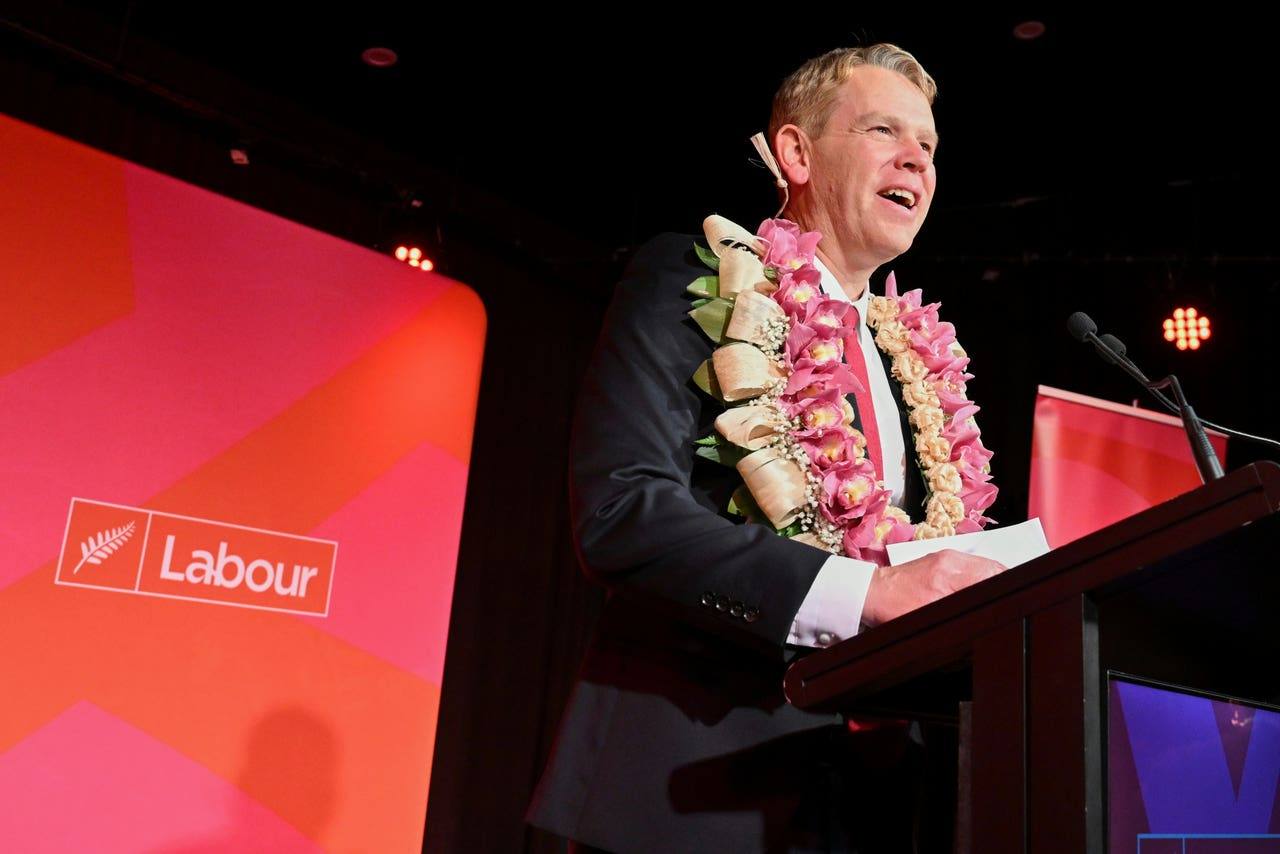
Counting is under way in New Zealand's general election and the first projection is in: with 14.4 percent of results counted, the ruling National Party had 30.90 percent of the party vote to Labour's 28.39 percent, and an Electoral Commission seat projection showed the current three-party National-led coalition heading toward retaining power — though Labour warned the declared vote was still low and a government could take weeks.
Published 2026-11-07 · Awaaz Punjab
The Bihar Cricket Association on Friday named 15-year-old India opener Vaibhav Sooryavanshi captain for the first two matches of the Syed Mushtaq Ali Trophy — against Saurashtra on November 14 and Railways on November 16 in Indore — a role that will make him the youngest captain in men's T20 cricket, Cricbuzz reported.
Published 2026-11-07 · Awaaz Punjab
The Narcotics Control Bureau (NCB), working with the SSB, CRPF and Arunachal Pradesh Police, has destroyed illicit cannabis cultivation spread over about 458 acres in the Kalaktang subdivision of West Kameng district, clearing more than 1.37 lakh kg of plants in the first phase of a drive that ran from October 26 to November 3, the agency said in an official release reported by IANS on Saturday, November 7.
Published 2026-11-07 · Awaaz Punjab
Following up Awaaz Punjab's earlier report that India won the toss and bowled first in the rain-cut 47-overs-a-side second ODI, India's bowlers finished the job in Wellington on Saturday: New Zealand were bowled out for 134 in 40.6 overs, with Gurnoor Brar taking a career-best 4-30 and Daryl Mitchell's 55 the hosts' only real resistance. India need 135 to win.
Published 2026-11-07 · Awaaz Punjab
Published 2026-11-07 · Awaaz Punjab
Published 2026-11-06 · Awaaz Punjab
Published 2026-11-06 · Awaaz Punjab
Published 2026-11-06 · Awaaz Punjab
Published 2026-11-06 · Awaaz Punjab
Published 2026-11-06 · Awaaz Punjab
Published 2026-11-07 · Awaaz Punjab
Published 2026-11-07 · Awaaz Punjab
Published 2026-11-07 · Awaaz Punjab
Published 2026-11-07 · Awaaz Punjab
Published 2026-11-07 · Awaaz Punjab
Published 2026-11-07 · Awaaz Punjab
Published 2026-11-06 · Awaaz Punjab
Published 2026-11-07 · Awaaz Punjab
Published 2026-11-07 · Awaaz Punjab
Published 2026-11-07 · Awaaz Punjab
Published 2026-11-06 · Awaaz Punjab
Published 2026-11-07 · Awaaz Punjab
Published 2026-11-07 · Awaaz Punjab
Published 2026-11-07 · Awaaz Punjab
Published 2026-11-07 · Awaaz Punjab
Published 2026-11-07 · Awaaz Punjab
Published 2026-11-07 · Awaaz Punjab
Published 2026-11-07 · Awaaz Punjab
Published 2026-11-07 · Awaaz Punjab
Published 2026-10-22 · Awaaz Punjab
Published 2026-10-19 · Awaaz Punjab
Published 2026-10-18 · Awaaz Punjab
Published 2026-10-18 · Awaaz Punjab
Published 2026-10-18 · Awaaz Punjab
Published 2026-10-18 · Awaaz Punjab
More from Awaaz Punjab
Our Editorial Standards
How we work: every story is checked against at least two independent, reputable sources before publication; allegations are labelled as allegations; figures carry the name of the outlet or agency that reported them and the date; corrections are published openly. Read our full verification method on the How We Verify page, our data desks on the School, Podcast and SUNO audio pages, and our numbered original investigations in the Investigations section.
Awaaz Punjab is an independent, trilingual newsroom — for Punjab, by Punjabis. We do not sell aggregated news; we publish investigations that stand on sources, with the outlet and date attached to every claim. Our first beat is Punjab's drug crisis, our second is Punjab politics. From Amritsar to Toronto — wherever a Punjabi lives, Awaaz Punjab reaches.