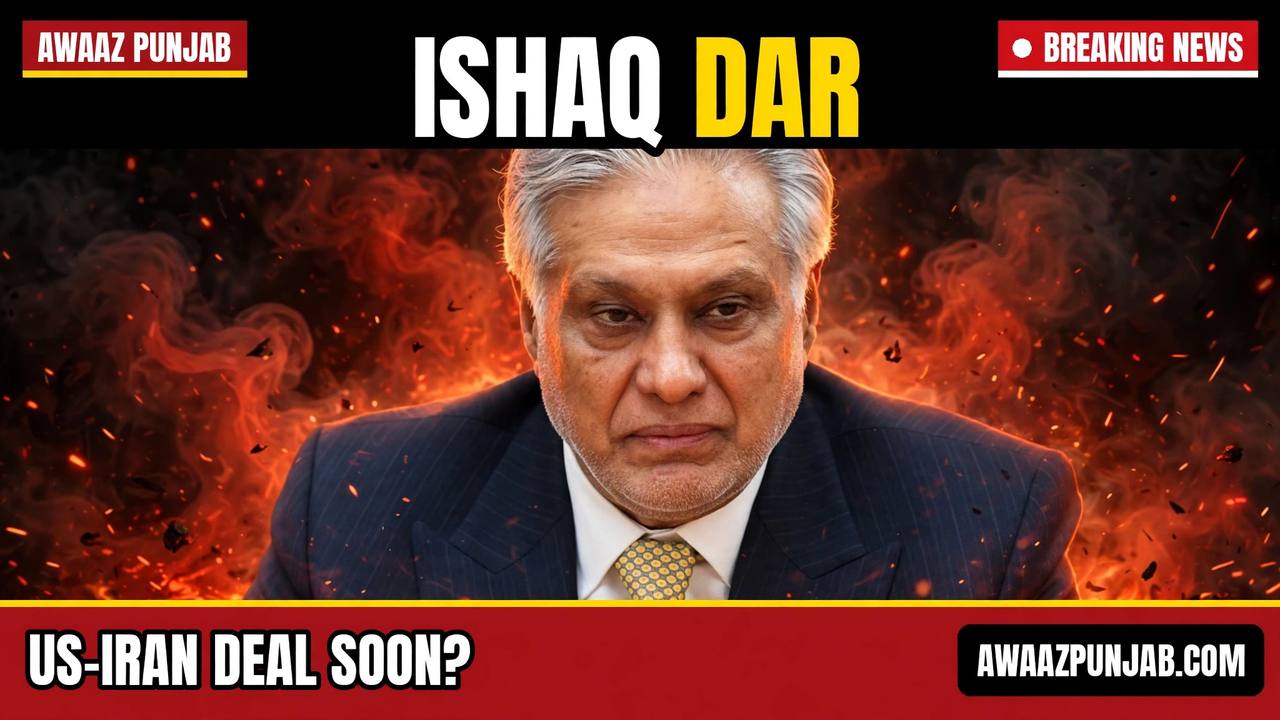
Pakistan's Deputy Prime Minister and Foreign Minister Ishaq Dar has said he expects the United States and Iran to reach an agreement to end their war, telling Euronews in an interview broadcast on Saturday that the world cannot afford a prolonged conflict in the Middle East. The interview, for Euronews' World Conversation programme, was filmed in Islamabad and broadcast by PTV News on November 21.
Source: The News
"I'm a born optimist. I think I would certainly expect that sooner or later, I hope it's sooner, that we will achieve that objective. Because, you see, the world cannot afford [it]. See the energy supply chain disruptions. See the price hikes. See the people suffering."
How Pakistan mediated
Dar said Pakistan was the first country to condemn the Israeli strike when the war broke out on February 28, 2026. On the morning of that first day, he said, he telephoned Iranian Foreign Minister Abbas Araghchi and urged him to exercise restraint and not to answer the US-Israeli strikes with attacks on Gulf states — which, he noted, Iran unfortunately did.
Source: Euronews via Daily Guardian
Pakistan's efforts, he said, led to the first direct, face-to-face negotiations between Washington and Tehran in 47 years, held in Islamabad on April 10 and 11. The session ran for 21 hours across six rounds, with only consultative breaks, and brought the two sides close to an agreement before one delegation paused the talks for consultations with its leadership.
Source: The News
Continued Pakistani mediation eventually produced the June 18 Islamabad Memorandum of Understanding, Dar said — a framework he said was signed remotely by US President Donald Trump, who was attending the G7 summit in Europe, and by Iran's president. Despite subsequent violations of the June 18 accord, Dar said Islamabad has not abandoned the peace process and continues to urge both sides to honour what they signed.
Source: The News
What Dar says comes next
Dar also described a five-point Middle East peace initiative he formulated during a visit to China on March 31, where he met Foreign Minister Wang Yi, and said the diplomatic effort expanded on October 23 in Istanbul through talks with the E4 — the United Kingdom, France, Germany and Italy.
He called the Mecca Pact — the mutual defence agreement signed by Pakistan, Türkiye and Saudi Arabia in August — a possible "beginning of the regional security architecture", and said the UK, France and Germany are engaging with the new structure while Italy is also interested. Germany, he said, has invited the R4 — Pakistan, Saudi Arabia, Türkiye and Egypt — to meet Europe's E4 in December, a grouping that grew out of a March consensus statement by twelve Islamic countries in Riyadh.
Dar said the most widely backed element of the June 18 accord was that there should be "no tolls, permits, fees or permissions" in the Strait of Hormuz, and that the European Union and the United Kingdom also supported the diplomatic process. He said Pakistan has not given up on treating the sea lanes as free movement.
What is solid
- The war began on February 28, 2026; the Islamabad talks were held on April 10–11; the Islamabad Memorandum of Understanding was signed on June 18.
- Dar's Euronews interview was filmed in Islamabad and broadcast by PTV News on November 21, 2026.
What is only claimed
- Whether the June 18 accord was violated, and by whom — each side blames the other for breaking it.
- Whether a deal is near — Dar says he expects one "sooner or later", while Trump said on Friday that Iran's terms are unacceptable and that he will not decide on new strikes until after the new year.
Why it matters for the Gulf
The war has disrupted energy supply chains and pushed prices higher — Brent crude was trading near $92–93 a barrel this week — and it hangs directly over the lakhs of Punjabi and Indian workers living in the Gulf, whose jobs, flights home and remittances depend on the region staying open for business. Dar said ordinary people are suffering, including in Pakistan itself, and that dialogue and diplomacy remain the only viable way to end major international conflicts.
What happens next: Pakistan says it will keep pressing both sides to respect the June 18 commitments, and the December meeting between the R4 and the E4 in Germany is the next date on the diplomatic calendar. No agreement has been announced, and Trump has said he will not decide on new strikes until after the new year — so the mediation continues against a clock both sides are watching.