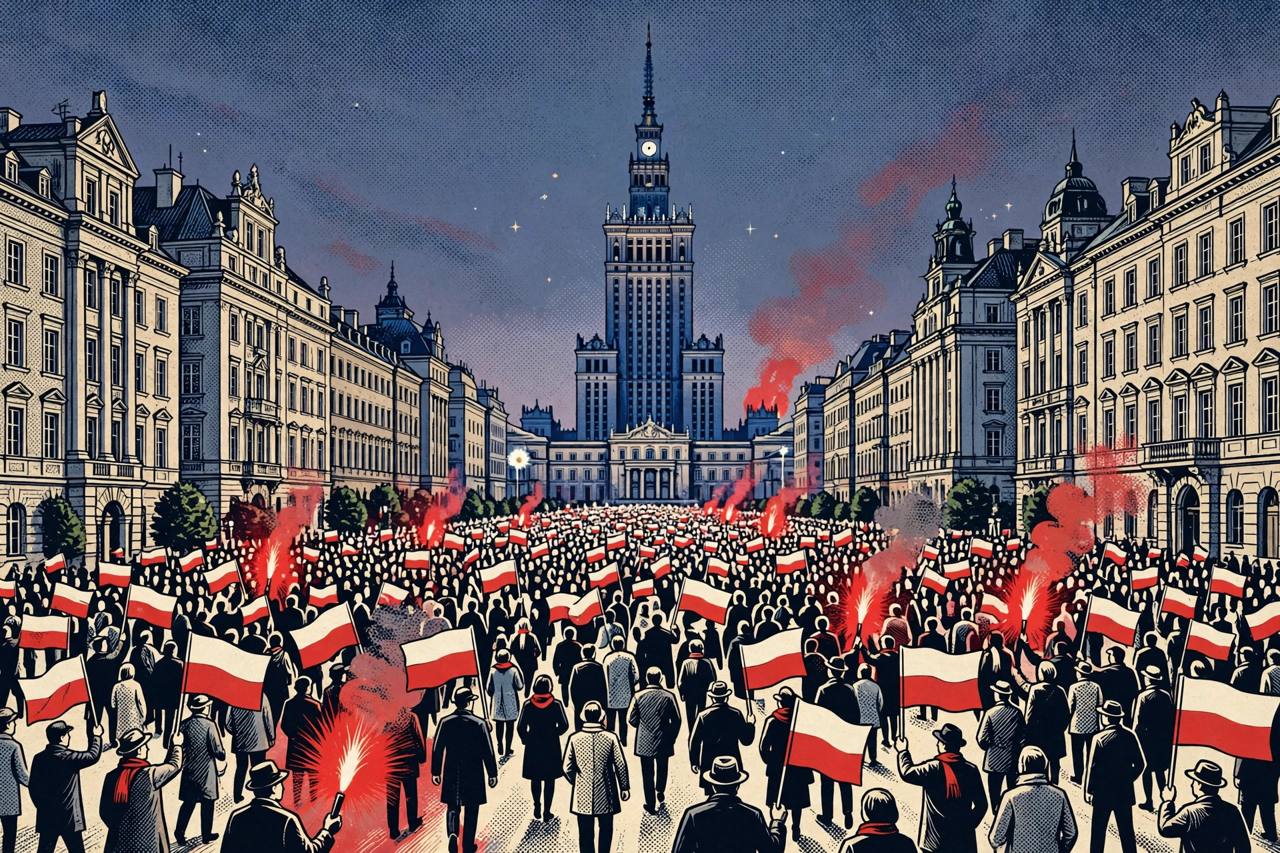
Tens of thousands of right-wing supporters, including Poland’s nationalist president, marched through Warsaw on Wednesday, November 11, for the annual Independence Day march, Reuters reported. Organisers estimated the crowd at about half a million, while city officials put it at 250,000.
President Karol Nawrocki, whose role is largely ceremonial, walked at the front of the crowd, which stretched for more than 3 km (1.9 miles) through the capital. The annual rally this year carried the slogan “Poles are masters of their own land” — in Polish, “Polak w Polsce gospodarzem”, roughly “A Pole is the host in Poland”.
A march under tight security
Poland deployed extra police in Warsaw, including officers brought in from outside the capital, though police declined to give numbers. The march passed without major incident, according to Bytes Europe, and Warsaw mayor Rafał Trzaskowski said that, other than the illegal use of pyrotechnics, it was proceeding without incident.
The march came just four days after a mass shooting in Krakow’s main square killed six people. Prime Minister Donald Tusk appealed for restraint amid sharper-than-usual political divisions, after ministers initially suggested the Krakow gunman may have been motivated by far-right ideology — a suggestion that outraged nationalists. That motive has not been established as fact.
Two Polands, one day
The rally has long caused friction between right-wing parties and the now-ruling centrists, who say it is a platform for racism and antisemitism. Participants deny those allegations, saying the gathering is an expression of national pride. One march organiser, Rafał Buca, was quoted as saying: “We want a sovereign Poland, independent of foreign capitals … We also envision a Poland that is as mono-ethnic as possible.”
Prime Minister Tusk marked Independence Day hundreds of kilometres away in Szczecin, where he issued an invitation to Nawrocki to visit his home for talks, Bytes Europe reported. The split — the president marching at the head of the nationalist rally, the prime minister celebrating elsewhere — captured Poland’s deep political divide.
Who marched
Organisers say they expected a record turnout, with many foreign nationalists among the marchers, including Spain’s Revuelta, a youth movement linked to Vox, and members of Hungary’s far-right Mi Hazánk party. Leading figures from opposition parties were present, including the national-conservative Law and Justice (PiS), the centre-right Development Plus and the radical-right Confederation of the Polish Crown, alongside Nawrocki.
The main organisers are associated with Confederation (Konfederacja), a far-right group in opposition in parliament. Nawrocki last year became the first Polish president to attend the march, according to Bytes Europe.
How big was it?
The two crowd figures — about 500,000 from the organisers and about 250,000 from the municipal authorities, which are controlled by Tusk’s centrist Civic Coalition — show how contested even the size of the event is. Bytes Europe noted that, on either figure, it would be the largest march other than the one in 2018, when a broader event marked the centenary of Poland regaining independence after World War One.
November 11 marks the 108th anniversary of Poland regaining independence in 1918. The annual march, held every year on that date, has in past years seen violent clashes, but this year’s event was reported as proceeding largely without incident.
What happens next is a political question: the march acted as a display of unity among the right-wing and far-right opposition ahead of next year’s parliamentary elections, Bytes Europe reported — and the gap between the president and the prime minister, on display all day in Warsaw and Szczecin, is unlikely to close soon.