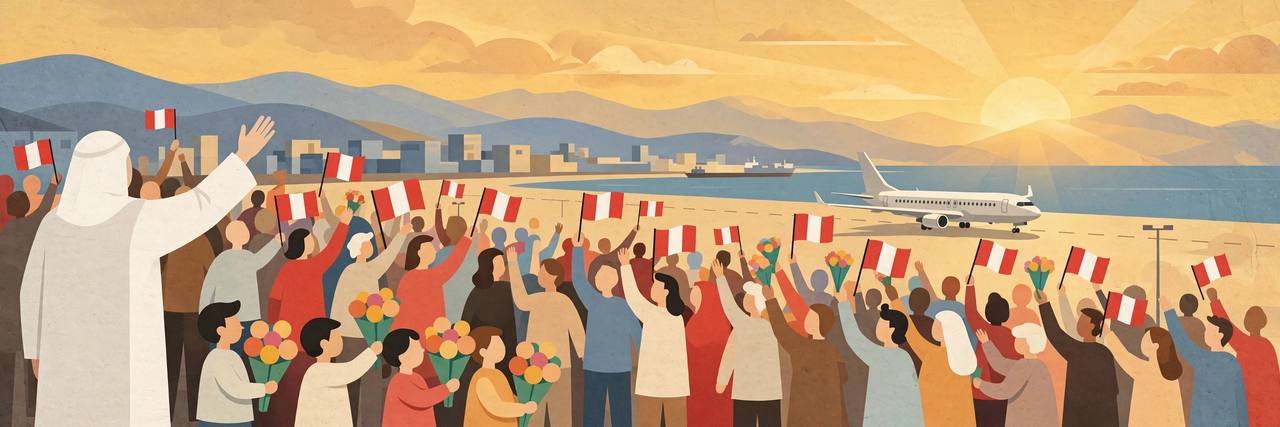
Pope Leo XIV arrived in Peru on Wednesday evening, November 11, landing at Callao Air Base beside the capital, Lima, at about 5 p.m. local time after a flight of around four hours and twenty minutes from Buenos Aires, Argentina. President Keiko Fujimori greeted the first Peruvian citizen to lead the Catholic Church at the foot of the aircraft steps, where two children presented him with flowers as crowds pressed against the fencing around the runway. In Lima's main plaza, thousands watching a big screen erupted into cheers as the plane touched down.
Source: Reuters via BusinessWorld
"One of my many homes"
The visit is Leo's first return to Peru since his election, and he has described the country as "one of my many homes", OSV News reported. In his very first speech as pope, he gave a special mention in Spanish from the balcony of St Peter's Basilica to "my beloved Diocese of Chiclayo, in Peru". Speaking in Lima on Wednesday, he said: "I can tell you, with deep gratitude, that I am returning to my homeland."
Source: OSV News via The Catholic Sun
Leo was born in Chicago and holds dual US and Peruvian citizenship. He first arrived in Peru as an Augustinian missionary priest in 1985 and later returned to lead the Diocese of Chiclayo, in the country's north, serving as its bishop from 2015 to 2023. Peru is the final and most personal stop on his 12-day, three-nation trip through Uruguay, Argentina and Peru, which began on November 6.
Speech urges Fujimori to build confidence
From the airport, Leo travelled to the presidential palace in Lima for the official welcome ceremony and a private meeting with President Fujimori, before addressing the country's political authorities, civil society and diplomats at the Grand National Theater in the first of 22 scheduled events in Peru. In a closely watched speech, he urged Fujimori to build confidence among her people after her narrow election victory earlier this year, an election marred by fraud accusations and vote-counting delays, and he alluded to the contested legacy of her father, the late former president Alberto Fujimori. Peru prepared for the homecoming with fervour: a 14-metre (46-foot) statue of Leo with outstretched arms towers over a seaside park in Callao, and inmates at the country's largest women's prison stitched velvet dolls in his likeness.
Source: Reuters via Devdiscourse
Three days in Chiclayo, then Cusco and the Amazon
On Thursday, November 12, Leo meets Peru's bishops and leads midday prayer at Lima Cathedral. On Friday he travels to Chiclayo, where he will celebrate an open-air Mass at Pampas de Pimentel - more than a million people are expected - and spend three days in the city he served as bishop. The itinerary also includes an Angelus at Saqsaywaman in Cusco, the former Inca capital high in the Andes, and a visit to Pucallpa, on the Ucayali River in the Amazon rainforest, to meet missionaries and Amazonian communities. He returns to Lima for a final Mass at Las Palmas Air Base on Monday, November 16, before departing for Rome.
Source: Vatican News via Radio Veritas Asia
Leo reached Peru after a three-day visit to Argentina, where record crowds greeted him in Buenos Aires and Cordoba. Read: Pope Leo arrives in Argentina
What is solid
- Leo landed at Callao Air Base on Wednesday, November 11, and was greeted by President Keiko Fujimori - reported by Reuters, OSV News and Vatican News
- Peru is the final leg of a 12-day trip that began in Uruguay on November 6 and continued in Argentina; the Peru visit runs to November 16
- Leo served as Bishop of Chiclayo from 2015 to 2023 and holds Peruvian citizenship
What is only claimed
- Crowd figures - three million in Lima, six million over three days in Argentina - are Vatican and local-official estimates reported by Reuters; they have not been independently counted
What happens next: all eyes now turn to Chiclayo on Friday, where Leo's Mass is expected to be the emotional peak of the homecoming - a bishop returning to his own diocese as pope. His speeches in Peru, after pointed remarks on the economy in Argentina, will be watched for what he says about poverty, trust in institutions and the country's turbulent recent past.