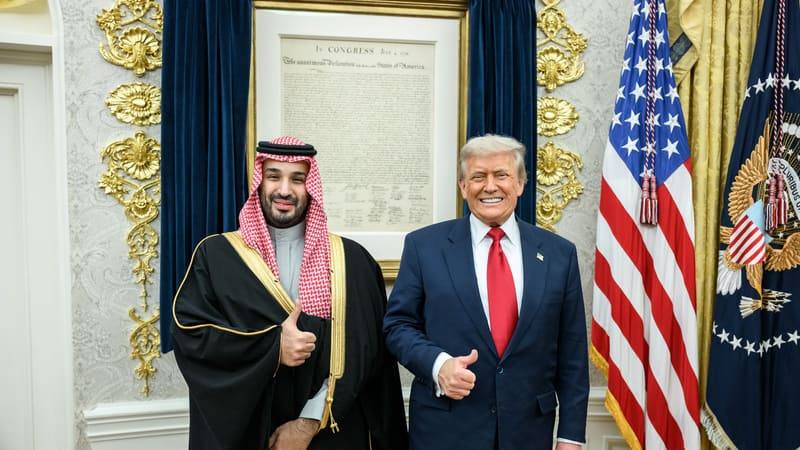
US President Donald Trump has said that Saudi Arabia and four other Gulf states asked him to hold off on further large-scale strikes on Iran, giving his own explanation for why the United States has not resumed major attacks in the war that began on February 28. In an interview with broadcaster Stephen A. Smith at the White House, reported on Friday, November 13, Trump said he was maintaining economic and military pressure on Tehran at the request of regional allies, Al Jazeera reported.
Source: Al Jazeera via Shafaqna India
"Saudi Arabia has asked me to please just let it be the way it is now for a while," Trump told Smith. He then named the others: "Qatar, if you look at that. Kuwait, UAE, Bahrain." The five states, he said, "would much prefer the waiting period," and he was holding off "at the request of the nations that I'm looking to protect."
"I'm not sure I agree with it," Trump said. Asked whether he would have launched further attacks without those requests, he replied: "Yes, I would." He claimed the United States could destroy Iran's energy infrastructure, bridges and manufacturing within three days: "In one day their energy is gone. In one day their bridges are gone. And in one day their manufacturing capability is gone. It would only take me three days." Those capability claims are Trump's own and were not independently verified.
Source: Trends MENA
A claim only Trump has made
None of the five governments — Saudi Arabia, Qatar, Kuwait, the United Arab Emirates or Bahrain — has confirmed Trump's account or denied it. The only version of the request on the record is his. Awaaz Punjab is therefore reporting the Gulf request as Trump's claim, not as a confirmed diplomatic fact. Trump made a similar disclosure on May 18, when he wrote that the rulers of Qatar, Saudi Arabia and the Emirates had asked him to call off an attack scheduled for the next day; Kuwait and Bahrain were not on that earlier list.
Source: Silent Dossier
The interview came out hours after Trump wrote on Truth Social: "We don't need a deal with Iran. Those days have long since passed," and told Vice President JD Vance to put his attention on domestic issues instead of the Iran file — a hardening of the US negotiating position that Awaaz Punjab reported on November 12.
That earlier development — Trump's 'no deal needed' post and the sidelining of Vance's back-channel — is covered here: Trump Says No Iran Deal Needed, Tells Vance to Focus on Domestic Issues
Earlier the same day, radio host Hugh Hewitt asked Trump what would happen if Iran killed a senior American official. "They will not exist very long any longer," Trump replied, and said he would have "no hesitation" in using force again — a threat Awaaz Punjab also reported separately. The Smith interview is the other half of that day's messaging: a president simultaneously threatening Iran and saying his allies are the reason he has not struck.
The Hewitt threat, reported on November 12: 'No Hesitation': Trump Threatens Renewed US Strikes on Iran
Hours later, Iran claimed a strike on Bahrain
Early on Friday, Iran's Islamic Revolutionary Guard Corps (IRGC) said its aerospace force had targeted and destroyed a US early-warning radar in Bahrain — one of the five states Trump had just named — in retaliation for an attack on a telecommunications tower in Sirik, on Iran's Strait of Hormuz coast in Hormozgan province. The claim has not been independently confirmed; the US military and Bahrain's government had not commented by Friday morning. Bahrain hosts the headquarters of the US Navy's Fifth Fleet at Naval Support Activity Bahrain in Manama.
The IRGC's Bahrain radar claim, with the Sirik background, is covered here: Iran Says It Destroyed a US Early-Warning Radar in Bahrain After a Strike on the Sirik Tower
On Thursday, Iran's foreign ministry spokesman Esmaeil Baghaei had addressed the Gulf host governments directly, warning that any state taking part in US action would "bear full responsibility" — a warning Awaaz Punjab reported on November 12. The Guards' statement also warned shipping companies working with the Americans in the Strait of Hormuz, through which about a fifth of the world's oil and liquefied natural gas passes.
Background: a pause built on pressure, not a settlement
There is no peace agreement. Washington is maintaining a naval blockade and economic pressure, Iran continues to demand conditions Washington has rejected, and Qatar — whose prime minister met Trump at the White House on November 9, after which Trump said "we're just keeping it the status quo" — remains the main channel between the two sides. Trump also acknowledged in the interview that rising gasoline prices caused by the war had contributed to the Republicans' losses in the November 3 midterm elections, while defending his decision to attack Iran; Vance wrote the day after the midterms that "the reason we lost is the war."
What it means for Gulf-based Indian and Punjabi workers
The pause Trump described is the main thing standing between the current uneasy calm and a fresh wave of strikes around the Gulf, where large numbers of Indian and Punjabi workers live and work. Houthi missile and drone attacks on Saudi Arabia have already disrupted aviation: Akasa Air has suspended flights to and from Riyadh and Jeddah until November 30, IndiGo has extended its Riyadh and Dammam suspensions to the same date, and Air India and Air India Express suspended services to Riyadh, Jeddah and Dammam until November 14, according to Trends MENA. Any confirmed strike on a US site in Bahrain, or a US decision to resume large-scale attacks, would put those routes — and workers across the Gulf states — under immediate new pressure.
What is solid
- Trump made the remarks in an on-record interview with Stephen A. Smith at the White House, reported by Al Jazeera and multiple outlets on November 13.
- Trump named Saudi Arabia, Qatar, Kuwait, the UAE and Bahrain, said 'I'm not sure I agree with it,' and said he would have struck again without their request.
- The IRGC claimed early on Friday that it hit a US early-warning radar in Bahrain in response to the Sirik tower attack.
What is only claimed
- Whether the five Gulf governments actually asked Trump to hold off: none has confirmed or denied his account; the request exists on the record only as Trump's claim.
- Whether the Bahrain radar was actually destroyed: the Guards' claim is unconfirmed, and the US military and Bahrain had not commented by Friday morning.
- Trump's claim that he could destroy Iran's energy, bridges and manufacturing in three days is his own assertion, not a verified capability assessment.
Watch for three markers: a statement from US Central Command or Bahrain on the radar claim; any public word from Riyadh, Doha, Kuwait City, Abu Dhabi or Manama about the request Trump described; and whether Washington answers the Bahrain claim with the strikes Trump says he held back. If the claim is confirmed, the governments Trump says asked for the pause will be pressed to justify it.