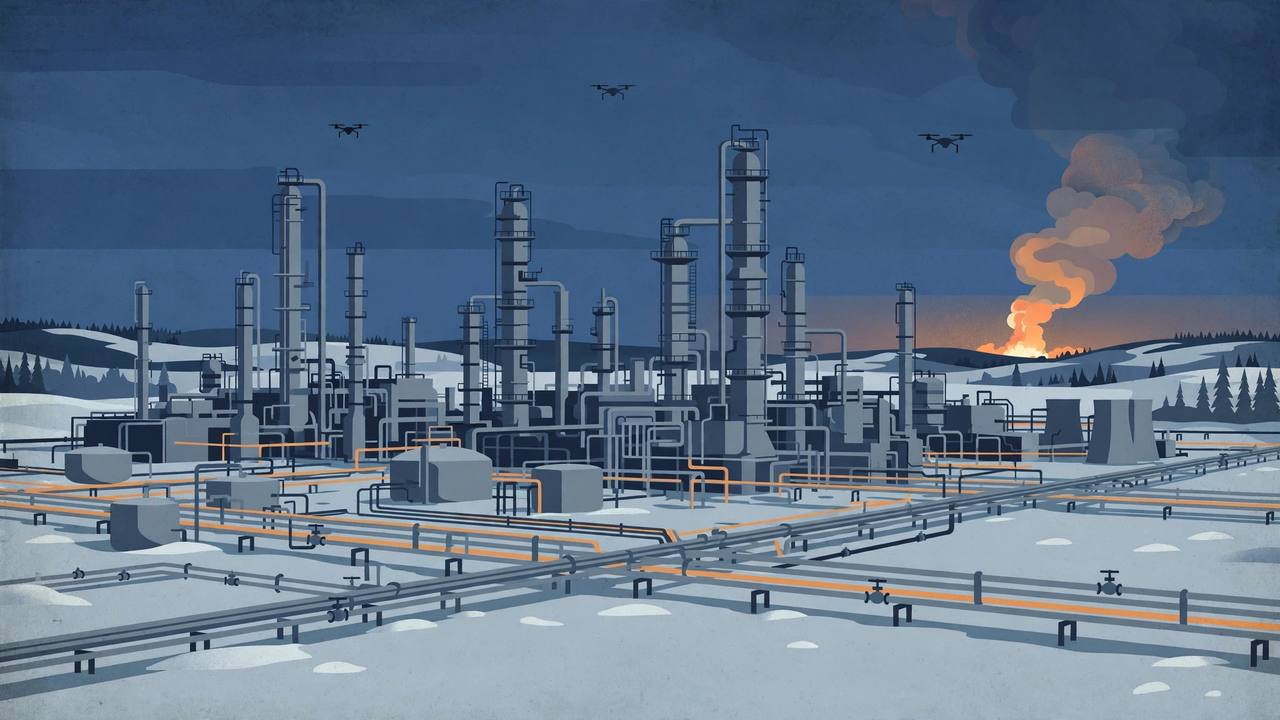
Ukraine's military said on Thursday, November 12, that it has struck Russia's five largest oil refineries since October 30 — the plants at Omsk, Kirishi, Ryazan, Nizhny Novgorod and Yaroslavl — in the most sweeping official accounting yet of Kyiv's deep-strike campaign against the Russian oil industry.
Source: Reuters, reporting the Ukrainian General Staff statement
In a post on Telegram, the General Staff said the smaller Novokuibyshevsk and Saratov refineries had also been hit in the same period, Reuters reported. Individual strikes in the campaign have been reported as they happened — among them the fire at the Kirishi refinery, Russia's second-largest, overnight on November 9 — but Thursday's statement is the first time Ukraine's military has claimed the complete set of the five largest plants in a single two-week campaign.
Source: Reuters
Omsk: eight hours of drone fire on Russia's largest refinery
The deepest strike came on Wednesday, November 11, when the Siberian city of Omsk — home to Russia's largest refinery — came under sustained drone fire for more than eight hours, according to local officials and monitoring channels reported by the Kyiv Independent. Omsk's governor, Vitaly Khotsenko, reported during the day that Ukrainian drones were attacking the region and urged residents to remain indoors.
Source: The Independent, reporting the Kyiv Independent
Residents reported a fire near the Omsk oil refinery, and the independent Russian Telegram channel Astra reported a blaze in the area, with blackouts in some districts. Khotsenko said emergency workers had been dispatched to all sites affected by what he called falling drone debris, but he did not specify which facilities were struck. The Kyiv Independent said it could not verify the claims at the time of publication, and Russia has published no damage figures for the Omsk plant.
Source: Europe Says, reporting the Kyiv Independent and Astra
The Omsk refinery, owned by state energy giant Gazprom Neft, is the largest in Russia by refining capacity, processing more than 21 million tonnes of crude a year — about 440,000 barrels a day — and producing roughly one in every six litres of Russian petrol and diesel. Ukrainian forces had struck the plant twice before, in July and October 2026; Ukraine's General Staff has said the plant also supplies fuel and petroleum products to the Russian military.
The wider toll — and what is still only claimed
Reuters reported on November 10, citing industry sources, that Ukrainian strikes since late October have disrupted about 30 percent of Russia's refining capacity, and that attacks in the past week alone disrupted operations or caused emergencies at nine of Russia's 35 major refineries. Ukraine's military intelligence directorate (HUR) said on November 5 that long-range strikes had knocked 15 of Russia's 38 major refineries out of operation and forced 12 more to cut production, estimating the damage at more than $23.2 billion — yaani, over 23 billion dollars, roughly Rs 2 lakh crore. Those are Ukrainian estimates: Russia has published no damage figures for any of its refineries, and the full extent of the disruption cannot be independently verified.
Source: Reuters industry-source reporting; HUR statement via Ukrainska Pravda
What is solid
- Ukraine's General Staff stated on Thursday that the five largest Russian refineries — Omsk, Kirishi, Ryazan, Nizhny Novgorod, Yaroslavl — plus Novokuibyshevsk and Saratov were struck since October 30 (Reuters)
- Omsk came under drone fire for more than eight hours on November 11; Governor Khotsenko confirmed an attack on the region and urged residents indoors
- The Omsk refinery is Russia's largest, at over 21 million tonnes a year, and was previously struck in July and October 2026
What is only claimed
- The scale of damage at Omsk and the other plants — residents and the Astra channel reported a fire near the refinery, the Kyiv Independent could not verify the claims, and Russia has published no damage figures
- The headline toll figures (~30% of capacity disrupted; $23.2 billion damage) — industry-source and Ukrainian intelligence estimates, not independently verified totals
What happens next
The claim lands in the middle of a diplomatic week: it came a day after US-mediated Russia-Ukraine talks ended in Abu Dhabi and on the day US envoys Jared Kushner and Steve Witkoff were meeting President Vladimir Putin in Moscow. Kyiv's case is that striking the oil industry squeezes the revenue and fuel supply behind Russia's war; the open questions are how much refining capacity Russia can repair or reroute, whether the campaign pushes Moscow towards or away from a ceasefire, and whether the strikes draw a Russian escalation against Ukraine's own energy grid as winter bites.