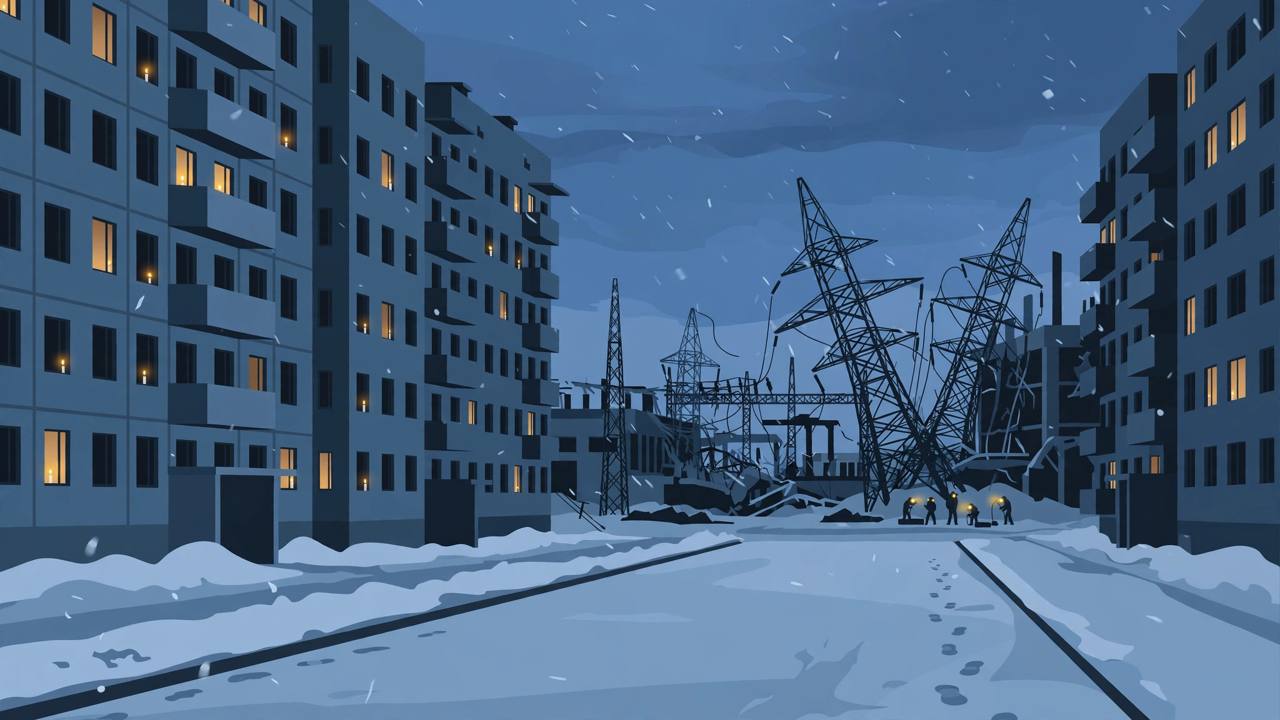
Kyiv — Ukraine's power supply is close to critical as Russian strikes on the country's energy grid bring darkness and cold to millions of homes at the start of winter, the BBC reported from Kyiv on Thursday, November 12. Rolling planned power cuts have been in place across Ukraine since October, as Russia intensified attacks on power stations, substations and transmission lines, and Ukraine has responded by striking Russian oil refineries.
Source: BBC News
This crisis has built up through weeks of strikes on the grid, including the attacks across 10 regions that Awaaz Punjab reported as the Abu Dhabi peace talks opened. Read: Russia pounds Ukraine's power grid in 10 regions
In Kyiv, resident Daryna Kulchytska, a single mother raising two children in a seventh-floor flat, told the BBC that in recent days her family had power for only four or five hours, in unpredictable windows: "For two hours we have electricity, then for eight hours we don't." Officials are concerned that life will quickly become unsustainable for millions of Ukrainians if supplies cannot be held at at least four hours per day, and some privately warn that point is already close, the BBC said. The cuts began earlier in the year than last winter and are already lasting longer, and Kyiv has been worst hit, with metro trains and trolleybuses at times brought to a standstill.
A destroyed power station that will not return this winter
The BBC visited one of Ukraine's largest power stations — which it was asked not to name for security reasons — after what it described as the most powerful and devastating strike of Russia's campaign against Ukrainian energy targets. A ballistic missile attack reduced the plant to twisted metal and broken pipes, burying its turbines in rubble and taking the site fully offline. Volodymyr Kovalenko, who was on duty in the control room when missiles hit at 3am and has worked at the plant for 25 years, described the attack as by far the most severe the site had experienced.
Repair work at the plant is being hampered by air raid alerts every 15 to 30 minutes — seven sounded during the BBC's four-hour visit, and a cruise missile was intercepted about 5 kilometres away. Energy workers are at enormous risk: since August there have been almost daily attacks on power facilities, claiming several lives every week, according to the report. Teams returning to restore the power lines feeding the national grid will not be carrying electricity from the shattered plant before the end of this winter, at least.
President Volodymyr Zelensky says Ukraine still has enough generating capacity to meet electricity demand — the problem, he says, is getting power to homes and businesses when so many lines and substations have been hit. Maxim Timchenko, chief executive of DTEK, Ukraine's largest private energy company, said Russia was already putting the degraded grid under even greater pressure than last year, that attacks had doubled in scale and intensity compared with last year, and that overstretched air defences cannot protect all critical infrastructure. He said rebuilding the damaged station would take at least until next summer, because workers under sustained attack can manage only one or two productive hours a day. "We are fighting for survival of not only the whole country but ordinary people, especially during winter," Timchenko said.
The wider campaign is independently documented: Ukrainian regional authorities reported Russian damage to energy infrastructure in Khmelnytskyi oblast on November 11, causing emergency outages, following strikes on six major substations across Vinnytsia, Kirovohrad, Zhytomyr and Cherkasy oblasts on November 10-11, the Kyiv Independent reported. On November 8, strikes cut power to more than 600,000 people in Dnipropetrovsk region and nearly 250,000 customers in Kharkiv region, according to DTEK and local officials reported by AFP.
Electricity in a Ukrainian winter is heating, water and transport at once: when the grid fails, taps run dry, flats go cold and metros stop. If daily supply falls below the four-hour floor officials describe, the BBC reports, ordinary life for millions becomes unsustainable — which is why Kyiv is pressing allies for more air-defence interceptors even as peace talks continue.
What is solid
- Rolling power cuts have been in place across Ukraine since October, per the BBC
- Some Kyiv families face outages of up to 20 hours a day, per the BBC and residents it interviewed
- A major Ukrainian power station is offline and will not feed the grid before the end of winter, per the BBC and DTEK
What is only claimed
- Russia's stated reasons for striking energy infrastructure, and Ukraine's and Russia's competing claims about each other's strikes, remain attributed claims by each side
- The exact date and full extent of damage at the unnamed power station have not been independently verified beyond the BBC's visit
What happens next: with winter deepening, further strikes are expected to keep straining repair crews and the grid, while the Abu Dhabi talks will test whether diplomacy can slow the attacks on energy infrastructure that both sides have traded through the autumn.