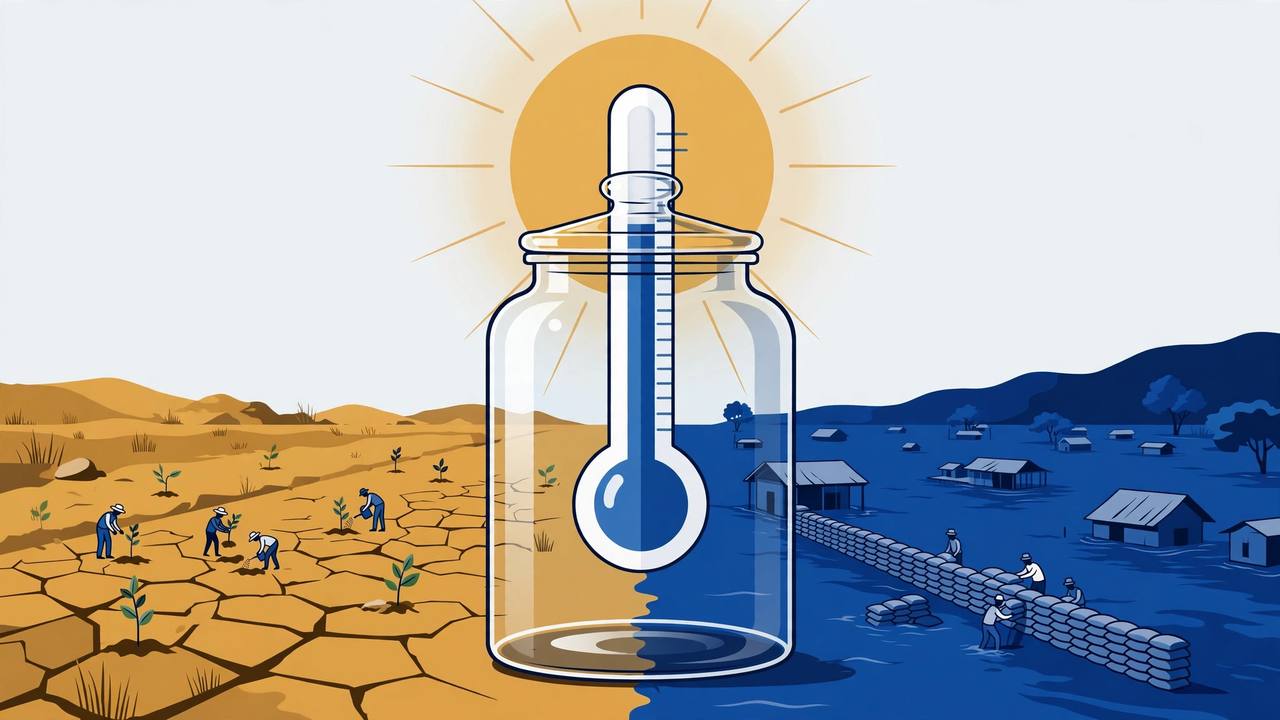
Developing countries will need about $305 billion a year by 2035 — yaani roughly $305 arab dollars every year — to adapt to worsening climate change, but rich countries provided only a small fraction of that in 2024, the United Nations Environment Programme (UNEP) said in its 2026 Adaptation Gap Report, titled “Ready? Not”, released in Nairobi on Wednesday, November 4. International public adaptation finance from developed to developing countries reached $28.2 billion to $31.7 billion in 2024, an increase of only about $1 billion over the previous year, Reuters reported.
Source: Reuters
“The world is not ready to adapt to current climatic conditions, never mind what overshoot of 1.5°C will bring,” said Inger Andersen, UNEP's Executive Director. The report warns that adaptation is too slow even as extreme weather becomes more frequent and severe — heatwaves, droughts, wildfires and floods — and that global temperatures are projected to exceed the critical 1.5 degrees Celsius (2.7 degrees Fahrenheit) threshold within a few years, Reuters reported.
Source: Reuters / UNEP
How the $305 billion figure is built
The $305 billion central estimate is drawn from countries' nationally determined contributions (NDCs), national adaptation plans (NAPs) and model-based estimates, UNEP said. The underlying assessments put annual needs at $255 billion to $328 billion for 155 developing countries over the next decade. UN News noted that the $305 billion figure excludes the private sector's own adaptation needs, meaning the true total could be double.
Source: UNEP / UN News
Even tripling the money leaves most of the gap
At last year's climate talks in Brazil, governments agreed an aspiration — the COP30 Global Mutirão decision — to at least triple adaptation finance by 2035, which could take flows to about $120 billion a year, or $85 billion to $120 billion depending on the baseline. UNEP found that would still leave a funding gap of more than two-thirds: after inflation, the tripling would meet just 20 to 29 per cent of developing countries' needs in 2035. Andersen said nations “will need to go even higher to save lives, avoid losses and damages and protect economies”, UN News reported.
Source: UN News / Reuters
What is solid
- UNEP's 2026 Adaptation Gap Report, released November 4, puts developing countries' adaptation needs at a central estimate of about $305 billion a year by 2035, based on NDCs, national adaptation plans and modelling
- International public adaptation finance reached $28.2-31.7 billion in 2024, up only about $1 billion on the year before, the report found
- Even a tripling of adaptation finance by 2035 — the COP30 aspiration — would cover only 20-29 per cent of needs after inflation, UNEP said
What is only claimed
- Whether governments will actually deliver the tripling, let alone go beyond it — no new funding commitment was made with the report; the test comes at COP31 in Türkiye
- How the separate COP29 Baku pledge of $300 billion a year in overall climate finance relates to the $305 billion adaptation-only need — the figures are close, but the Baku pledge covers all climate finance, not adaptation alone
Other money is growing — from a small base
The report pointed to growth in other channels: funding channelled through multilateral development banks and flows between developing countries themselves more than doubled to $9.6 billion in 2024, from $3.8 billion in 2019, Reuters reported. UNEP also said financing from multilateral development banks is likely to have increased significantly in 2025, and South-South flows have continued to rise — but those sums remain small beside the $305 billion need.
Source: Reuters
This adaptation report is the companion to UNEP's emissions assessment published earlier — the two together describe a world overshooting 1.5°C while underfunding protection against it: UNEP Emissions Gap: 1.5°C overshoot
What happens next
Countries meet in Antalya, Türkiye, from November 9 to 20 for COP31, the next round of UN climate talks, where negotiators will examine why nations remain off track on the COP29 Baku pledge to deliver $300 billion a year in climate finance to developing countries — a pledge close to UNEP's $305 billion adaptation-need estimate. Andersen urged nations at COP31 “and beyond” to focus on achieving the tripling of adaptation finance by 2035, while understanding they will need to go higher, according to UNEP's release.
Source: UNEP
For readers in Punjab and across South Asia, the gap is not abstract: adaptation money is what pays for flood defences, heat protection, stronger infrastructure and restored ecosystems in the developing countries that emit the least but face worsening floods and heat — and on the report's own figures, roughly nine-tenths of the yearly need is currently unmet.
Source: Capital FM / UNEP