This is the US confirmation of the strike first reported earlier on Tuesday, when an Iranian provincial official said US attacks had hit Qeshm Island and five to six explosions were heard. Washington had then offered no update; a US military official has now confirmed the strike and identified its target. Read the earlier Qeshm strike report
The United States has confirmed that its fighter aircraft struck an Islamic Revolutionary Guard Corps (IRGC) missile launch site on Iran's Qeshm Island on Tuesday, in what a US military official described as a self-defense strike carried out with precision munitions.
Source: Air & Space Forces Magazine
"Earlier today, U.S. fighter aircraft used precision munitions to strike an Islamic Revolutionary Guard Corps (IRGC) missile launch site on Qeshm Island in self-defense. The strike was in response to IRGC aggression targeting U.S. personnel and assets. U.S. Central Command remains highly vigilant and fully postured to protect Americans across the region," a senior US military official told The Center Square.
Source: The Center Square via The ANSWER Orlando
The confirmation changes the picture given earlier on Tuesday. Iran's official IRNA news agency had reported five to six explosions across Qeshm, and Iranian media reports had speculated that an air-defence site was targeted — a detail that was not independently confirmed at the time. The US official has now identified the target specifically as an IRGC missile launch site. The extent of damage to the site has not been independently verified.
The Bahrain drone attack that came first
The strike came hours after Iran launched one-way attack drones toward Bahrain, where the US Navy's Fifth Fleet is headquartered. The IRGC said its combat drones had targeted a US-operated radar system at Sheikh Isa Air Base. US Central Command said the drones were intercepted: "Multiple Iranian one-way attack drones launched by the IRGC today toward Bahrain were intercepted without any damage to U.S. equipment or injury to American personnel. CENTCOM and partner forces remain highly vigilant," CENTCOM posted on social media. The Bahrain Defence Force also said the drones were intercepted and destroyed before reaching their target.
Iran also claimed on Tuesday that it had shot down a US MQ-1 drone in the latest exchange. That claim has not been independently verified and is reported here as an Iranian claim only.
Iran's account: no damage to homes or infrastructure
Ahmad Nafisi, deputy governor of Iran's southern Hormozgan province, was quoted by IRNA as saying: "The American attack on locations on Qeshm island caused no damage to residential, commercial, or infrastructural areas." Iranian officials reported no casualties from the Qeshm strike. No US casualties from Tuesday's exchanges have been reported by CENTCOM.
Shipping, carriers and the blockade
Qeshm Island sits in the Persian Gulf just outside the Strait of Hormuz, the chokepoint through which about one-fifth of global oil and liquefied natural gas moved before the war. Several tankers have been attacked near the strait in recent days, and a liquefied petroleum gas tanker exploded after being attacked on November 16, Air & Space Forces Magazine reported, citing Lloyd's List. Iran's claims about further tankers hit by mines in the strait on Tuesday have not been independently verified.
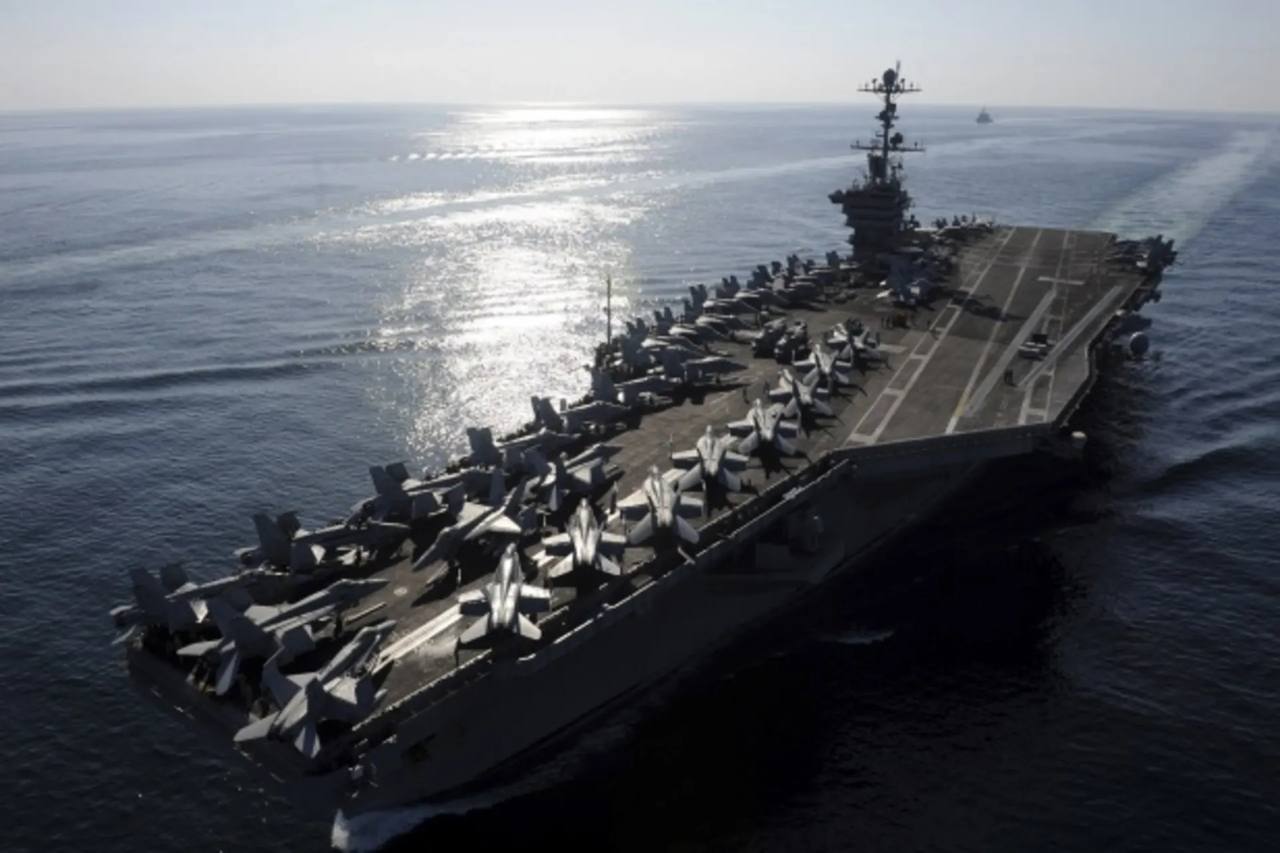
The strikes also come with more US airpower in the region. US Central Command announced on November 16 that the USS Theodore Roosevelt carrier strike group had arrived in the Middle East, joining the USS George Washington and the USS George H.W. Bush — three US aircraft carriers in the region at once — alongside dozens of deployed Air Force and Marine Corps fighters. The Trump administration says the US Navy maintains a complete naval blockade on Iranian ports, which it estimates is costing the Iranian economy between $400 million and $500 million a day; that figure is the administration's own estimate.
Trump, in Manila, on the dirty-bomb report
President Donald Trump, travelling in Asia, was also asked on Tuesday about a CNN report citing US intelligence assessments that Iran could be planning an attack involving a so-called dirty bomb or a chemical weapon in Washington. "If there is, they will pay a price the likes of which no country has ever paid before. I hope it's not, but we take it very seriously, because they are crazy," Trump told reporters, according to The Center Square. The White House has said there are no credible threats to the homeland at this time, and Iran's foreign ministry has called the allegations baseless. Those allegations remain unconfirmed intelligence reporting, not an established attack plan.
Background: a war since February 28
The US-Iran war began on February 28, 2026, with US and Israeli strikes on Iran. An April ceasefire ended the all-out strike campaign, Operation Epic Fury, but the US has since maintained a military pressure campaign and a blockade of Iranian ports, and Air & Space Forces Magazine has previously reported a series of limited US airstrikes on Iran since early September that were not publicly announced at the time. Earlier this month Trump said on Truth Social that he was pulling Vice President JD Vance off Iran talks, saying the US no longer needed a deal with Iran; on November 16 Vance told Fox News that Trump would not let the conflict become a "forever war."
For the large Punjabi and Indian workforce across the Gulf states, each confirmed exchange in the strait carries weight beyond the battlefield: Hormuz is the route for the region's oil and gas exports, and continued disruption typically pushes up fuel and food prices and adds uncertainty for shipping, construction and service jobs. No specific impact on Indian or Punjabi workers from Tuesday's strike has been reported.
What happens next will depend on whether Iran answers the Qeshm strike with further drone or missile fire at US bases or shipping in the Gulf, whether Washington carries out further strikes, and whether mediation efforts can reopen safe passage through Hormuz. For now the central fact has changed since Tuesday evening: what was first reported on Iran's account alone is now confirmed by the United States itself — a precision strike on an IRGC missile launch site, described by Washington as self-defense.