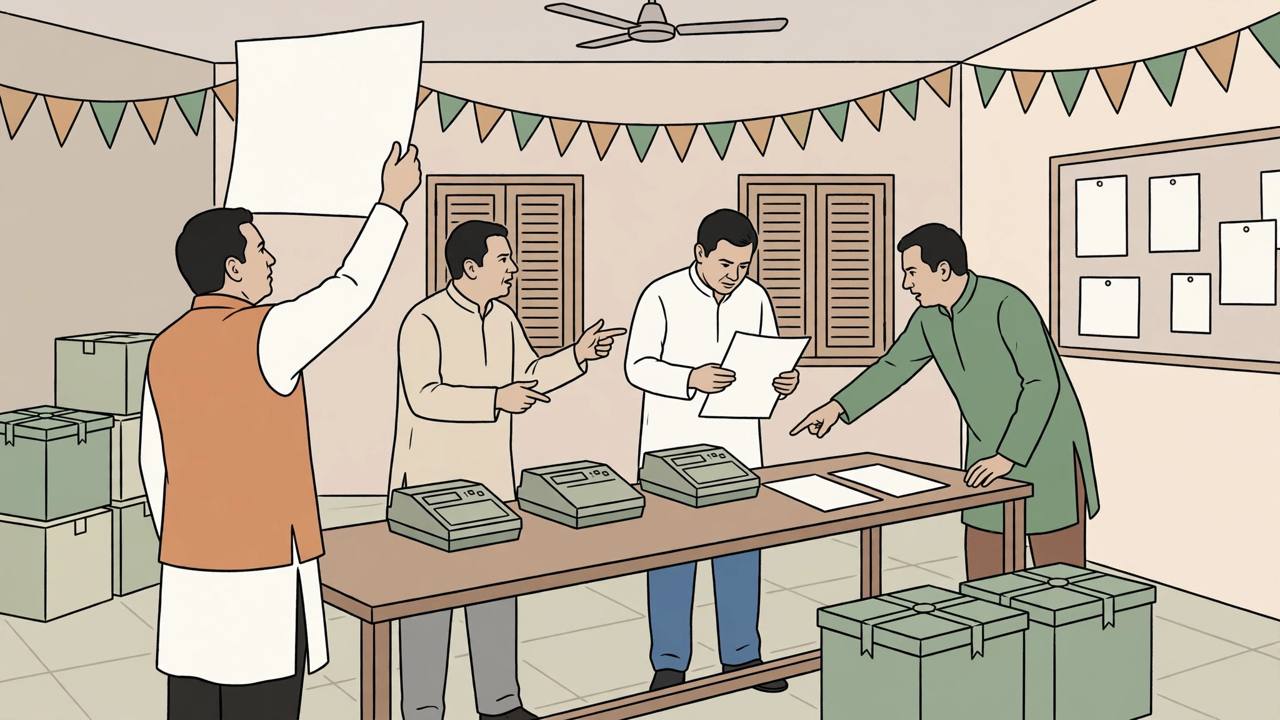
Election officials on Wednesday rejected a report alleging that votes cast and votes counted did not match in 51 constituencies in the 2024 elections, calling the findings misleading and factually incorrect. The Maharashtra Chief Electoral Officer (CEO), responding on X, said the report had confused the total number of registered electors with the number of votes actually polled.
Source: Nation Press — Maharashtra CEO statement
The allegation comes from the Reporters' Collective, whose 'Election Audit' investigation said it examined returning officers' records for 467 assembly seats and 63 parliamentary seats across Maharashtra, Haryana and Jammu and Kashmir, cross-checking 4,212 physical records. The Collective alleged discrepancies in 51 seats: in 19 of them, it said, officials had entered zero or nil against the number of voters who entered polling stations, and in 32 contests the votes recorded as polled did not match the votes counted on EVMs, with 12 showing fewer votes counted than polled. These claims are allegations by the Collective and have not been independently verified.
Source: Reporters' Collective report, via DY365 Live
Among the examples the report cited was Mumbai North, won by Union minister Piyush Goyal, where it said internal records showed 18.11 lakh votes polled against 10.33 lakh counted. In Haryana's Badkhal, where Congress candidate Vijay Pratap Singh lost by 6,181 votes, it cited 3.32 lakh votes polled against 1.60 lakh counted, and in Kaithal it said a record showing 215 voters sat alongside 1,67,285 votes counted. The Collective said no repoll was held in any of the 51 seats.
Source: Reporters' Collective report, via DY365 Live
The Maharashtra CEO answered with the Election Commission's own index-card figures. In Beed, the CEO said, total electors were 3,84,885, of whom 2,38,845 voted on EVMs and 2,42,084 voted in all including postal ballots — so the report's claimed gap of 1,45,256 'uncounted' votes was simply the difference between electors and votes polled. The same explanation was given for Dahanu (3,01,257 electors; 2,20,919 EVM votes; 2,21,818 total) and Mumbai North (18,12,115 electors; 10,33,267 EVM votes; 10,36,496 total), where 18.11 lakh was the elector count, not votes polled. The CEO said polling-day figures are shared with candidates' agents in Form 17 and reconciled with EVM tallies at counting, and that no candidate or party had complained of any such difference in the disputed seats.
Source: Nation Press — Maharashtra CEO statement
Haryana's Chief Electoral Officer also called the report misleading, saying through news agency IANS that the Kaithal figures cited did not account for postal ballots and that the actual votes polled there, including postal ballots, were 1,68,851. Election Commission sources made the same broader point, citing Form 17C, the statutory polling-station document prepared by presiding officers, as the record against which counts are verified.
Source: Indian Witness — Election Commission response
What is solid
- The Reporters' Collective published an 'Election Audit' report alleging tally differences in 51 seats in Maharashtra, Haryana and J&K.
- The Maharashtra and Haryana Chief Electoral Officers have publicly rejected the report as misleading.
- Official index cards list electors, EVM votes and total votes including postal ballots separately for each seat.
What is only claimed
- Whether internal records show real differences between votes polled and votes counted in 51 seats, as the Collective alleges.
- Whether the gaps the report cites are counting discrepancies or simply the difference between total electors and votes polled, as officials say.
The Collective said it had sent questions to the Election Commission before publishing and that the Commission routed them through its public grievance system and asked it to hand over its data confidentially; the Collective said it would publish its questions and, with later parts of the series, its raw data and original records. DY365 noted that the Collective's figures could not be independently verified. With the official rebuttal now on record and the underlying data still to be published in full, the dispute is likely to remain under scrutiny in the weeks ahead.