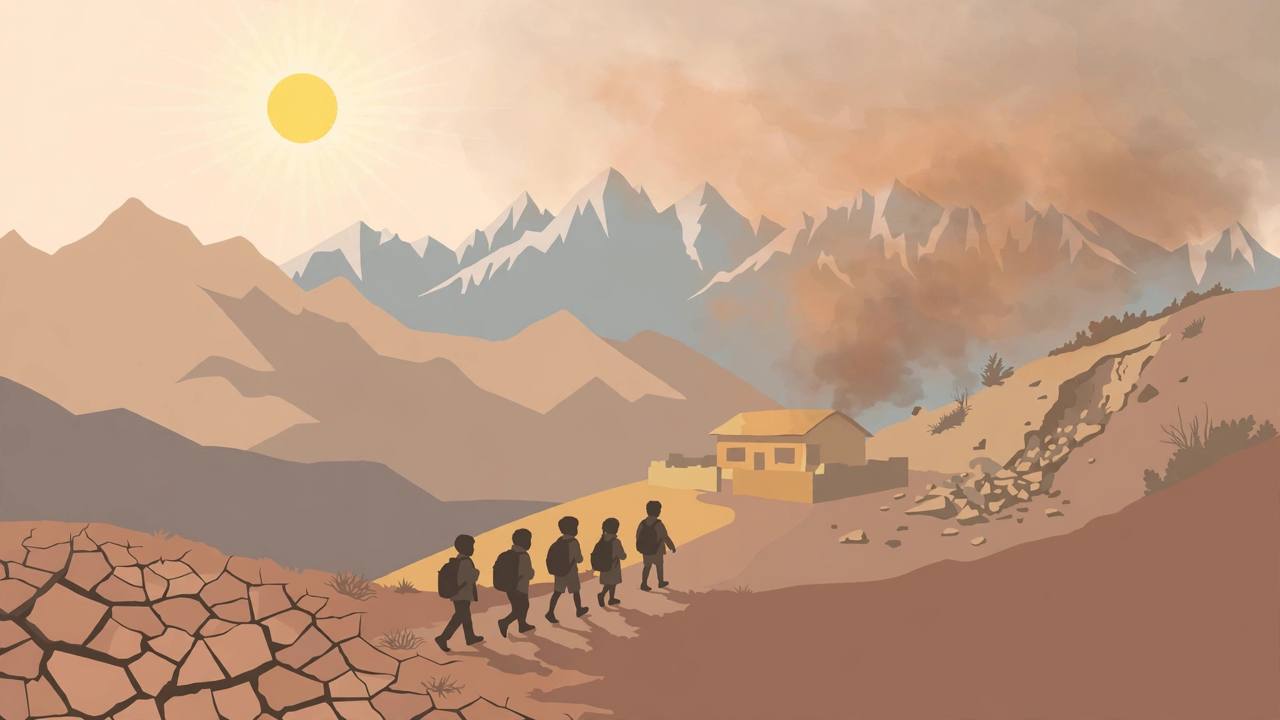
Millions of children in Nepal are facing escalating and overlapping climate, environmental and disaster risks that threaten their health, nutrition, education, protection and future prospects, UNICEF warned on Thursday as it launched a new advocacy brief, 'Growing Up in a Climate Hotspot: The Risks Shaping the Lives and Futures of Nepal's Children', in Kathmandu on 5 November 2026.
Source: UNICEF Nepal
Air pollution is the most widespread of the threats the brief documents. It also warns that climate change is placing growing pressure on the services children rely on: only 47.5 per cent of Nepal's population has access to safely managed drinking water, one in four children under five is stunted, and 22 per cent of children live in multidimensional poverty, while climate-related shocks keep raising the risks of child labour, child marriage, disease outbreaks and disrupted learning.
Source: UNICEF Nepal
"The climate crisis is increasingly becoming a child rights crisis"
"The climate crisis is increasingly becoming a child rights crisis," said Alice Akunga, UNICEF Representative to Nepal. "Children have contributed least to climate change, yet they are among those bearing its greatest consequences. Every flood, drought, heatwave and pollution episode threatens children's health, nutrition, education and protection. As Nepal prepares to engage in global climate discussions at COP31, we have an opportunity and responsibility to ensure children are placed at the centre of climate action, climate finance and adaptation efforts."
Source: UNICEF Nepal
The brief stresses that the risks are not shared equally. Children living in poverty, girls, children with disabilities, children from historically marginalized communities and those in remote, climate-vulnerable areas face disproportionately higher risks while having fewer resources to cope and recover. The Himalayan Times also reported the launch on Thursday, carrying the same exposure figures for air pollution, drought, extreme heat and landslides.
Source: The Himalayan Times
Ahead of COP31 in Türkiye, UNICEF pointed to a step Nepal has already taken: on 29 October 2026, during the National Climate Summit, the Government of Nepal formally endorsed the Declaration on Children, Youth and Climate Action — a global declaration first launched at COP25 and now endorsed by 78 countries — committing to climate action that responds to the rights and needs of children and young people. The signed declaration will be formally handed over to UNICEF representatives at COP31.
Source: UNICEF Nepal
"Climate change is not a future problem for children; it is already affecting our lives today," said Jayanti Bam, UNICEF Nepal Youth Advocate for Climate Action. "When floods damage schools, children don't just lose classrooms. We lose learning opportunities, routines, friendships and a sense of safety." UNICEF is calling on the government to integrate children's needs across climate policies, adaptation plans and financing frameworks, on climate finance institutions to invest more in child-responsive adaptation, and on all levels of government to plan using child-focused climate risk data.
Source: UNICEF Nepal
The brief draws on the Global Child Hazard Database, Nepal's Children's Climate Risk Index–Disaster Risk Model (CCRI-DRM), the Nepal Multiple Indicator Cluster Survey (NMICS) 2024-25 and UNICEF Nepal's Climate Landscape Analysis for Children — which UNICEF describes as together providing the most comprehensive picture to date of children's exposure to climate hazards in Nepal and the vulnerabilities that amplify their impact.
Source: UNICEF Nepal