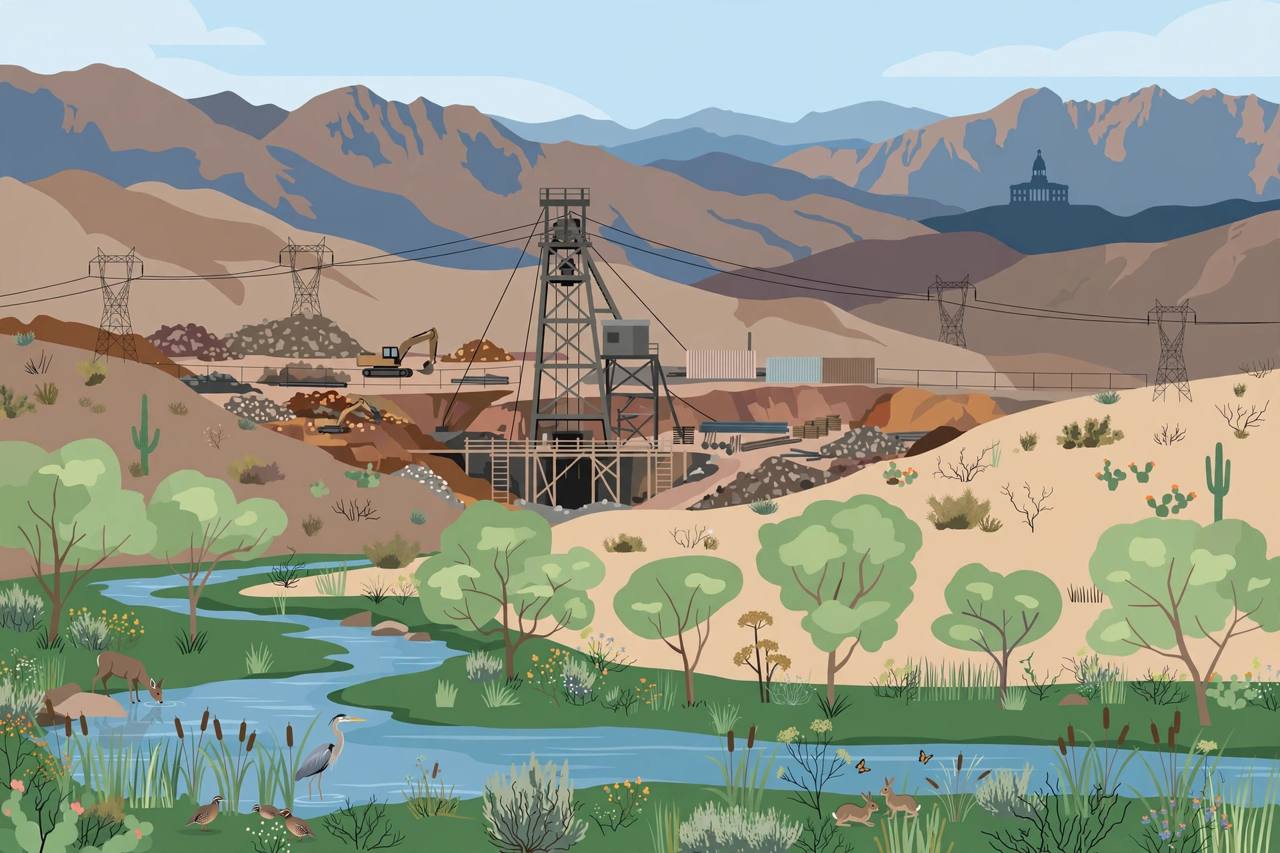
A federal judge in Tucson has refused to halt construction at South32 Ltd.'s $3.3 billion Hermosa critical-minerals project in southern Arizona, allowing work to continue while an environmental lawsuit against the project's federal approvals runs its course. The U.S. Department of Justice announced the decision on Tuesday, November 10, drawing national attention back to a mine that has become a test case for how fast the United States can build new supplies of minerals it considers critical, and at what cost to water and wildlife.
Source: Engineering News-Record
Senior U.S. District Judge Raner C. Collins denied the request for a preliminary injunction on November 6. The request had been brought by the Patagonia Area Resource Alliance and the Center for Biological Diversity, two environmental groups challenging approvals granted by the U.S. Forest Service and the U.S. Fish and Wildlife Service. Judge Collins heard arguments in the case in Tucson on November 3 before ruling three days later.
What the judge decided, and what he did not
Collins found that the groups had not demonstrated a likelihood of irreparable harm from the work expected to happen before the court can decide the underlying case. That distinction is the heart of the ruling: a preliminary injunction is an emergency order, and the judge concluded the near-term work on federal land was too limited to justify stopping a $3.3 billion project before a full hearing on the merits. The ruling does not resolve the environmental groups' underlying claims, and Collins said it does not “validate every aspect of the Project.” He ordered both sides to submit an expedited briefing schedule within 14 days, setting up a faster timetable for the main lawsuit.
Source: U.S. Department of Justice, via Engineering News-Record
Much of the mine itself is being developed on private land, but its supporting infrastructure extends onto roughly 423 acres of the Coronado National Forest. The federal-land components include a primary access road, water infrastructure, connecting haul roads, additional drilling, a second tailings storage facility and a transmission line being built by UNS Electric Inc. South32 told the court that work on federal land over the next year would largely involve geotechnical investigations, limited exploration drilling, work in previously disturbed areas and safety fencing. Construction of the second tailings facility is not expected to begin until 2028 and still requires additional engineering and state permitting, the company said.
The transmission line is further along than most of the federal-land work. South32 describes it as a permanent 138-kilovolt connection to the local grid, with about seven miles crossing federal land. UNS Electric began construction on September 8, and that work could be completed before the court decides the main case — one reason the judge treated the immediate footprint as limited.
A zinc, lead, silver and manganese project built around the Taylor deposit
Hermosa is a zinc-lead-silver mine and processing project under construction about 55 miles south of Tucson, near the town of Patagonia in Santa Cruz County. Its first major mine, named Taylor for the geologist who first discovered the deposit, is the centrepiece of a larger project that also includes manganese and copper deposits. South32 expects Taylor to begin production in the second half of its 2028 fiscal year. Sundt Construction is serving as construction manager at risk, and the $805 million Taylor deposit process plant was listed as Sundt's largest project to break ground during 2025 in an industry survey.
The spending numbers show the scale of what is at stake. South32 spent $197 million on Hermosa during the September quarter alone, as crews extended an underground decline and sank the main and ventilation shafts, and the company said all flotation cells and major electrical transformers have been installed. It plans another $1 billion in Hermosa growth capital spending in fiscal 2027. Collins also weighed the project's economic and national-security implications: South32 expects about 2,380 direct, indirect and induced jobs, and the company and UNS Electric argued that stopping work could disrupt contractors and development schedules. “The record identifies a substantial public interest in domestic critical-mineral supply,” Collins wrote, calling the national-security interests “relevant and substantial, though not independently dispositive.”
Why environmental groups say the approvals were rushed
The lawsuit, filed on September 29, challenges the administration's September 2 approval of the mine's expansion onto federal public lands. The groups allege — and the government and South32 dispute — that the agencies failed to adequately evaluate threats to endangered species, groundwater and other public resources, and they dispute the Forest Service's authority to approve some mine infrastructure on federal land. In their filing announcement, the groups said the expansion would extend industrial mining across more than 52,000 acres of public land in the Coronado National Forest for 83 years, in one of Arizona's most biologically rich mountain ranges. Those figures are the groups' characterisation of the approval, presented here as their claim.
Source: Center for Biological Diversity
“It would be difficult to find a place that is more important for threatened and endangered species in North America than right where they're wanting to expand this mine,” Graham Rex, an attorney representing the environmental groups, told Arizona Public Media, as reported by Engineering News-Record.
Hermosa's permitting history is part of why Washington is watching. The project became, in 2023, the first critical-minerals development accepted into FAST-41, the federal programme created under the 2015 Fixing America's Surface Transportation Act to coordinate reviews for major infrastructure. On September 2, 2026, the Federal Permitting Improvement Steering Council announced that Hermosa had completed federal permitting — the first mining project to do so under FAST-41 coverage. The Permitting Council described Hermosa as a $3.3 billion zinc and manganese mining and processing operation that will produce up to five federally designated critical minerals, including zinc, silver and manganese, and the Forest Service has said the project's Clark deposit is the nation's only advanced project proven through pilot testing to produce battery-grade manganese from a domestic ore source.
Source: Federal Permitting Improvement Steering Council
What happens next
For residents of Patagonia and Santa Cruz County, the practical effect is immediate: construction continues, including the transmission line, while lawyers argue over groundwater, endangered species and the limits of the Forest Service's authority. For the wider United States, the case will help decide whether the FAST-41 fast track can deliver a major mine on schedule when its approvals are challenged in court. The next step is procedural but important — the expedited briefing schedule Collins ordered within 14 days of November 6 will set the pace for a merits decision that could still change, condition or stop parts of the project. Until then, neither side has won the mine: the groups have lost the emergency halt they sought, and South32 has won only the right to keep building while the lawsuit is decided.