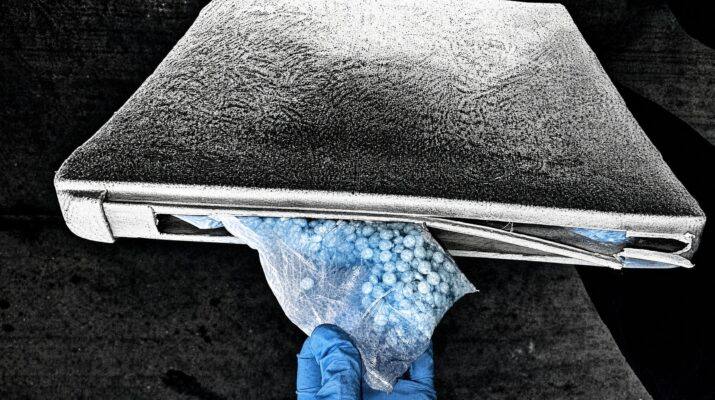
Border officers at Nogales, Arizona, pulled more than 112 pounds of fentanyl out of a load of plastic folding chairs this month — over 300 packages of the drug packed inside the chairs in the bed of a pickup truck crossing from Mexico, U.S. Customs and Border Protection announced on Tuesday. The seizure, at the DeConcini Crossing of the Port of Nogales, is one of the largest single fentanyl interceptions announced at an Arizona port this fall.
Source: U.S. Customs and Border Protection
The stop itself happened a week earlier, on November 3. CBP officers referred a 36-year-old male U.S. citizen, driving a 2006 Nissan Titan and returning from Mexico, for secondary inspection. What officers found inside the chairs — and how a routine crossing turned into a major drug seizure — shows the layered screening now standard at Southwest border ports, and the lengths smugglers go to in order to hide narcotics inside ordinary household cargo.
Source: U.S. Customs and Border Protection
Technology first, then the dog
The discovery came in stages. Using nonintrusive inspection technology — the large-scale scanning systems that X-ray vehicles and cargo without unloading them — officers identified anomalies in the folding chairs in the truck bed. A CBP canine team was then brought in and alerted officers to the presence of narcotics. Only then did officers physically open the chairs, and inside them they found more than 300 packages containing fentanyl concealed within the chair frames and padding.
Source: U.S. Customs and Border Protection
"This exceptional interception highlights the relentless vigilance of our frontline personnel, the immense value of our canine units, and the critical role that advanced NII technology and modernized infrastructure play in our operations. We are aggressively disrupting transnational criminal networks and stopping deadly narcotics from reaching our communities." — Roque Caza, Director of Field Operations for CBP's Tucson Field Office
The vehicle and the narcotics were seized by Customs and Border Protection. Homeland Security Investigations special agents responded to the port of entry, and CBP says the case is pending further investigation. The agency's release did not name the driver and did not announce criminal charges; the driver is described only as a 36-year-old male U.S. citizen.
Half a million pills in one pickup bed
Fentanyl is a synthetic opioid so potent that traffickers move it in compact, high-value loads — and commonly press it into pills, like the blue tablets visible in CBP's photograph of a package being pulled from inside one of the chairs. Border-watch reporting on the seizure equated the 112 pounds to roughly half a million pills. A single pickup load of that size, had it cleared the port, would have fed distribution networks well beyond Arizona: Nogales sits at the southern end of Interstate 19, the corridor that runs north through Tucson to Phoenix and connects from there to highways serving the whole Southwest and the trucking routes beyond.
Source: Cartel Watch
For Arizona communities — and for the Punjabi trucking families whose drivers run I-19, I-10 and the border corridors every day — seizures like this one cut both ways. Every load stopped at the port is a load that does not reach the street, where fentanyl drives the overdose crisis that has hit trucking towns and warehouse corridors hard. At the same time, concealment inside legitimate-looking household cargo is exactly why inspections at ports like Nogales are intensive, and why cross-border drivers can face long secondary-inspection delays when officers are working a major find.
The port, and the pattern
The DeConcini Crossing is the main vehicle and pedestrian gateway between Nogales, Arizona, and its twin city of Nogales, Sonora, and the Port of Nogales as a whole is one of the busiest commercial crossings on the Arizona–Mexico border, handling produce and manufactured goods alongside passenger traffic. CBP's Tucson Field Office, which oversees Arizona's ports of entry, has repeatedly announced large fentanyl seizures this year, and officers say smugglers rotate concealment methods — vehicle panels, cargo loads, luggage and, in this case, furniture — as scanning technology improves.
What happens next
The case now sits with Homeland Security Investigations, the investigative arm that typically takes port seizures forward toward prosecution and toward the network behind the load. CBP has not said whether the driver has been charged or whether further arrests are expected, and the agency has not released his name. The announcement itself came a week after the stop — CBP published its release on Tuesday, November 10 — a reminder that port seizures are often disclosed only after the initial investigative steps are complete.