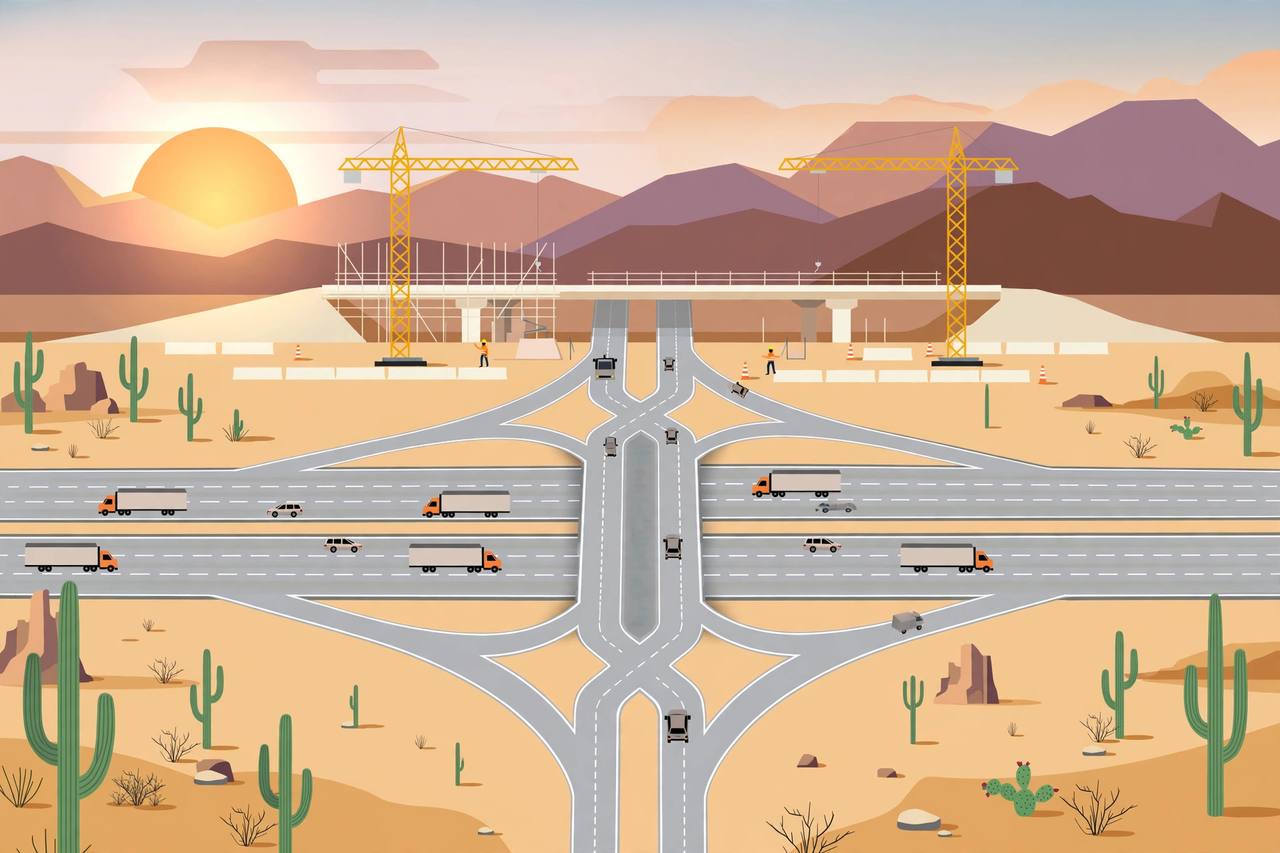
TUCSON, Arizona — Drivers and truckers crossing southern Arizona on Interstate 10 got a new way on and off the freeway this week: the Arizona Department of Transportation (ADOT) opened a brand-new interchange at Country Club Road at the start of the Monday morning commute on November 9, southeast of downtown Tucson. The opening is the most visible milestone so far in the $600 million project to reconstruct and widen I-10 between Kino Parkway and Alvernon Way — a corridor that carries local Tucson traffic alongside one of the heaviest east-west freight routes in the American Southwest.
Source: Arizona Department of Transportation, Nov. 9, 2026
ADOT describes the wider scheme as the largest highway construction project in Southern Arizona history. Work began in June 2025 with the stated goals of reducing delays and enhancing safety, and construction is expected to continue through 2028, so the new interchange is an early piece of a much larger rebuild rather than the finish line.
A different kind of interchange
The Country Club Road interchange is a diverging diamond, a design ADOT calls a relatively new kind of interchange for Southern Arizona. It has one major difference from the standard diamond interchanges common around the state: traffic on the local street makes a temporary shift to the left side of the road while crossing the freeway, which allows drivers to make direct left turns onto entrance ramps without waiting at an additional traffic signal, ADOT explained in its November 9 release.
This is only the second diverging diamond in Southern Arizona, following one that opened in November 2021 at I-10 and Houghton Road in east Tucson. The Country Club interchange replaces the former Palo Verde Road interchange, which closed earlier this year; ADOT shifted the interchange location to Country Club Road to allow for safer traffic movements to and from I-10.
What the full project builds
When the whole project is finished, I-10 will be widened to three lanes in each direction between Kino Parkway and Alvernon Way, with auxiliary lanes between ramps. The interchange at Kino Parkway will itself be reconstructed as a diverging diamond, the Palo Verde Road interchange will be removed, a new westbound on-ramp will be built at the Alvernon Way interchange, and a new I-10 undercrossing will connect the North and South Kino Sports Complex, according to ADOT's project description.
Source: Arizona Department of Transportation project page, Nov. 9, 2026
Construction reporting on the project puts the overall build at about 40 percent complete in its recent milestones: traffic was shifted onto 1.3 miles of new concrete pavement between Park Avenue and Country Club Road, and crews had installed 82 bridge girders at five locations through the project area, including abutments for the new Kino Parkway bridge over I-10, according to ACP / Rocky Mountain Construction reporting on ADOT's progress. Throughout the work, ADOT says it will maintain two lanes of travel in each direction on I-10 during peak travel times while maintaining access to businesses along the corridor.
Why truckers and local drivers feel it now
I-10 is the main east-west freight artery linking Southern California and Phoenix with Tucson, El Paso and Texas, and it is a daily route for long-haul drivers — including many Punjabi truckers based in California and Arizona — as well as for Tucson commuters. A smoother interchange at Country Club Road should cut the stop-and-wait pattern the old Palo Verde layout imposed, but ADOT is still advising drivers to plan for restrictions on I-10 between Park Avenue and Alvernon Way during the November 8-14 work window, and to check live conditions on az511.gov or the AZ511 app before travelling.
The construction years have also had a local cost. Tucson television station KVOA's reporting on the opening cited business owners along the construction zone who absorbed disrupted access, noise and dust; Monica Jimenez, store manager at Gerson's, said daily customer traffic sometimes dropped to fewer than 20 people during the worst of the construction. ADOT's commitment to keep business access open during the remaining work is aimed at exactly that pressure.
The rebuild is the first project to result from a study completed in 2020 that recommended how to improve mobility along a roughly 10-mile stretch of I-10 from I-19 to Kolb Road. The same study identified an alignment for an extension of State Route 210 (Barraza Aviation Parkway) along Alvernon Way that will connect I-10 to downtown Tucson.
What happens next
Drivers should expect the Country Club Road pattern — including the brief shift to the left side of the road over the freeway — to be the new normal at this interchange, while crews move on to the remaining pieces: the Kino Parkway diverging-diamond rebuild, the removal of the old Palo Verde interchange structures, the Alvernon Way westbound on-ramp and the sports-complex undercrossing. ADOT expects construction to continue through 2028 and advises motorists to use designated detours whenever closures are in place, noting that schedules can change with weather and other unforeseen factors. For freight operators, the practical advice is unchanged until the widening is done: build the Tucson segment's peak-hour limits into trip plans, and treat the two-lane peak guarantee — not the finished three-lane freeway — as the capacity to plan around.