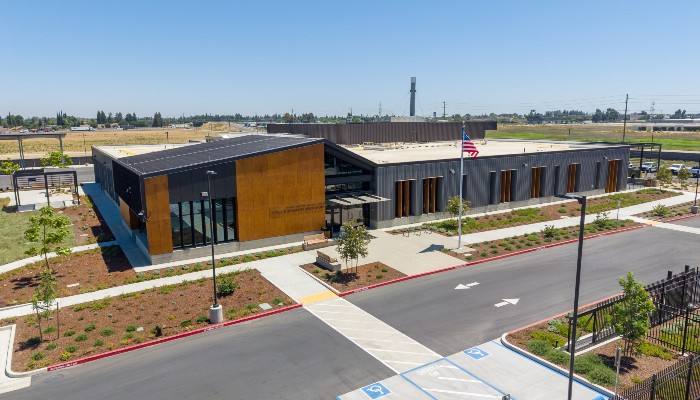
Turlock, in the heart of California's Central Valley, is now home to one of the state's front-line defences against animal disease. A new $108 million animal health and food safety laboratory was dedicated on Friday, November 6, in the Stanislaus County city — a facility nearly nine times larger than the lab it replaces, operated by the University of California, Davis, Weill School of Veterinary Medicine in partnership with the California Department of Food and Agriculture (CDFA).
Source: University of California, Davis, Nov. 6, 2026
The building, named the Arthur A. Bickford–Bruce R. Charlton Turlock Branch Laboratory, is part of the California Animal Health and Food Safety Laboratory System (CAHFS), a network of four laboratories headquartered at UC Davis and operated by the veterinary school for the state. CAHFS marked the dedication by running the Turlock lab on reduced hours on November 6, with client services and sample receiving available only from 2:30 p.m. to 5:00 p.m. because of the ceremony.
Source: CAHFS Connection, UC Davis, November 2026 and July 2026
What changes for Valley farmers and ranchers
Until now, the Turlock lab handled only poultry, so veterinarians and ranchers with deceased cattle, horses, pigs or goats that needed evaluation had to go to the other lab locations. “Limited space in our Turlock facility meant livestock ranchers would drive several hours to our CAHFS labs in either Davis or Tulare to get services,” said Simone Stoute, branch chief of the CAHFS-Turlock laboratory. “The new lab will eliminate that need and reduce turnaround time for diagnostic testing.”
Source: University of California, Davis, Nov. 6, 2026
The extra space lets the lab perform animal autopsies, called necropsies, and other diagnostic testing on deceased cattle, horses, pigs, goats and other livestock, in addition to poultry. The CAHFS lab offers necropsy services, blood tests, bacteriology, parasitology, tissue analysis (histology) and expanded molecular testing. Its staff will nearly double, and the new building houses both CDFA and CAHFS employees, allowing increased collaboration and coordination to prevent and manage disease outbreaks.
Source: University of California, Davis, Nov. 6, 2026
Why a disease lab sits on the food-supply front line
The Turlock lab plays a key role in detecting diseases that threaten California's commercial poultry industry. Testing of birds submitted to the lab has helped identify cases of highly pathogenic avian influenza, commonly known as bird flu. “We're there to protect the health and productivity of California's agricultural industries and ensure that we have a safe, productive and wholesome food supply,” said Ashley Hill, director of CAHFS.
Source: University of California, Davis, Nov. 6, 2026
“California is proud to be home to the largest and most diverse agriculture in the world,” said Karen Ross, secretary of the California Department of Food and Agriculture, at the dedication. “As we dedicate this new laboratory in Turlock, we are reminded that skilled scientists with state-of-the-art diagnostic equipment are truly at the front line, working with farmers, ranchers and veterinarians to protect the safety and security of our nation's food supply.” The new services are especially important to the estimated $3.5 billion livestock and poultry industry in the Turlock region.
Source: The National Provisioner, Nov. 6, 2026
Background: a project years — and $108 million — in the making
The old Turlock laboratory was a roughly 5,100-square-foot facility made up of a repurposed 1950s building and two trailers, with serious infrastructure, safety and space deficiencies that prevented it from offering mammalian services at all, the state Department of Finance's budget documents record. The Budget Act of 2017 appropriated $3.088 million to acquire the site for a replacement; the capital project's budget was later augmented to $104.8 million as construction costs rose, and UC Davis puts the final project's cost at $108 million. The same budget documents note why mammalian capacity became urgent: federal requirements for premovement milk testing for influenza A H5N1 in lactating dairy cows, after the virus was found in dairy herds.
The move itself happened in the summer. CAHFS announced the new facility at 830 Dianne Drive, Turlock, would open beginning July 20, 2026, with the lab closed July 13–17 for the move, and November 6 was the formal dedication of the building that has been receiving samples since July. The new laboratory also consolidates three CDFA Animal Health and Food Safety Services branch field offices alongside the diagnostic lab.
Source: CAHFS Connection, UC Davis, November 2026 and July 2026
The San Joaquin Valley around Turlock, Modesto, Merced and Fresno is dense dairy, poultry and orchard country, and home to many Punjabi farming and dairy families. A full-service state lab in Turlock means a dead cow, horse or flock no longer has to travel hours to Davis or Tulare before anyone can say what killed it — the turnaround point branch chief Simone Stoute made at the opening — and faster answers are what stop an outbreak from becoming a regional loss.
The two names on the building
The laboratory is named for two leaders in poultry disease diagnostics. Arthur A. Bickford and Bruce R. Charlton were both veterinary pathologists who led the Turlock laboratory and received national recognition for their contributions to avian medicine. Bickford retired in 2001 and died in 2023. Charlton led the laboratory until his death in 2014.
Source: University of California, Davis, Nov. 6, 2026
What happens next
The laboratory is already operating: farmers and veterinarians in the northern San Joaquin Valley can now submit livestock as well as poultry cases at Turlock instead of routing them to Davis or Tulare, and CAHFS continues to run its four-branch network — Davis, Turlock, Tulare and San Bernardino — for the state's animal industries. The dedication closes the construction chapter of a project the state first funded in 2017; the testing work it was built for, from bird flu surveillance to dairy-herd disease checks, is the part that now runs every day.
Source: CAHFS Connection, UC Davis, November 2026 and July 2026