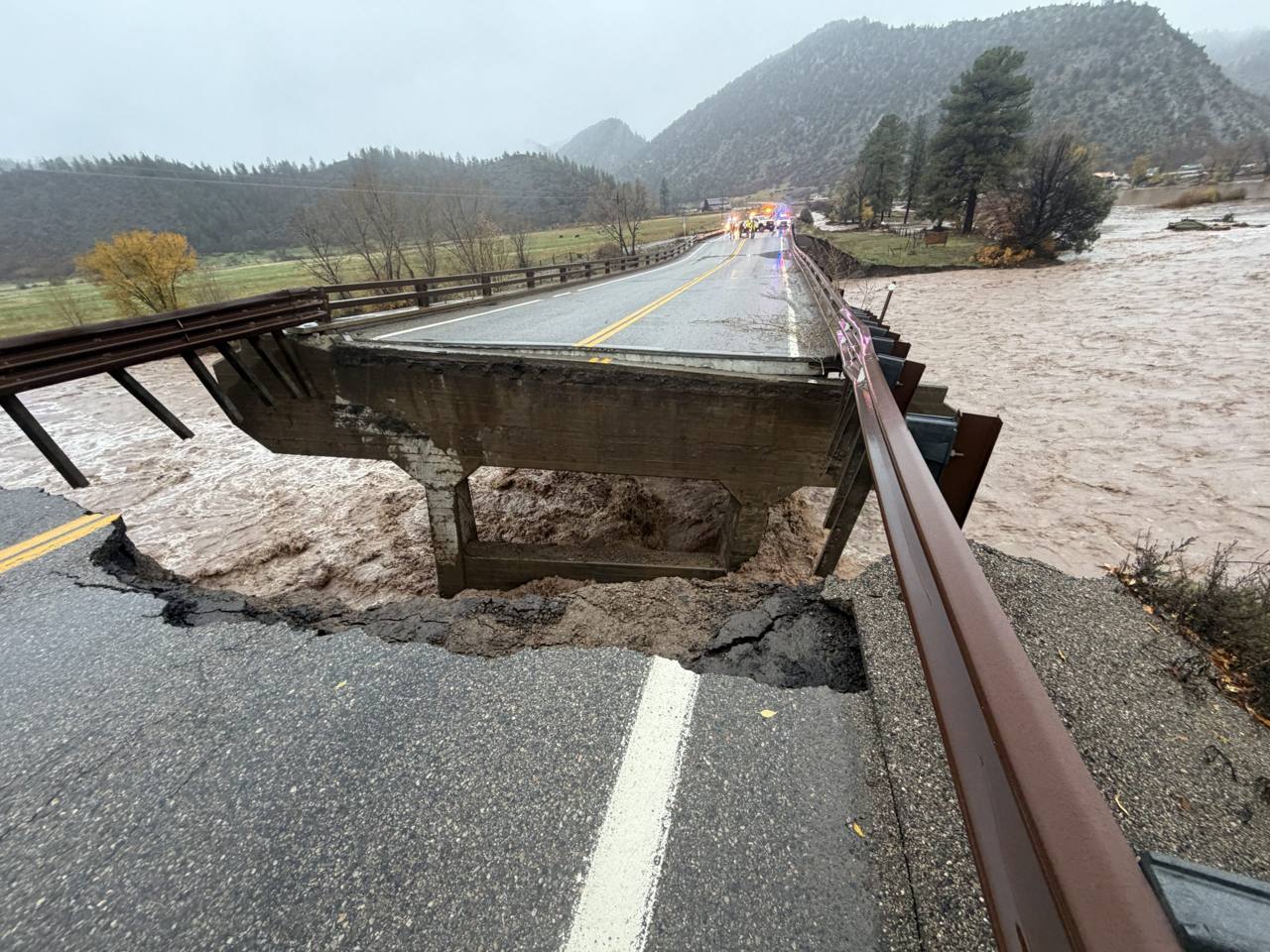
PAGOSA SPRINGS, Colorado — Wolf Creek Pass, the US Highway 160 mountain crossing that has been closed for the past 12 days after a second round of heavy rainstorms tore up the road, could reopen to limited traffic by this weekend, the Colorado Department of Transportation (CDOT) said at a briefing in Durango on Tuesday, November 10. It is a major new development in a story Awaaz Punjab first reported in late October, when flooding first closed the pass and damaged Colorado 151: since then a second storm, on November 1–2, caused fresh destruction at several new locations, collapsed the Piedra River Bridge piers and cut Pagosa Springs off again — and Tuesday was the first time officials set reopening dates.
Source: Colorado Department of Transportation, Nov. 10 briefing (via EIN Presswire, Nov. 12)
CDOT Executive Director Shoshana Lew said the team is on track to get limited traffic over Wolf Creek Pass by this weekend and to reopen CO 151 before Thanksgiving, with speed reductions and extra traffic control in place. “Our teams on the ground have made remarkable progress to make repairs after the two rounds of severe flooding,” Lew said. “We won't stop this work to repair every damaged section of roadway, and some critical milestones that restore connectivity in southwest Colorado are very near.”
Source: Colorado Department of Transportation, Nov. 10 briefing (via EIN Presswire, Nov. 12)
What the crews are facing on the pass
The pass is a 26-mile mountain corridor between Pagosa Springs and South Fork that normally carries 2,700 to 3,400 vehicles a day. Southwest Regional Transportation Director Julie Constan said crews have been clearing rocks, mud and debris six to eight feet deep in places, in stretches a couple of hundred feet long. “Shoulder damage, we have some retaining walls up there that were damaged. We have places where guardrail is just kind of hanging in thin air and a lot of culverts were plugged up and damaged as well, along with our fiber that goes over Wolf Creek Pass,” Constan said.
Source: Alamosa Citizen, Nov. 11
On the east side of the pass, through The Narrows, crews are reconstructing new segments of road where washouts undercut the riverbanks, CDOT said. West of the summit, extensive mud and rockslide clearing continues. The east side near South Fork saw four feet of water on the road surface at one point, and the Jackson Mountain Slope — a slow-moving landslide on the pass — has moved significantly in the rains, officials said. When the pass reopens, motorists should expect one-lane alternating traffic through multiple work zones, weather permitting.
Source: Colorado Department of Transportation, Nov. 10 briefing (via EIN Presswire, Nov. 12)
Two other closures: CO 151 and the collapsed Piedra River Bridge
As of November 10, three highways remained fully closed: US 160 over Wolf Creek Pass, US 160 at the Piedra River Bridge, and CO 151 south of Chimney Rock National Monument. On CO 151, floodwaters washed out two segments of road and damaged drainage along a three-mile stretch, mile points 27 to 30, between Pagosa Springs and Durango. Rebuilding it before Thanksgiving would remove the detour through New Mexico and cut the Pagosa Springs–Durango drive from about 3.5 hours back to about 1.5 hours, CDOT said.
Source: Colorado Department of Transportation, Nov. 10 briefing (via EIN Presswire, Nov. 12)
The hardest single repair is the Piedra River Bridge on US 160 at mile point 121, between Pagosa Springs and Bayfield/Durango, where floodwaters collapsed the bridge piers on October 31. CDOT says the structure needs a complete rebuild. A contractor has begun preparing the site and removing what is left of the old bridge, and a temporary bridge on a temporary alignment is to be installed by January 2027, with a permanent replacement to follow. A detour is in place for local residents.
Source: Colorado Department of Transportation, Nov. 10 briefing (via EIN Presswire, Nov. 12)
Background: two storms in two weeks, and the money
Southwest Colorado was hit twice in about two weeks: a first storm on October 22 and a second on November 1–2. Pagosa Springs was the hardest-hit town in both, CDOT and local reporting say. Colorado has freed up $20 million in state transportation contingency funds and received another $6.5 million in Federal Highway Administration emergency relief for the urgent repairs, Lew said. Officials initially requested $65 million in federal emergency funds after the October storm; after the second deluge, total repair costs are now estimated in the $100 million range by the end of 2027, according to CDOT figures reported by The Colorado Sun and other Colorado outlets.
Source: Alamosa Citizen, Nov. 11
The closure also shut access to Wolf Creek Ski Area, which had opened for the season over Halloween and then had to suspend operations when the road washed out — one reason officials describe the weekend target as a race to get the ski season, and holiday travel, back on track before Thanksgiving.
Source: Alamosa Citizen, Nov. 11
CDOT urges drivers to check COtrip.org or the COtrip Planner app before travelling in southwest Colorado. Closures, detours and work-zone delays can change daily, and CDOT says COtrip is updated ahead of other mapping services.
What it means for drivers and truckers, and what happens next
US 160 is one of the few east–west crossings of the southern Rockies and a working freight and supply route for the Four Corners region. While it is closed, through traffic faces the long New Mexico detour, and even after a limited reopening drivers and truck drivers should expect one-lane sections, signals, lower speeds and possible weather-related setbacks. For Punjabi and other long-haul truckers who run Colorado and the Southwest, the practical advice from CDOT is simple: check COtrip on the day of travel, do not rely on an old route plan, and allow for the detour until the pass is confirmed open.
What happens next comes in stages: a limited, one-lane reopening of Wolf Creek Pass targeted for this weekend, weather dependent; CO 151 restored before Thanksgiving, likely with speed reductions and flaggers; a temporary Piedra River Bridge by January 2027; and then the permanent bridge and the wider repair programme, which officials say could run through the end of 2027. CDOT says it will keep issuing updates as each milestone is reached.