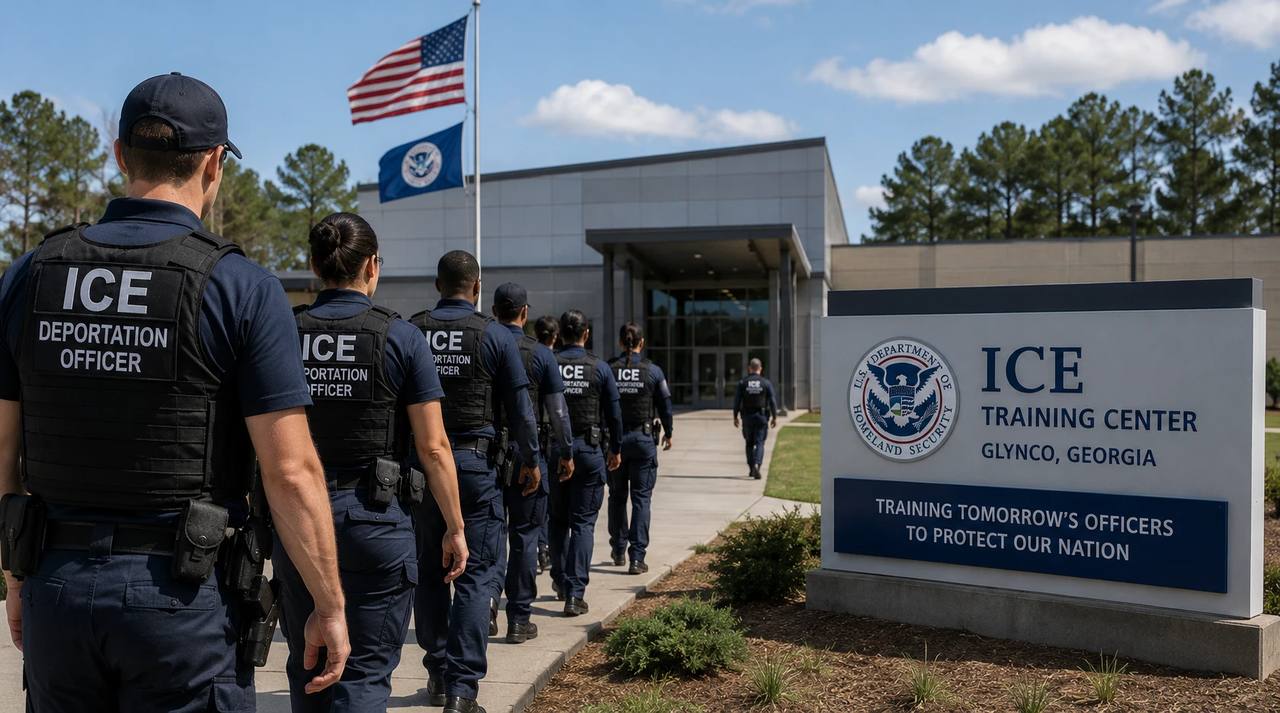
The Department of Homeland Security went too far in loosening training standards for thousands of newly hired immigration officers, according to a 19-page draft report from the department's own watchdog that was obtained by The New York Times and reported on November 20. The draft, from the Office of Inspector General, amounts to a sweeping critique of the plan carried out under then-Secretary Kristi Noem to rapidly hire and deploy 10,000 new officers — and one recruit instructor quoted in it called the training rollbacks a "catastrophic failure." The report is a draft: it has not been finalized or released, and its findings could change before a final version is published.
Source: The New York Times (via Particle News / Immigration Analytics)
The online academy
More than 3,500 recruits with prior law-enforcement experience were allowed to complete their basic training virtually instead of attending a monthlong in-person program at a training centre, the draft found. The online option let recruits speed through the material: more than 80 percent finished the online coursework within 10 days, more than 10 percent finished in under 24 hours, and at least five completed it in about two hours. The group makes up roughly 35 percent of ICE's active deportation officers nationwide, the Times reported.
Source: The New York Times (via Immigration Analytics)
A shorter academy for new recruits
The shortcuts were not limited to experienced hires. For more than 2,000 recruits with no prior law-enforcement background, ICE cut the in-person academy from 543 hours to roughly 300 hours and compressed the schedule from 72 days to 42 days. The cuts were made beginning in November 2025 and ran until February 2026. According to the draft, training hours were cut in areas including "law enforcement handguns," how to control detainees during deportation flights, driving manoeuvres, and "arrests and determining citizenship."
Unlimited retakes
The draft also criticized the decision to scrap a policy that gave recruits only two chances to pass a training test. With the cap removed, recruits could retake the test as many times as needed — and one officer took it 32 times before passing. Nearly 90 percent of on-the-job trainers who answered the watchdog's questionnaire called the make-up program unsuccessful, according to the Times' account of the draft.
Who drove the changes
The draft says former Secretary Kristi Noem and adviser Corey Lewandowski strongly supported the reductions, and ICE's former training chief told investigators he was ordered to carry them out. The hiring drive was backed by tens of billions of dollars provided by Congress to rapidly expand the deportation workforce. In all, nearly 6,000 officers went through a sharply reduced training model between August 2025 and roughly July 2026, according to the draft.
What DHS and ICE say now
The draft noted that the current secretary, Markwayne Mullin, restored the more robust training standards in July 2026. Two days before the draft's contents were reported, Mullin told the House Homeland Security Committee that officers who have not completed full background checks or the full 13-week training are on administrative leave. An ICE spokesperson told the Times that "a significant portion of officers brought on during the hiring surge have law enforcement experience and have already successfully completed a law enforcement academy."
Source: The New York Times (via Raw Story / Newstro)
Two important limits apply to the draft itself. First, Inspector General Joseph V. Cuffari — one of the few internal agency watchdogs not dismissed after President Trump retook office — objected to the leak of the draft. Second, the draft did not consider whether the lax training had contributed to problems on the ground, so it draws no link between the training cuts and any specific field incident. The figures reported so far come from press accounts of the draft rather than the document itself, and the inspector general's final report — including the agency's formal response and whether it agrees with the recommendations — is not yet public.
Related background: in November, The Washington Post found at least 19 new ICE officers had been hired despite misconduct, criminal charges and firings — a separate vetting story from the same hiring surge. Read the vetting report
Why it matters, and what happens next
These are the officers carrying out arrests, detentions and deportations across the United States — including in the Punjabi diaspora's home states and along the trucking corridors where many of our readers work. The draft describes a workforce in which more than a third of active deportation officers completed their basic course online, some in hours rather than a month, and in which thousands of others received roughly half the classroom time of a normal academy. Whether that left gaps in skills that matter on the street — firearms handling, detainee control, lawful arrests — is the question the final report, and Congress, will now have to answer.
What happens next: the inspector general's office will finalize the report after receiving the agency's comments, and the final version could change some findings. Congressional oversight is already moving — Mullin faced the House Homeland Security Committee this week — and lawmakers are expected to press DHS on remedial training for officers already deployed, and on whether the officers who finished the course in hours will be retrained. Awaaz Punjab will update this story when the final report is released.