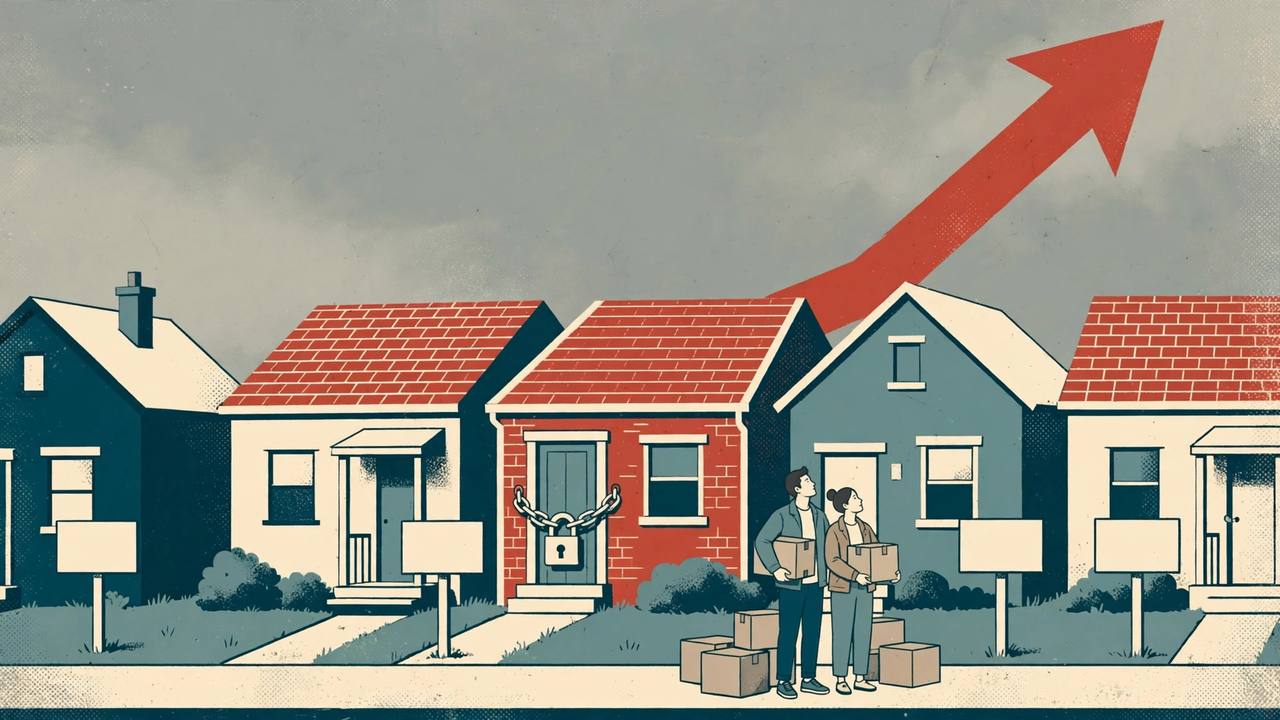
Sales of previously owned homes in the United States tumbled 5.5% in October to a seasonally adjusted annual rate of 3.75 million units — the lowest level since August 2010, when sales were still falling as a homebuyers' tax credit expired after the global financial crisis, the National Association of Realtors said in a report released on Thursday, November 12.
Source: Reuters
The drop was deeper than economists expected — they had forecast resales at a 3.85 million rate — and it was broad: sales fell 8.8% compared with October a year ago, and declined across every price category, including homes priced at $1 million and above, which had been growing strongly in prior months, Reuters reported.
Source: Reuters
Mortgage rates above 7% are the choke point
The NAR and economists put the blame squarely on borrowing costs. The 30-year fixed mortgage rate jumped above 7% in late August and rose to 7.40% by mid-September — a total rise of 142 basis points since the United States and Israel attacked Iran at the end of February, according to data from mortgage finance agency Freddie Mac cited by Reuters. The rate averaged 7.11% in the latest week, down slightly from 7.18% the week before, but still far above the levels buyers had planned around.
Source: Reuters
“Home buying is difficult when mortgage rates have climbed to their highest levels since 2000, aside from a single month in 2023,” said Lawrence Yun, the NAR's chief economist.
Source: Reuters
More homes for sale — but prices still at record highs
In a market short of buyers, listings are piling up without prices cracking. Existing-home inventory rose 1.3% to 1.590 million units, the highest since November 2019 and up 4.6% from a year ago. At October's sales pace it would take 5.1 months to exhaust that inventory — the most since November 2015, up from 4.4 months a year earlier.
Source: Reuters
Yet the median existing-home price still advanced 0.4% from a year ago to $421,900, the highest ever recorded for an October. The NAR's Housing Affordability Index fell to 100.7, from 107.3 in October 2025. First-time buyers accounted for just 29% of sales, down from 32% a year ago — well short of the 40% share economists say a robust housing market needs — while distressed sales stayed negligible at 2%, a sign the weakness is about demand and affordability, not forced selling.
Source: Reuters
The housing freeze traces back to energy and inflation. The US-Israeli war with Iran, now in its ninth month, has pushed up oil and borrowing costs across the economy. Government data this week showed consumer prices rising faster than expected in October — the Associated Press put annual inflation at 4%, up from 3.7% in September, with increases spreading into services, beef, auto insurance and electronics. That has flipped the Federal Reserve debate from cuts to hikes.
Why the Fed is unlikely to rescue buyers soon
The Federal Reserve left its benchmark rate in the 3.75%–4.00% range last month, and after this week's inflation data, financial markets have almost fully priced in a 25-basis-point rate hike in December and anticipate another increase in January, Reuters reported; the AP, citing CME Group's FedWatch tool, put the odds of a December hike at about 90%. Dallas Fed President Lorie Logan said this week she supported two additional quarter-point hikes, Philadelphia Fed President Anna Paulson also spoke publicly on the inflation data, and Fed Governor Michelle Bowman warned that price increases are broadening beyond energy and tariff shocks.
Source: Associated Press
A firm labour market gives the Fed room to stay focused on prices: in a separate report on Thursday, new jobless claims rose to 200,000 for the week ended November 7 while continuing claims fell — a stable, low-layoff picture that removes any urgency for the central bank to cut rates to protect jobs.
Source: Reuters
What it means for diaspora buyers
For Punjabi and wider South Asian families in the big buying corridors — California's Central Valley, Houston and Dallas, New Jersey and the New York suburbs — the arithmetic has changed twice over: the typical home now carries a record October price and a mortgage rate above 7%, a combination that pushes monthly payments hundreds of dollars beyond what the same house cost to finance when rates were lower. With first-time buyers already down to 29% of the market, the buyers being squeezed out first are the ones without equity from a previous home to roll forward.
What happens next
Oxford Economics expects the freeze to last. “With mortgage rates expected to remain above 7% through most of 2027, we expect home sales to remain below 4 million until late next year,” said Nancy Vanden Houten, the firm's lead US economist. The next tests come quickly: the Federal Reserve meets on December 8–9, and November's sales figures will show whether October's 16-year low was a floor or a step on the way down.
Source: Reuters