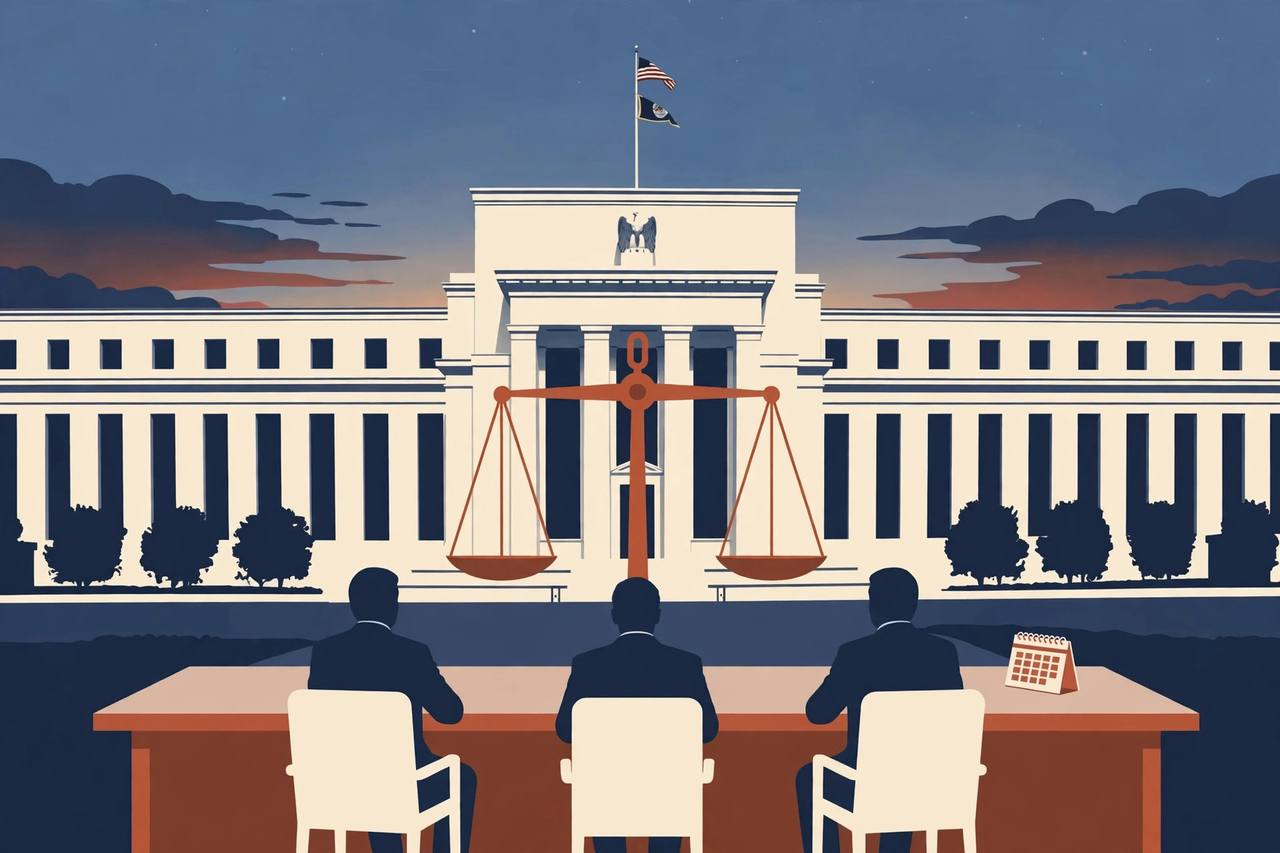
The White House has scheduled a hearing for Monday, December 14 into allegations against Federal Reserve Governor Lisa Cook, in a new phase of President Donald Trump's effort to remove her from the United States central bank, Reuters reported on Wednesday, citing a New York Times report based on an unnamed White House official. The hearing had originally been announced for Thursday, November 5 — the day after the midterm elections — and the move pushes the confrontation more than five weeks into the future, past the Federal Reserve's own December 8-9 policy meeting.
Source: Reuters
Nothing else about Cook's position changed with the announcement. She remains a governor of the Federal Reserve, is still listed as one on the Fed's official website, and has not been removed from the board that sets interest rates for the world's largest economy. The December 14 date is a hearing, not a verdict: a three-person committee appointed by Trump will hear the case and then recommend to the president whether, in its view, there is 'cause' to fire her. Whether Cook will even attend the rescheduled hearing has not been confirmed — her lawyer did not respond to fresh requests for comment from Reuters or CNBC.
What the committee is — and what it is investigating
Trump created the committee of inquiry in early October, more than a year into his campaign against Cook. Its members are Kevin Hassett, the president's assistant for economic policy and one of his top economic aides; Andrea Lucas, the chair of the Equal Employment Opportunity Commission; and Keith Sonderling, the director of the Office of Government Ethics, CNBC reported. The committee's written mandate is to investigate allegations that Cook made false statements in connection with 'one or more mortgage instruments' and to report back to Trump on whether there is 'cause' for her removal within the meaning of the federal law cited in a Supreme Court ruling in June.
Source: CNBC via USA News Hub
The allegations themselves concern statements Cook is accused of making on mortgage applications. They are allegations, not findings: no court has ruled that Cook committed mortgage fraud, and Cook denies any wrongdoing. Her position, set out in the lawsuit she filed challenging her attempted firing, is that the mortgage claim is a pretext — that the real reason Trump wants her out is her refusal to agree to his demands that she vote for lower interest rates, CNBC reported. The White House disputes that characterisation by pressing ahead with a process it describes as giving her a chance to answer the allegations.
Why the date moved
The White House official told CNBC that the postponement came at Cook's request. Her lawyer, Abbe Lowell, had told the White House last month that she would not be available for the November 5 date and could not attend until after the Federal Open Market Committee's December 8-9 policy-setting meeting; CNBC also reported that Lowell said she would be carrying out her official duties as a governor at financial and monetary policy meetings in Europe in the intervening period. Separately, Lowell has raised questions about the committee's fairness and objectivity and sought information from the White House about how the hearing will be run before agreeing to a date — questions that, on the reporting available, have not been publicly answered.
Hassett, who sits on the committee, told Bloomberg TV last week that Cook's lawyers had agreed to a date in December for what he described as a fair hearing, according to Reuters. That is not the same as Cook agreeing to attend this specific December 14 hearing, and both Reuters and CNBC reported on Wednesday evening that her attendance remained unconfirmed. Readers should treat the date as set by the White House, and her appearance as an open question.
Source: Reuters
A fight that began in August 2025
Trump first tried to dismiss Cook in August 2025, in what was already then an unprecedented move: no president in the 112-year history of the modern Federal Reserve has ever removed a sitting central banker. Cook sued, and the case climbed to the Supreme Court. In June, the justices ruled that Trump cannot fire a Fed governor 'at will', but left open the possibility that he might be able to remove her if she is given a chance to defend herself — keeping in place a lower-court order that protects her from removal while her lawsuit proceeds, and not deciding whether the president ultimately has the power to fire her in these circumstances.
The October committee is the White House's answer to that June ruling: a formal hearing process designed to supply the defence opportunity the Supreme Court described. That is why the fairness questions from Cook's side matter so much — if the committee recommends removal and Trump acts on it, the adequacy of this very hearing is likely to be the centre of the next round of litigation. The process also sits inside a wider pattern Reuters has documented through Trump's second term: a series of attempts to exert more direct control over the Federal Reserve, an institution deliberately built to set interest rates at arm's length from day-to-day politics.
The Federal Reserve sets the benchmark interest rate that flows into US mortgage rates, car loans, credit cards and the truck and equipment loans many Punjabi-American families and owner-operators carry. A public fight over whether a president can remove a governor who will not vote for lower rates is therefore not only a constitutional story — it goes to how predictable, and how political, the cost of borrowing in America will be. Nothing in Wednesday's announcement changes any interest rate or anyone's payment; it changes the calendar of the fight.
What happens next
The next fixed points are the Federal Reserve's December 8-9 policy meeting, where Cook is expected to sit and vote as a governor in the ordinary way, and then the December 14 hearing itself. After the hearing, the committee will report its recommendation to Trump. Cook's separate lawsuit challenging her attempted firing continues in the courts regardless of what the committee does, and the Supreme Court has not yet decided the underlying question of presidential removal power over the Fed. For now, the only confirmed change is the calendar: the hearing that was to happen the day after the midterms will instead happen a week before the Christmas break, with the composition of the Federal Reserve Board unchanged in the meantime.