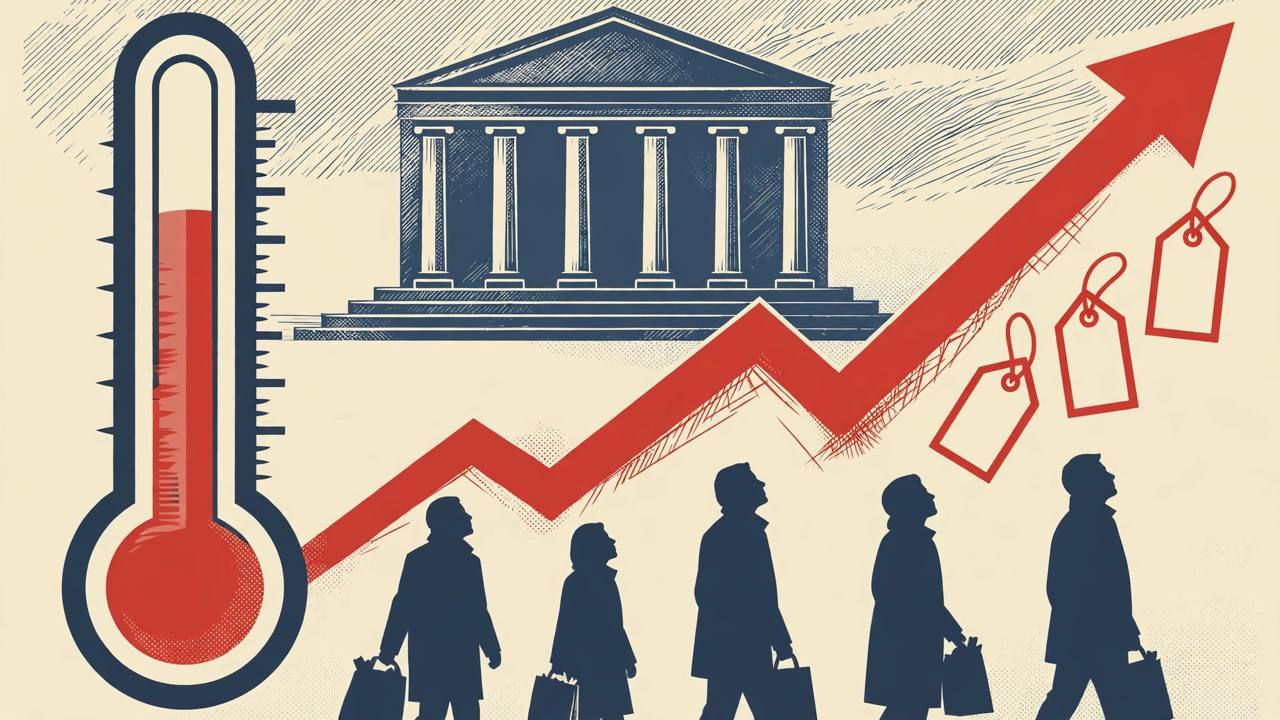
The United States Federal Reserve "has some work to do on inflation," Kansas City Federal Reserve President Jeff Schmid said on Sunday, November 15, warning that price pressures are "running too hot" and moving in the wrong direction. Schmid was speaking to a credit union conference in Hawaii, in remarks reported by Reuters.
Source: Reuters
Schmid said inflation is "uncomfortably above the 2% price stability target, and moving in the wrong direction." He did not specifically call for additional interest-rate increases, but his message added to a chorus of senior Fed officials who have spent the past week signalling that the central bank's next move is more likely to be a hike than a cut.
Not Just an Energy Story
Schmid stressed that the inflation problem is broader than the energy shock. Inflation would still be running at about 3% even with energy prices stripped out, according to a market report of his remarks — a point that undercuts the argument that price pressures will fade on their own once fuel costs settle.
Source: InvestingLive
He also pushed back against a growing narrative inside the debate: that the sources of demand-driven inflation right now — including the enormous artificial-intelligence buildout, with its data centres, chips and construction — are resistant to Federal Reserve policy. Schmid said he disagrees with that narrative, meaning he believes higher borrowing costs can still cool this cycle's demand.
The October Numbers Behind the Warning
Schmid's remarks landed days after the October Consumer Price Index report came in hotter than expected. Headline CPI rose 0.4% on the month against an expectation of 0.3%, and core CPI — which strips out food and energy — rose 0.3% against an expected 0.2%. It was the third consecutive core print at that pace, lifting the three-month annualised core rate to 3.7%, its fastest since April 2024. Because October 2025 data was lost during last year's government shutdown, the Bureau of Labor Statistics did not publish annual rates; interpolated estimates put headline inflation near 4.0% and core near 2.8%.
Source: The National
Other senior officials have gone further than Schmid. Speaking in London hours before the CPI release, Fed Governor Christopher Waller argued that a core reading around 0.3% or higher should prompt the Fed to consider a 50-basis-point hike at the December 8–9 meeting, because a smaller 25-point move alone would put the Fed's credibility at risk. Dallas Fed President Lorie Logan has estimated that the current 3.75%–4.00% range sits at least 50 basis points below the level needed for even modest restriction, and Boston Fed President Susan Collins has indicated a tighter policy path may be appropriate.
Where Policy Stands Now
The Fed raised rates by a quarter of a percentage point in September, to 3.75%–4.00%, then held steady at its October meeting. Since the latest inflation readings, interest-rate futures markets have moved to fully price in a quarter-point increase in December — up from roughly 84% odds of a hike on November 9 — with a small probability of a half-point move. The dollar index touched 103.08 this week, its strongest since April 2025, and the 10-year Treasury yield sits above 5%, so financial conditions have already tightened ahead of any decision. Schmid himself is not a voting member of the Federal Open Market Committee this year, so his remarks shape the debate rather than the vote.
The FOMC votes on December 8–9 without the November CPI report, which is not due until December 10 — a day after the decision. The Fed's preferred gauge, the Personal Consumption Expenditures (PCE) index, is due later this month and is the last major inflation reading policymakers will see before they vote.
What It Means for Households — and for Truckers
For the site's readers across the United States, including the Punjabi diaspora, this debate is not abstract. If the Fed hikes again in December and signals more to come in January and March, borrowing stays expensive for longer: truck loans and equipment financing, diesel bought on credit, mortgages, car loans and small-business lines all price off the same tightening cycle. Grocery and rent pressures are the other half of Schmid's warning — inflation near 3% even without energy means the cost squeeze is sitting in everyday goods and services, not only at the fuel pump.
What Happens Next
The next marker is the PCE inflation release later in November, followed by the FOMC meeting on December 8–9. A quarter-point hike is fully priced by markets; the open questions are whether a minority argues for 50 points, as Waller has floated, and what the Fed signals for January and March. Schmid's Sunday remarks — from a non-voting president, at a credit union conference far from Washington — show how united the hawkish message has become: in the Fed's own words, it still has work to do.