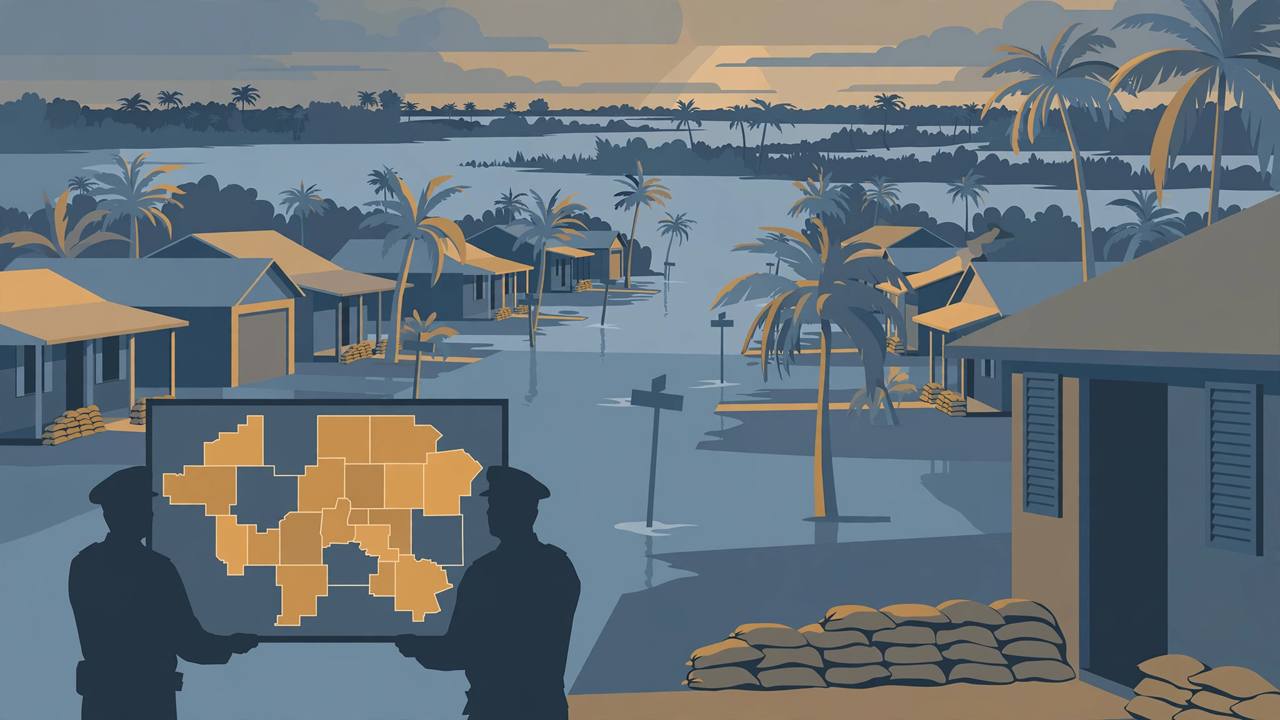
TALLAHASSEE, Florida — Governor Ron DeSantis on Wednesday, November 4, 2026, widened Florida's flood state of emergency from seven counties to 14, signing Executive Order 26-228 as water from Brevard County's record rainfall drains north into the St. Johns River, which forecasters expect to keep rising through the weekend and possibly for weeks. The new order amends Executive Order 26-227, which DeSantis signed on Monday, November 2 — the expansion is a follow-on to that first declaration, which Awaaz Punjab reported earlier this week.
Source: Launchpad Digital Florida
Executive Order 26-228 adds Glades, Hendry, Lake, Okeechobee, Palm Beach, Seminole and Volusia counties to the original seven — Brevard, DeSoto, Hardee, Highlands, Indian River, Martin and St. Lucie. It takes effect immediately and expires when the original order does. The Florida Division of Emergency Management announced the change on X, saying it 'strengthens the state's ability to continue deploying critical resources, supporting local response efforts & helping impacted communities recover.'
Source: Launchpad Digital Florida
The order itself gives two reasons for expanding. It says parts of Palm Beach County, including the City of Riviera Beach, 'witnessed record breaking, severe, and heavy rainfall of over 19 inches within a twelve-hour period,' and that National Weather Service forecasts show 'the St. Johns River will experience minor to moderate flooding which could last several weeks.' WKMG News 6 reported that an emergency order of this kind frees state agencies to coordinate logistics and resources and activates the Florida National Guard and the Florida State Guard, and the declaration also lets counties draw emergency funding from the state's emergency preparedness and response fund.
Source: Gator Current
The river is the next worry
The St. Johns is one of the few major American rivers that flows north — from Brevard County toward Jacksonville, passing Seminole, Lake and Volusia counties on the way — which is exactly why those counties were added on Wednesday. National Weather Service Melbourne flood warnings in effect Wednesday evening showed the river rising along much of that path: near Cocoa in Brevard County, moderate flooding was already occurring and the forecast had been raised to major flooding by late this week, staying there into the weekend; the weather service said that at 17 feet, roads flood and water approaches low-lying homes in the Silver Pines area.
Source: Launchpad Digital Florida
Above Lake Harney in Seminole County, minor flooding was occurring, with moderate flooding forecast and rises near major flood stage possible late this weekend into early next week. Near Sanford, also in Seminole County, the river is forecast to reach minor flood stage in the next couple of days — federal forecast data put the Sanford crest as high as 6.4 feet by Monday — and the weather service said that at 6.5 feet, water enters a few lower-lying homes in the Stone Island and Stillbrook subdivisions. Near DeLand and Astor, in Lake and Volusia counties, DeLand was in minor flood stage and could near moderate early next week, while at Astor moderate flooding was already occurring and homes near Wildhog and Bonnet roads were becoming hard to reach.
Source: Gator Current
On Florida's west side, NWS Tampa Bay extended warnings for the Peace River at Arcadia and Zolfo Springs, Horse Creek near Arcadia, the Alafia River at Lithia and the Manatee River near Myakka Head. The immediate weather, at least, should help: NWS Melbourne posted that mostly dry weather was expected across east central Florida on Wednesday night, though with a high risk of rip currents at the beaches.
Source: Launchpad Digital Florida
Palm Bay formally names the two people who died
In Palm Bay, the city at the centre of the disaster, Mayor Rob Medina formally identified the two people who died in the flooding as 34-year-old Joshua Bennett and 78-year-old Archie Richards, who were not related, WESH 2 reported. Bennett died when rising water trapped his car on San Filippo Drive. The Brevard County Sheriff's Office found Richards in his vehicle near Richards Lane and Hall Road on Tuesday, a day after a Silver Alert had been issued for him. 'That is devastation within our city,' Medina said, according to ABC News, which reported that one Palm Bay family found 38 inches of water inside their living room.
Source: Launchpad Digital Florida
The scale of the response gives a sense of what fell on Brevard County in roughly a day. Florida Today reported that at least 20 inches of rain fell in just under 24 hours on November 1-2, that Florida Fish and Wildlife Conservation Commission officers evacuated 190 residents, and that emergency services took 3,000 calls for service on Tuesday alone. 'Many worked for 24 hours,' Palm Bay Fire Rescue Chief John Ringleb said. 'Right now we can't say how many people were affected by all of this.' FWC spokesperson Chad Weber told Florida Today the operation 'has moved from carrying out rescues to a recovery mode.' Insurance Journal, citing Florida Today and the National Weather Service, described the storm as a '1-in-1,000-year' rainfall event, produced by a slow-moving low-pressure system over the eastern Gulf of Mexico pushed against a high-pressure system off the East Coast, and noted that vehicles could be seen floating down streets at the height of the flooding.
Source: Insurance Journal
Help, travel and what residents should do now
Florida Today listed an American Red Cross shelter at the Wickham Park Senior Center and a pet-friendly shelter at the South Mainland Community Center, 3700 Allen Ave., in Micco. The state says calling 211 connects residents with local help — with one catch: if you use Wi-Fi calling, 211 may not connect, so look up your local 10-digit number at 211.org. The Division of Emergency Management advises residents to document damage before cleanup — photographs of damaged belongings, high-water marks on walls and affected rooms, taken only from a safe location — and warns people to never enter standing floodwater. FloridaDisaster.org/FallFlooding carries county emergency contacts, boil-water notices and road closures. For truckers and other drivers crossing central Florida, the practical point is that river flooding is a moving target for days, not hours: check current NWS warnings and state road information before driving anywhere near the St. Johns, and expect local closures around Cocoa, Sanford, DeLand and Astor to change as the crest moves north.
Source: Launchpad Digital Florida
The flooding has already reached into Florida's farm economy as well. In Polk County, in central Florida, groves took six to ten inches of rain in 36 hours, and a citrus consultant in Fort Pierce, on the Atlantic coast, posted video of a home grove block standing in water after about 18 inches of rain in roughly 30 hours — a reminder that the same water now filling the St. Johns first fell across a wide band of the state.
Source: Specialty Crop Grower
The St. Johns River is forecast to crest in stages through the weekend and into Monday — as high as 6.4 feet near Sanford — and the executive order itself warns the river's flooding could last several weeks. Brevard County has shifted from rescues to recovery, damage documentation is the state's immediate ask of residents, and the expanded 14-county emergency stays in force until the original November 2 order expires.