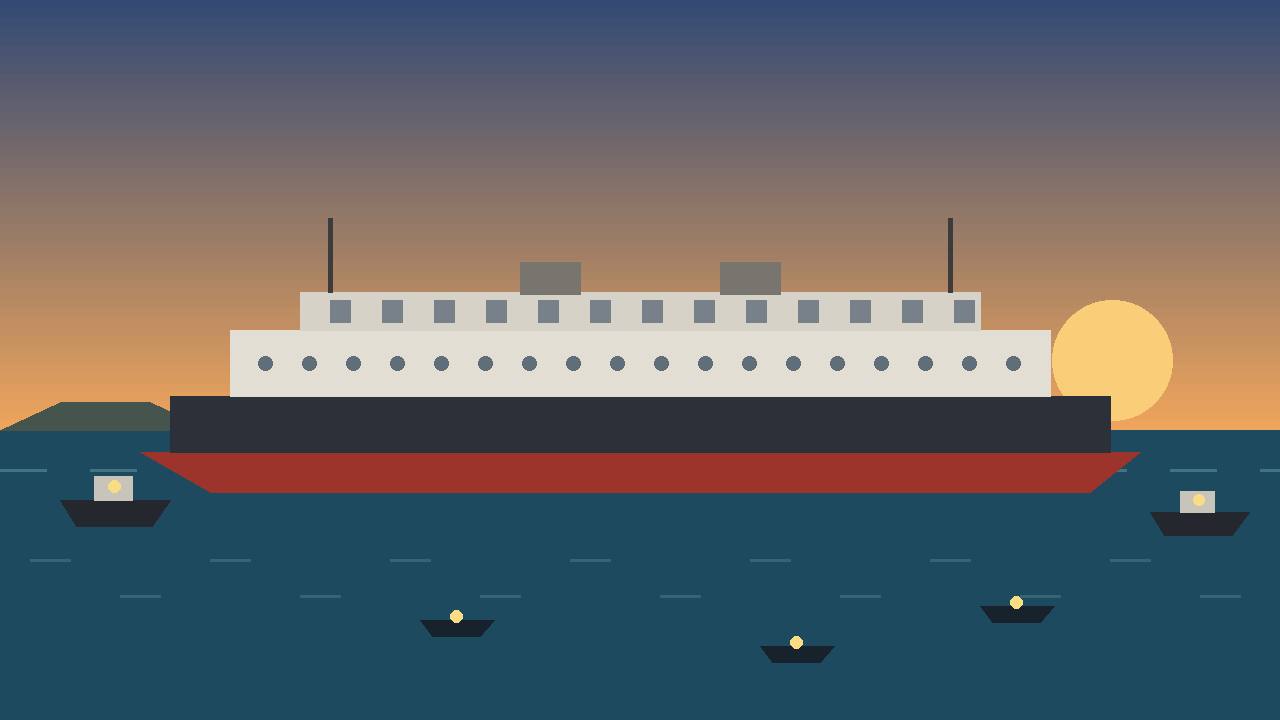
The SS United States — the largest passenger ship ever built in America and still the fastest ocean liner to cross the Atlantic — began its final descent into the Gulf of Mexico off Destin, Florida, on Wednesday, in a deliberate sinking designed to turn the nearly 1,000-foot vessel into the world's largest artificial reef, Reuters reported. The sinking is the moment Okaloosa County previewed in October, when officials said the liner would be submerged in the second week of November, weather permitting — the plan Awaaz Punjab reported on October 26. On Wednesday it stopped being a plan and became a slow, livestreamed farewell, watched by dozens of tugboats and recreational vessels that accompanied the rusted hulk, stripped of its two funnels, on its final voyage.
Source: Reuters
The reef site sits about 22 nautical miles southwest of Destin-Fort Walton Beach and 32 nautical miles southeast of Pensacola, at 30° 07.148' N, 86° 46.755' W, according to county figures published by the Pensacola News Journal — coordinates that could shift slightly once the ship settles. The county moved the sinking up a day, from Thursday, because forecast heavy winds threatened unsafe conditions, officials told WEAR-TV in Pensacola and WPVI-TV (6abc). The ship had left Mobile, Alabama, under tow on Monday morning.
Source: Pensacola News Journal via Cape May Scanner
A sinking measured in hours, not minutes
Deployment operations began at about 1 p.m. Central time, but the descent was so gradual that most of the liner's hull was still above the surface as the sun set, surrounded by the blinking lights of nearby vessels, Reuters reported. Officials had estimated the sinking would take about 45 minutes; by the county's 8:15 p.m. update, relayed by the Pensacola News Journal, the ship was still afloat, sitting lower in the water with the red paint on the bottom of its hull still showing above the waterline on the Destin-Fort Walton Beach livestream. Crews opened the last valves and left the ship at about 5:45 p.m. Eastern time, the News Journal reported.
There were no explosives. Federal environmental and explosives rules bar the county and its contractor from using them, the Associated Press reported, so seawater was allowed to flood the hull through opened valves. Work crews had spent months preparing the ship: removing residual fuel, wiring, glass, ductwork and other non-metal and environmentally unsafe materials, and anything that could entangle a scuba diver; cutting holes strategically through the hull and decks — including 10-foot-by-10-foot openings, county spokesperson Nick Tomecek said — and removing more than 400 portholes, so the liner would sink gradually, level and upright, with passageways opened inside for marine life to move through.
Why Okaloosa County bought a 1,000-foot liner
Okaloosa County, in Florida's Panhandle, bought the ship as a roughly $13 million project — county figures put the cost at $13.5 million — after the vessel sat moored in Philadelphia for nearly 30 years, seemingly destined for the scrapyard, Reuters reported. The wreck will join more than 500 smaller underwater sites in the Destin-Fort Walton Beach Artificial Reefs, a divers' haven built from sunken ships. "We're trying to be the best diving destination in the world," Tomecek said. Organizers expect the upright wreck's upper deck to end up about 50 feet beneath the surface; county figures say about 60 feet.
"While the weather may have changed our plans, it has given this historic occasion an especially meaningful date. On Veterans Day, as we honor the men and women who served our nation, we will also honor the legacy of the SS United States." — Okaloosa County Board Chairman Trey Goodwin
The fastest ocean liner ever — and its long wait in Philadelphia
Launched 75 years ago, the SS United States was a marvel of post-World War Two engineering and luxury that carried the rich and famous across the Atlantic. Its 1952 maiden voyage set a speed record, averaging almost 41 mph and beating a 1938 record held by Britain's RMS Queen Mary — a crossing record that still stands. The liner was retired from service in 1969 as commercial air travel took over, and it had been docked in Philadelphia since 1996. In February 2025 tugs moved it down the Delaware River and down the coast to Mobile, where, after permission from the U.S. Coast Guard and other agencies, it was prepared at a shipyard for disposal at sea.
The sinking survived two late legal attempts to stop it. The SS United States Preservation Foundation went to federal court in Pensacola on November 3, arguing the U.S. Army Corps of Engineers had approved the project without an environmental impact statement or a completed historic preservation review, and asked for an emergency order halting the sinking. U.S. District Judge M. Casey Rodgers denied the request on November 6 and an amended request on November 7, noting the substantial expense of keeping a ship that size berthed and that any renewed request would have to propose a bond sufficient to protect county taxpayers. An earlier challenge, by the New York Coalition to Save the Steam Ship United States, was dismissed in August 2025 for lack of standing.
What remains above water is memory, deliberately kept. The SS United States Conservancy, which sold the ship to the county, has preserved the liner's funnels and is developing an SS United States museum in Okaloosa County. "It was our goal to make sure that she wasn't lost forever," Conservancy board member David Lawrence told PBS. Susan Gibbs, granddaughter of the ship's designer, said: "She really embodies and expresses this country's best."
What happens next
If the descent completes as planned, the liner will settle upright in about 180 feet of water, and the wreck is expected to open to divers the day after it goes down, WALA-TV (FOX10) in Mobile reported. Final coordinates will be confirmed once the ship settles. Below the surface, the cut passageways are meant to let fish and other marine life colonize the hull — the start of the ship's second career as a reef, 75 years after it first went to sea as the fastest liner on the Atlantic.