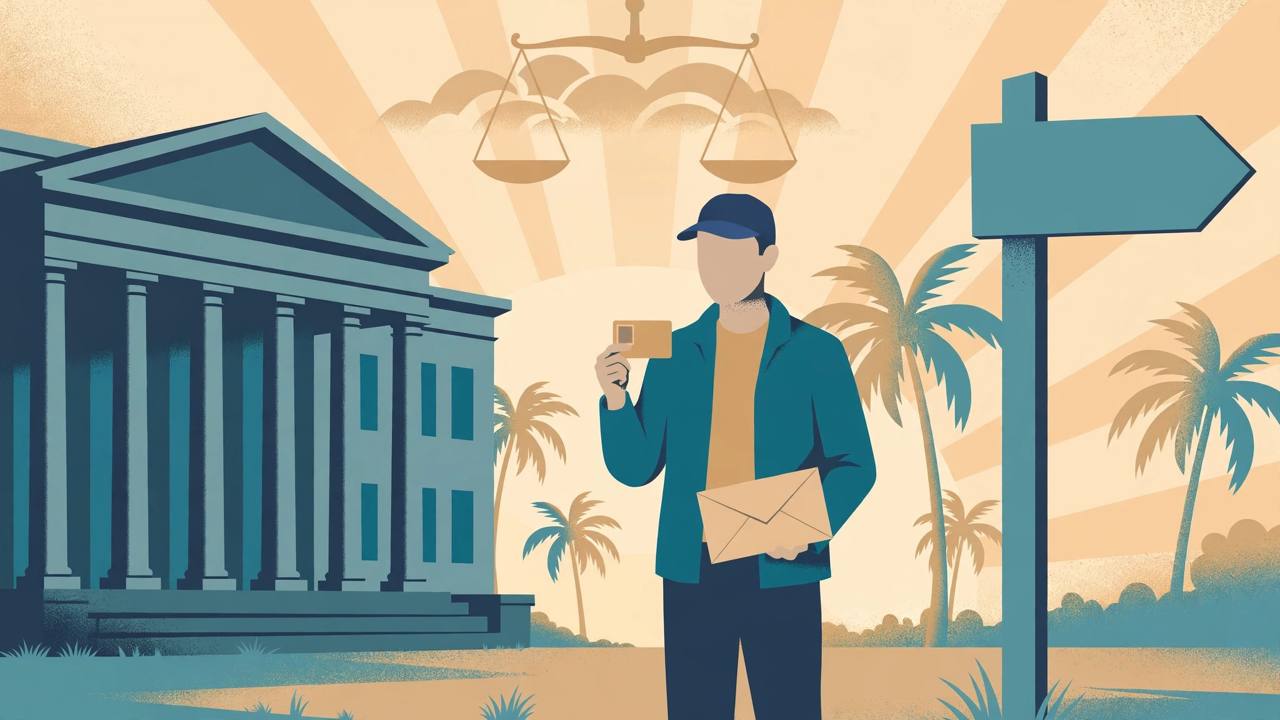
A Tampa father of two is sitting in jail in Florida's latest voter-fraud sweep while his lawyer argues the state has not proved the central fact of its own case — that Donta White actually cast a ballot. White, 44, is one of 20 defendants charged with illegally voting in the statewide operation, and he recently appeared in a Hillsborough County courtroom in an orange jumpsuit for a hearing that was meant only to schedule his trial.
Source: Tampa Bay 28 (ABC Action News) I-Team
The appearance was procedural, but its consequences are not. Because the new voting charges triggered a violation of the 10-year probation White was already serving, he is back behind bars while the case moves toward a jury trial set for early next year — separated from his two young children and from the body shop he runs in Tampa.
"I thought it was a prank. Like, what do you mean? There's officers here to arrest you for voting? He's like, I didn't do it," said Taquilla Allen, White's girlfriend, who is helping to care for his two young children while he remains in jail. "It's been rough, but you know, we're just gonna take it a day at a time," Allen told Tampa Bay 28 investigative reporter Katie LaGrone.
What prosecutors allege
According to a press release from the Florida Attorney General's Office, White was serving a 10-year probation sentence for grand theft when he signed a state form warning him not to register or vote until after he had completed his sentence. Prosecutors allege that, despite that warning, White submitted two voter registration applications in October 2024 falsely claiming his voting rights had been restored, and then voted early in the 2024 general election.
Source: Florida Attorney General's Office sweep announcement, via The Crosswire Daily
White is charged with illegal voting and two counts of false swearing. A spokesperson for the Attorney General's Office said White admitted to authorities that he registered and voted. That admission claim is the state's account; White's defence disputes what the evidence can actually prove, and the charges remain allegations that White is presumed innocent of unless a jury convicts him.
The defence: a voter card the state itself sent
"There is no clear-cut evidence that would support the fact that he actually went to the polls and voted himself," said White's attorney, Lynley Flagler. Flagler says that although White was not eligible to vote because of his felony conviction, the state sent him a voter ID card as if he was eligible — the same kind of card at the centre of several earlier Florida cases.
"I feel that there's an entrapment issue. They want to prosecute voting, but they have not put any checks and balances in place to let people know when they're able to vote and when they can't vote," Flagler said. "He runs a body shop. He's a father. He's just, overall, really changed his life. So to see him in this position saddens me on a personal level as well as a professional level."
A voter ID card by itself does not grant anyone the right to vote. Under Florida law, people with felony convictions can have their voting rights restored only once they have completed their full sentence — including probation. White's probation was still running in 2024, which is why prosecutors say any ballot he cast was illegal.
A longer Florida argument: fraud, or confusion?
Questions about felon voting eligibility are not new in Florida. In 2022, Governor Ron DeSantis announced the arrests of 20 former felons who had cast ballots despite disqualifying convictions; several of those arrested said they believed they were allowed to vote. "What we discovered from a review of all those cases was there was more confusion than fraud," said Ramon De La Cabada, a Florida criminal defence attorney who co-chairs a committee formed after those arrests.
De La Cabada believes White's case may be another example of that confusion. He pointed to the recent arrest of Astrid Navarette Quintana, who is in a Lee County jail after the state charged her with voting as a non-citizen; reporter Katie LaGrone's investigation found she is a permanent resident married to a U.S. veteran — and that she, too, was sent a voter ID card. Asked why voters should not be responsible for knowing their own eligibility, De La Cabada replied: "Absolutely, but I think the better question is why isn't the government creating better communication about eligibility? What you're finding in all these cases is massive confusion as to eligibility."
The latest sweep, announced by Attorney General James Uthmeier's office in September, charged 20 people across nine counties — Brevard, Collier, Columbia, DeSoto, Hillsborough, Lee, Marion, Okeechobee and Polk. Sixteen were accused of being non-citizens who falsely claimed U.S. citizenship to register and vote, and four were convicted felons accused of voting while still on probation. The cases were built by Florida's Office of Election Crimes and Security, created in 2022, working with county election offices that reviewed registration records.
What happens next
White's jury trial is set for early next year in Hillsborough County. He faces up to 15 years in prison on the illegal-voting charges and up to 30 years for the probation violation that stemmed from them. Until then, he remains in jail and his family remains apart. "Who would throw away their life away to vote? That's what it all boils down to," Allen said. "It's petty, but we're dealing with it."