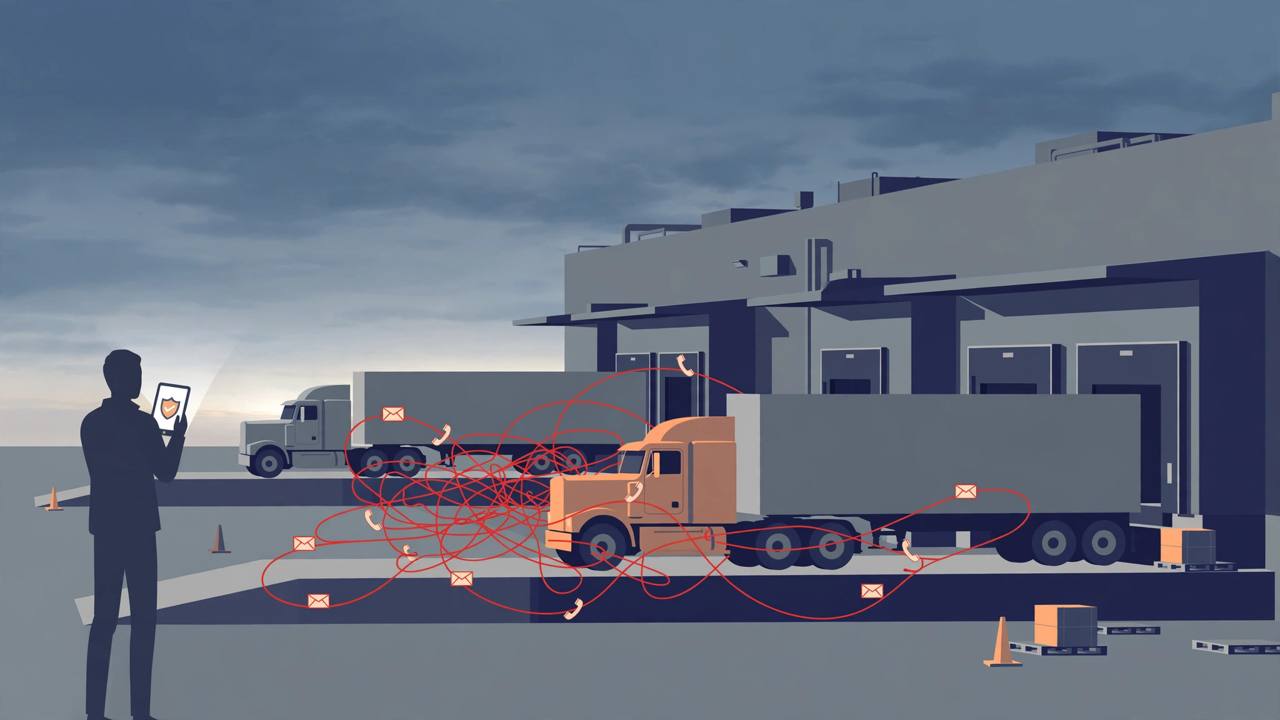
A trucking company can have genuine operating authority, verified credentials and years of clean history — and none of that proves the person asking for its next load actually controls the business. That is the central warning of Highway's third-quarter Freight Fraud Index, published this week and reported by FreightWaves on Saturday, November 7: criminals are increasingly stealing freight not by breaking into trucks, but by breaking into the trusted digital identities of established carriers.
Highway, a carrier-identity platform used by freight brokers, analysed how criminals targeted established carrier accounts between July and September 2026. Its single biggest finding is that compromised communications — criminals taking over a real carrier's email account and using the familiar address to request sensitive shipment information — were behind 40.2 percent of the stolen loads reported on its network in the quarter. Brokers received messages that appeared to come from trusted transportation partners, and emailed rate confirmations became a vulnerability of their own: once an inbox is compromised, an unauthorised person can read shipment details even after a broker has fully approved the legitimate carrier.
Real credentials, different people
Ownership churn is the second warning sign. Highway received 518 carrier ownership-change reports in the third quarter, an increase of 111.4 percent from the previous quarter and 12.4 percent year over year, while fraudulent and spoofed phone calls blocked by the company rose 90.3 percent year over year. Criminals exploit established motor-carrier authorities to obtain freight under recognisable company names; Highway says some buyers even offered sellers money to falsely confirm that a carrier's ownership had not changed. Thefts associated with sold authorities did fall, from 21.1 percent to 7.1 percent of reported incidents, which the company credits in part to its ownership-verification checks.
The most brazen method is direct theft: a carrier accepts a legitimate shipment and then steals the freight itself. Direct-theft incidents declined 16 percent on the quarter, but because other categories fell faster, their share of reported stolen loads rose from 31.3 percent to 36.4 percent. Highway documented operators who collected multiple loads within several days before brokers discovered the freight was missing — pickups that looked routine precisely because the carriers involved had established operating histories, legitimate equipment and trusted broker relationships.
Alyssa Fleury, director of operations at PEI, a freight brokerage in Griffin, Georgia, told FreightWaves her team has hired one carrier only to discover a different trucking company arriving for pickup: "A carrier can look great on paper, with established authority and a clean history" — but the individuals currently operating under that authority may differ from its previous owners. Her brokerage now checks operating authority, insurance and the relationship between the businesses whenever that happens.
One finding needs careful reading. Highway reported that 87 percent of direct-theft events involved carriers where at least one user had a non-domiciled or limited-term CDL designation in their records, measured across reported direct-theft events in the preceding 90 days. But Highway itself did not provide the share of its overall carrier network with the same designation — and without that baseline, FreightWaves notes, the figure cannot establish whether such histories are disproportionately common among theft-involved carriers, and it does not establish that the flagged users transported or stole the shipments. The federal FMCSA rule on non-domiciled CDLs, which took effect March 16, 2026 and limits foreign-domiciled applicants to H-2A, H-2B and E-2 classifications, is a separate licensing policy; Highway's report does not establish that non-domiciled CDL holders are more likely to commit cargo theft.
What is solid
- All figures in this report come from Highway's own network; the company cautions they are not nationwide cargo-theft totals.
- Stolen-load reports on Highway's network fell 28.1% in Q3 2026 versus Q2, while remaining 8.2% above the same quarter last year.
- Highway blocked 670,230 fraudulent inbound emails and recorded 15,491 unauthorised FMCSA contact changes in the quarter.
What is only claimed
- The 87% figure linking direct-theft events to carriers with a non-domiciled or limited-term CDL user lacks a network-wide comparison baseline, so it cannot on its own show disproportionate involvement — and the report does not establish that non-domiciled CDL holders are more likely to commit cargo theft.
The identity trail runs deeper than email. Highway identified 22,020 vehicle identification numbers (VINs) appearing on insurance certificates for multiple carriers — 975 of them across at least three authorities, 104 connected to five or more trucking businesses, and one VIN on certificates involving 15 different companies. It also found 5,336 identity documents associated with multiple user accounts, 746 of them connected to more than one carrier authority. Highway cautions that shared records do not automatically mean fraud: equipment leasing, affiliated businesses and clerical errors can produce legitimate overlaps.
Geographically, California remained the leading pickup location for stolen loads reported to Highway, accounting for nearly half of the company's third-quarter incidents; New Jersey ranked second, followed by Texas. General merchandise, electronics and bulk commodities were the most frequently targeted freight categories. Highway also recorded Colombia, India and the Philippines as the leading origins of blocked foreign sign-in attempts — while noting that criminals can disguise their connection location, so the recorded country does not necessarily show where a person physically was.
For Punjabi and other diaspora truckers and small fleet owners — who run a large share of the owner-operator trucks on exactly the California, New Jersey and Texas corridors named in this report — the practical risk is double-sided. A small carrier's own hijacked email or quietly sold authority can be used to steal someone else's freight, leaving the legitimate owner answering police and broker questions; and a driver who skips verification steps under time pressure can hand a high-value load to an impersonator. Highway's advice is aimed at brokers, but it protects carriers too: confirm the authorised contact, check the driver's information, and document every exception before a shipment is released.
What happens next
Highway expects holiday shipping demand in the fourth quarter to create fresh opportunities for cargo thieves, warning that tighter capacity will pressure brokers to bypass verification on urgent bookings, including nights and weekends. Its recommendation is to hold the line anyway: authenticated rate confirmations, identity checks on the individual — not just the carrier — requesting freight, and documented exceptions before any load is released. For drivers and fleet owners, the quarter's numbers make one habit essential: treat every unexpected change of contact details, bank information or ownership paperwork as a stop-and-verify moment, not an administrative detail.