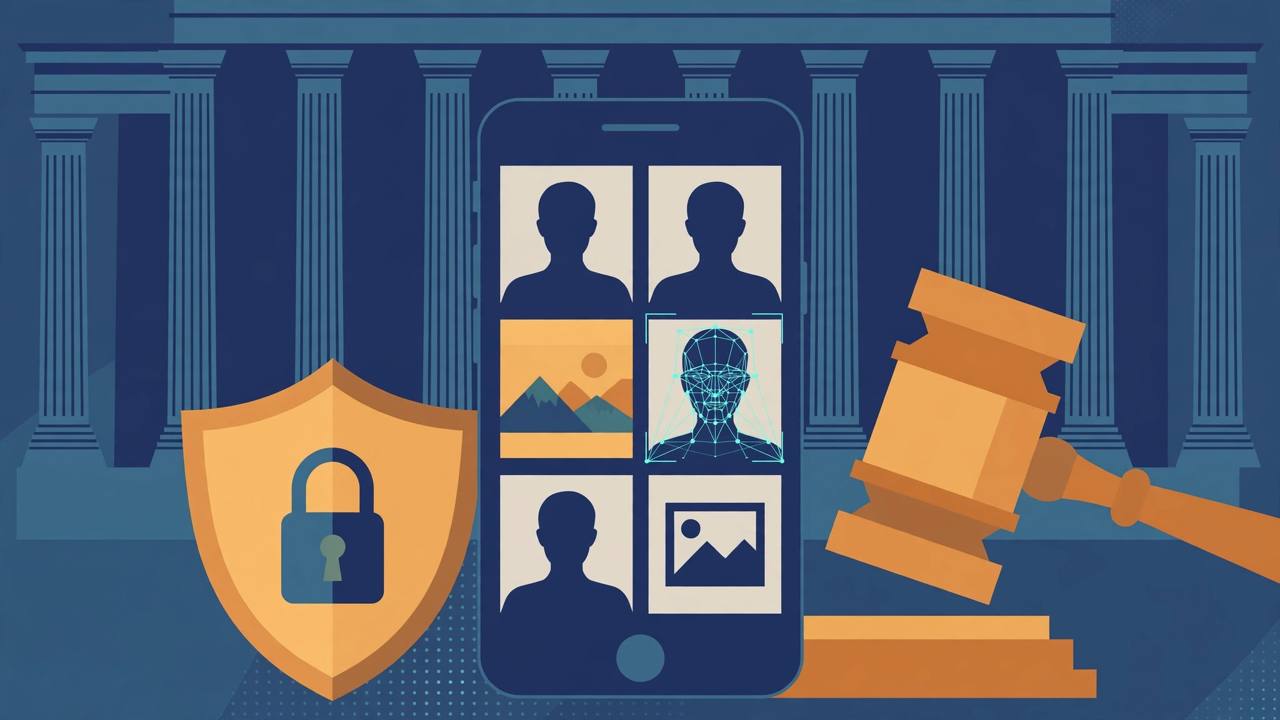
A federal judge in Chicago has let hundreds of thousands of Illinois Amazon Photos users sue together
A federal judge in Chicago has ruled that a lawsuit accusing Amazon of collecting face data from Illinois users of its Amazon Photos service without the notice and written consent required by state law can proceed as a class action — a decision that lets the claims of potentially hundreds of thousands of people move forward together instead of one user at a time.
Source: GlobeNewswire / Wexler Boley & Elgersma LLP
U.S. District Judge John J. Tharp Jr. granted class certification on Tuesday, November 10, 2026, in the case Hogan v. Amazon.com, Inc., case number 1:21-cv-3169 in the U.S. District Court for the Northern District of Illinois. Legal news service Law360, which independently reported the order the same night, noted that the judge certified the class of Amazon Photos account holders but rejected a proposed second class of people who were pictured in other users' photographs without having accounts of their own.
Source: Law360
What Amazon is accused of doing
The lawsuit alleges — and Amazon has not been found liable for — a violation of Illinois' Biometric Information Privacy Act, known as BIPA. According to the complaint, Amazon Photos used facial-recognition technology to analyse photographs uploaded to users' accounts, generate numerical representations of a person's facial characteristics, called face embeddings, and group photographs that depict the same individual. The plaintiffs allege Amazon acquired that biometric data without first informing people in writing that it was being collected, and without providing the notices BIPA requires about the specific purpose of the collection and how long the data would be stored.
In his order, Judge Tharp found that Illinois users could switch on Amazon Photos' image-recognition feature without ever viewing the notices BIPA requires. The court also highlighted that Amazon's Terms of Use did not expressly identify the information being collected as biometric data, and never used the terms “biometric identifier,” “biometric information” or “facial recognition” — words at the heart of the state law.
“Amazon insists that ‘informed consent’ is an individualized issue, but this is not a subjective inquiry,” Judge Tharp wrote. “BIPA is concerned with what information Amazon provided to allow for users’ informed consent.”
Why the class was certified
Amazon argued that consent questions differed from user to user and should defeat a single class action. The court rejected that argument. Judge Tharp found that several central questions in the case can be answered with evidence common to every class member — including the threshold question of whether the face data Amazon collected counts as biometric identifiers under BIPA at all. The court also found the class is sufficiently identifiable, because Amazon's own account records, together with information from potential class members, can establish who belongs to it.
The certified class covers Illinois residents whose faces appeared in at least one photograph uploaded to their own Amazon Photos account in Illinois while image recognition was enabled, during the period from October 18, 2016 through January 31, 2023. Amazon itself has identified 339,847 accounts tied to Illinois billing addresses in which image recognition had been switched on at some point. The court appointed Angela Hogan and her child as class representatives — the child is not named in the court announcement — and appointed attorneys Kenneth A. Wexler and Justin N. Boley of Wexler Boley & Elgersma LLP as co-lead counsel, joined by co-counsel from Gustafson Gluek PLLC, Stephan Zouras, LLC and Keller Rohrback L.L.P.
The law behind the case
BIPA is Illinois' biometric privacy statute, and it is the law that governs how companies operating in Illinois may collect face, fingerprint and voice data. As the court filings in this case describe it, the law requires a company to tell a person in writing that their biometric data is being collected, to explain the specific purpose and the length of time it will be kept, and to obtain informed written consent — a written release — before collection. The Hogan plaintiffs say none of that happened when Amazon Photos' image recognition was turned on. Because the case sits in Chicago's federal court and covers Illinois accounts, its outcome will be watched by every technology company that stores or scans photographs for Illinois users.
Why this matters to readers in Illinois and beyond
Amazon Photos is widely used to back up family photographs — weddings, birthdays, gurdwara and community events — including by Punjabi and South Asian families across the Chicago area and Illinois, one of the largest such communities in the Midwest. The ruling does not find that Amazon broke the law; certification decides only that the case can be heard once, for the whole class, rather than in hundreds of thousands of separate lawsuits. But it means the question of what a photo app must tell users before it scans their faces will now be answered in a single, closely watched case.
What happens next
Class members can expect a formal notice process explaining the case and their rights, and the litigation now moves toward the merits — whether Amazon's notices and consent process complied with BIPA, and whether the face embeddings at issue are covered by the law. Amazon's reported position in court was that consent was an individual question; the reports of the order carried no separate public statement from the company, and the certification ruling is not a finding of liability or an award of damages. Any damages figure would be decided later, at trial or in a settlement, and none has been determined.