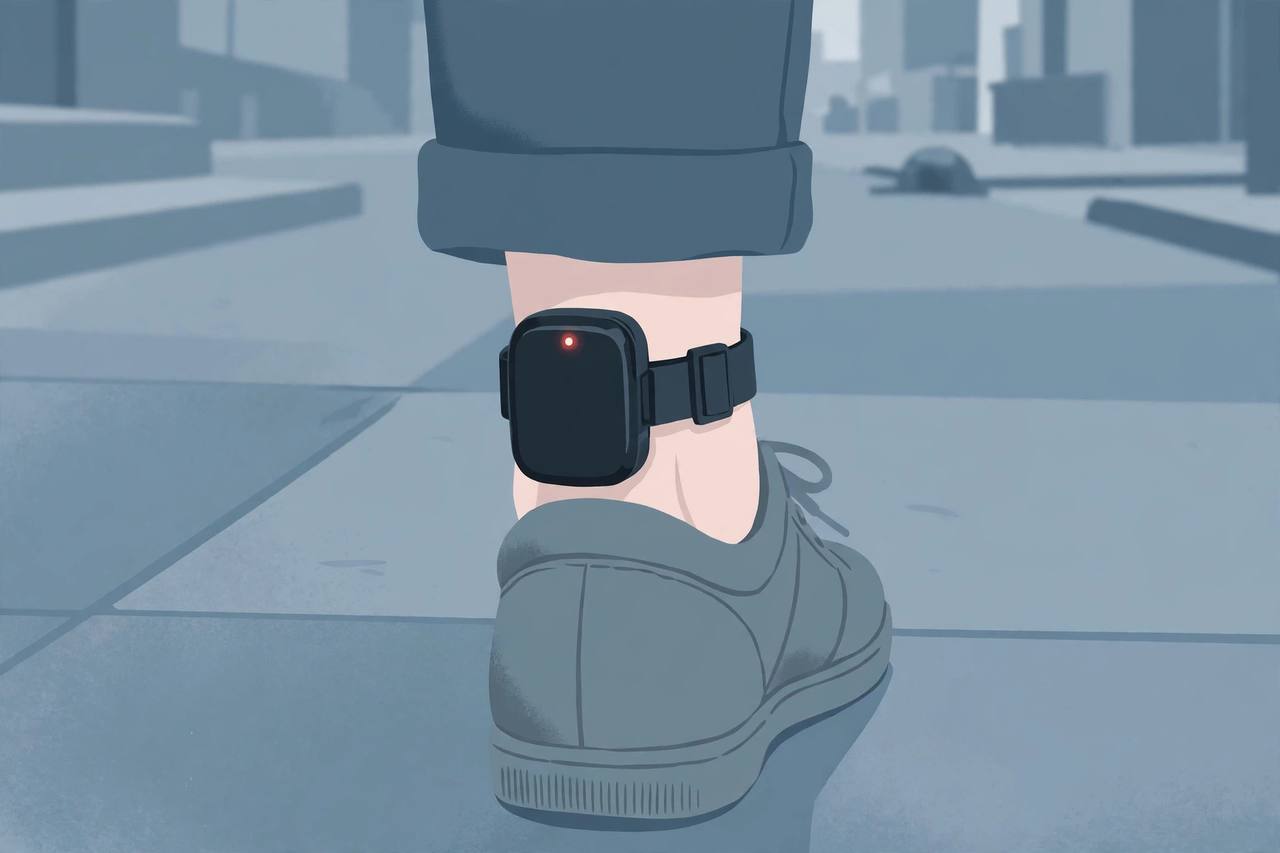
In Chicago, the GPS ankle monitor has become a constant presence in the lives of thousands of immigrants. New data analysed by WBEZ and the Chicago Sun-Times shows that ICE's Chicago field office issued nearly 3,800 ankle monitors so far this year — a jump of almost 40% since 2024 — and people are wearing them for far longer than before.
Source: Chicago Sun-Times / WBEZ
Nationwide, more than 53,000 noncitizens were fitted with ankle monitors in 2026 under the Department of Homeland Security's Alternatives to Detention programme — more than triple the number in 2024. The Chicago field office, which covers Illinois, Indiana, Wisconsin, Missouri, Kentucky and Kansas, issued 3,719 monitors between January 1 and July 11 this year, against 2,665 in all of 2024 — a rise of 39.6%.
A steady climb, then a surge
ICE's own figures, charted by the Sun-Times, show the scale of the change. The Chicago field office issued 2,031 monitors in 2019 and 2,349 in 2020, before the numbers collapsed to 985 in 2021, 264 in 2022 and 430 in 2023. They rebounded to 2,665 in 2024, rose to 3,374 in 2025, and reached 3,719 in just the first six and a half months of 2026.
People are also wearing the devices for longer. The average length in the programme stood at 244 in 2024 and 442.3 in 2025; in 2026 it has reached 610.8. The report puts the daily cost of the technology at more than $145,000 in 2026, up from roughly $25,500 a day in 2022; advocates argue the expansion is driven by cruelty and by the profits of the companies that supply the monitors.
Liz: 'Why are we being monitored?'
For Liz, a Guatemalan asylum-seeker living on Chicago's North Side, the monitor is not a statistic but a nightly ordeal. WBEZ is not using her family's full names because they fear government retaliation. Her monitor vibrates in the night, waking her in panic — ICE agents told her it vibrates if the device is broken or tampered with. She has lived in constant anxiety since she and her family were fitted, and asked agents in Spanish why they were being monitored and whether they had done something wrong.
Her husband was fitted with an ankle monitor when he first arrived in the United States in 2024. The family fled violence and street crime in Guatemala; he worked as a scrap-metal collector and she cleaned homes. At an August check-in, agents tried to fit a monitor on Liz's high-school daughter, who plays flag football. The teenager sobbed, worried she would not be able to play; the agents ultimately let her go without one. Liz says she can no longer wear a skirt or dress to church and must wear trousers, and that she is now trying to hold the family together on her own.
In late October, Liz was ordered to report for an immigration check-in. Her lawyer could not attend, so a pro bono lawyer was arranged. The appointment went well: a technical glitch had stopped her monitor sending location data to ICE, which had triggered the summons. She felt temporary relief, but the tracker — and the anxiety — remain.
The human cost is also visible in Florida, where the Sun-Times reports that Pierre Damas Bel, a 22-year-old Haitian college student, was fitted with a monitor after the Trump administration stripped Haitians of Temporary Protected Status in June. The report says he shared his distress and humiliation over the device on social media, and died by suicide in August.
The policy behind the surge
According to an advocate identified as Hodges, the upward trend began soon after an internal Trump administration directive in the spring that expanded ankle-monitor use to immigrants who have not been accused of any crime. His organisation has filed a class-action lawsuit accusing the administration of requiring noncitizens to wear an ankle or wrist monitor without a proper legal basis.
The case, M.O. v. Helland, was filed in June by the Amica Center for Immigrant Rights and the Robert F. Kennedy Human Rights Center. It challenges an internal ICE memorandum — the Helland memorandum — that directed officers to put GPS monitors on nearly everyone enrolled in Alternatives to Detention, without any individualised justification, and asks the court to vacate it. The case is pending.
Source: Robert F. Kennedy Human Rights Center
The Department of Homeland Security did not answer the Sun-Times' specific questions about the increase. The agency said people without a flight risk or criminal history are enrolled because it considers that the most effective approach. Data journalist Austin Kocher has reported that ICE has increasingly imposed GPS monitors even after federal judges ordered people released.
An alternative to detention — or another form of it?
Alternatives to Detention began more than 20 years ago as a way to track immigrants awaiting court hearings while they lived in their communities. Advocates say round-the-clock surveillance is a different form of detention, not an alternative to it. Jennifer Babaie, an associate director at the National Immigrant Justice Center, told the Sun-Times the policy is, in her words, making the act of being an immigrant a criminal state. Advocates add that for people who are complying with their immigration cases, the monitors are unnecessary and take a heavy toll on mental health.
Why this matters in Chicago — and for Punjabi families
Chicago is home to one of the largest Punjabi communities in the United States, and immigration cases touch many families here. The monitors do not only track movement: they shape what work people can take, what they can wear, and how they live day to day. A device that vibrates at night, that must be charged and kept in range, and that marks its wearer in public, follows people into their homes, workplaces and places of worship.
What happens next
The class-action lawsuit is pending, and a federal judge in Charlotte heard arguments on November 18 over whether ICE must publish the full memo behind the expansion. Until a court rules, the monitors stay on — and the numbers keep climbing. For Liz, the next check-in, the next vibration in the night, and the next decision about her family's case are all still ahead.