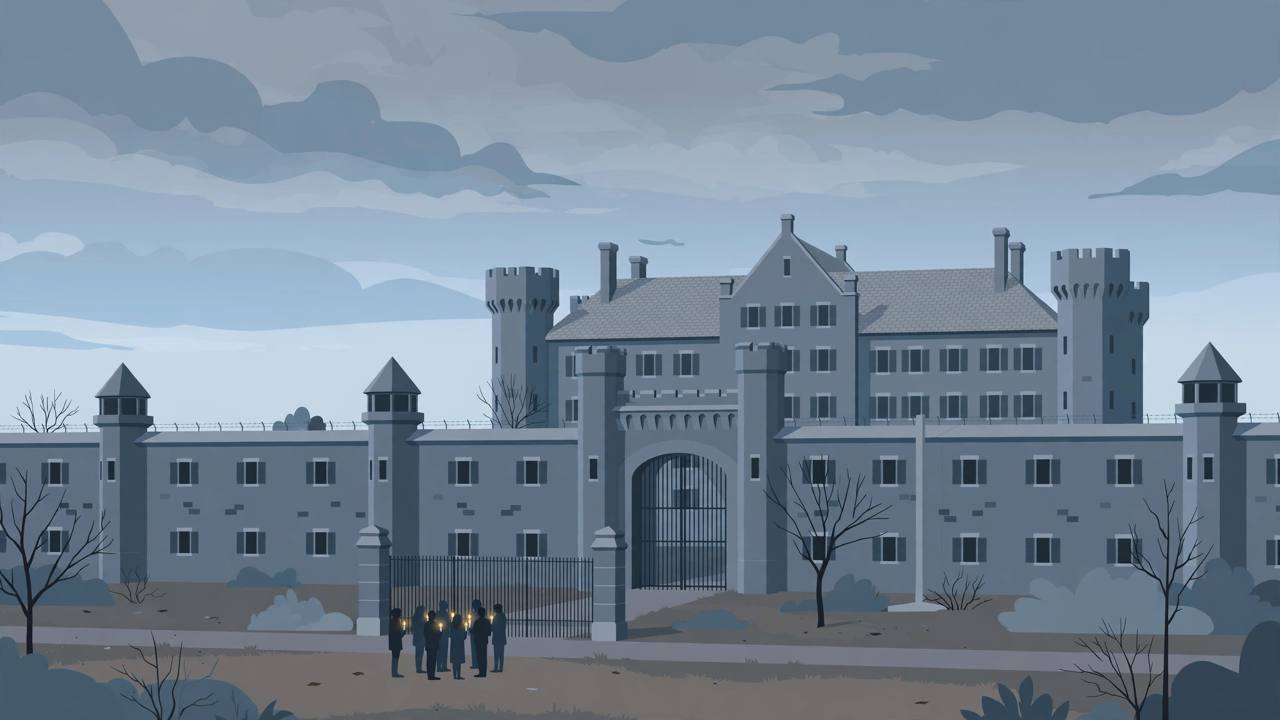
MICHIGAN CITY, Indiana — Indiana executed Jeffrey Weisheit, 50, early on Thursday, November 5, at the Indiana State Prison in Michigan City, carrying out the death sentence imposed in 2013 for the murders of two children, ages 8 and 5, in a 2010 house fire near Evansville. The Indiana Department of Correction (DOC) reported his time of death as 12:45 a.m. Central time. This is the development Awaaz Punjab's earlier reports had been building toward: Governor Mike Braun denied clemency on Monday, and the Indiana Supreme Court voted 3–2 on Wednesday to reject a final request for a stay.
Source: Indiana Capital Chronicle
Witnesses were allowed to see only three minutes of the execution. DOC said the process began shortly after midnight, but the blinds over the window into the chamber did not open until 12:34 a.m. Weisheit was already lying on the gurney, his left arm extended and restrained and a white sheet covering the lower half of his body, as his spiritual adviser, Deacon Brian Nosbusch, stood over him speaking and appearing to pray. At 12:36 a.m. Nosbusch was still speaking; at 12:37 a.m. he made the sign of the cross and Deputy Warden Dawn Buss closed the blinds. DOC placed the death eight minutes after the blinds closed. The Indiana Capital Chronicle, the only media outlet to witness the execution, reported that Weisheit did not visibly move or open his eyes during the viewing period and that it could not determine whether he was conscious, where an IV had been inserted, or when the lethal drugs were administered.
Source: Indiana Capital Chronicle
DOC said Weisheit had no final words. His final meal was barbecue ribs from Texas Corral and Mountain Dew, the Chronicle reported. The wire account carried by the Dispatch Times likewise reported the 12:45 a.m. pronouncement, the barbecue-ribs final meal and that officials said he had no final words, corroborating the official timeline.
Source: Dispatch Times
Who watched, and what they said afterward
Indiana provides no independent witness seats for the press; journalists may attend only if the condemned person selects them for one of five invited witness positions. The Chronicle gained access through Weisheit's personal witness list. The other witnesses were his parents, his sister and his defence attorney, Joe Perkovich. The group entered the prison gates by van at 10:48 p.m. Wednesday, passed security screening, waited in a visiting room from 11:06 p.m. until 12:22 a.m., and reached the witness room at 12:33 a.m. Afterward, in the prison parking lot, Perkovich said the limited view left him unable to explain what he had witnessed: “I don't know what I saw,” he said, adding, “I don't know that he was unconscious.” Weisheit's father, Bert, said: “They sure did not allow us to see very much.”
Source: Indiana Capital Chronicle
The case, and the split inside one family
Weisheit was convicted of setting the 2010 fire near Evansville that killed the two children — a girl, 8, and her brother, 5 — who had been left in his care while their mother worked an overnight shift. A jury convicted him in 2013 and he was sentenced to death. The children's parents took opposite positions in the final weeks: their mother urged officials during last month's clemency proceedings to uphold the death sentence, the Chronicle reported, while their father asked Braun to spare Weisheit, saying another death would not restore his children. In a sworn statement supporting clemency he asked: “What good does it do the memory of my children to put this man to death?” — the question the defence repeated in its statement after the execution.
The final legal path ran through three decisions in four days. On Monday, Braun rejected Weisheit's request to commute his sentence to life without parole, after the Indiana Parole Board unanimously recommended against clemency. On Wednesday, the Indiana Supreme Court voted 3–2 to deny an emergency stay while Weisheit challenged the drugs and execution procedures in Marion Superior Court. Chief Justice Loretta Rush and Justice Christopher Goff dissented; they would have granted a 10-day stay for immediate submissions on the drugs' formulation, expiration, storage and testing. The majority questioned the timing of a challenge submitted hours before the execution; the defence said it could not have filed sooner because key information about the supplier and the state's receipt of the drugs had only recently emerged.
Source: Indiana Capital Chronicle
The unanswered questions about the drugs
Weisheit's attorneys alleged — and the state disputed by defending its preparations — improper drug procurement, inadequate storage safeguards and insufficient qualifications for staff placing IV lines. A supplemental filing alleged that the pharmacy supplying the drugs contributed $5,000 to Attorney General Todd Rokita's campaign in June while on probation; that is an allegation in a court filing, not a finding. DOC confirmed on Monday that it paid $275,000 for the drugs, and an inventory log released that day recorded receipt of six 50-millilitre vials of pentobarbital on October 29. Perkovich said the defence still had not received testing results or temperature records for the newly acquired drugs, and the Chronicle's public-records requests had not produced them by early Thursday. Before the execution, DOC and the attorney general's office defended the state's preparations and declined to discuss supplier information, citing Indiana's confidentiality law.
Source: Indiana Capital Chronicle
The supplier identified in the reporting, Pharmaneek Inc., an Indianapolis pharmacy, is on probation and faces possible emergency suspension in a disciplinary case over alleged violations of restrictions on compounding; the Board of Pharmacy has not ordered a suspension. The board's November 9 agenda still listed the case under “Order to Show Cause” on Thursday morning; Weisheit's lawyers said the hearing had been postponed again, to December 14, while the board did not respond to the Chronicle's questions about the pharmacy's role or the postponement. Those proceedings continue after the execution.
Governor Braun: “Jeffrey Weisheit's case has been heard and reviewed numerous times by both state and federal courts, including the Indiana Supreme Court, since his conviction in 2013. These reviews have never resulted in an overturned sentence.” Attorney General Rokita said the execution delivered “long-awaited justice” for the two children and expressed sympathy for their family: “Nothing can ever bring their children back, and the pain of this loss will never fully leave them.”
Background: Indiana's return to executions, and a three-execution day
Indiana resumed executions in December 2024 after a 15-year pause, beginning with Joseph Corcoran; at that execution, which the same Chronicle reporter witnessed, the blinds were open for about six minutes, roughly twice Thursday's viewing window. Weisheit's was the first of three executions scheduled across the United States on Thursday — Alabama was set to execute Michael Taylor and Florida was scheduled to execute Jesse Guardado later in the day — and it would be the second time this year that three people were put to death in the US on the same day, after executions in Alabama, Tennessee and Oklahoma on August 13, the Dispatch Times reported. Outside the prison on Wednesday night, the Diocese of Gary organised a prayer vigil, and the Indiana Abolition Coalition, Death Penalty Action and other opponents remained in the parking lot through the execution.
Source: Dispatch Times
What happens next: the Alabama and Florida executions were scheduled for later Thursday. In Indiana, the Board of Pharmacy's case involving the identified supplier continues — listed for November 9, with the defence saying it has moved to December 14 — and the questions the defence raised about drug testing and storage records remain formally unanswered in the reporting. For Punjabi and other diaspora families in Indiana — including the trucking community that runs the I-65, I-70 and I-80/90 corridors through the state — this closes a case the state had carried since 2010, while leaving a live public argument about how much of an execution the public is allowed to see: on Thursday, the answer was three minutes.