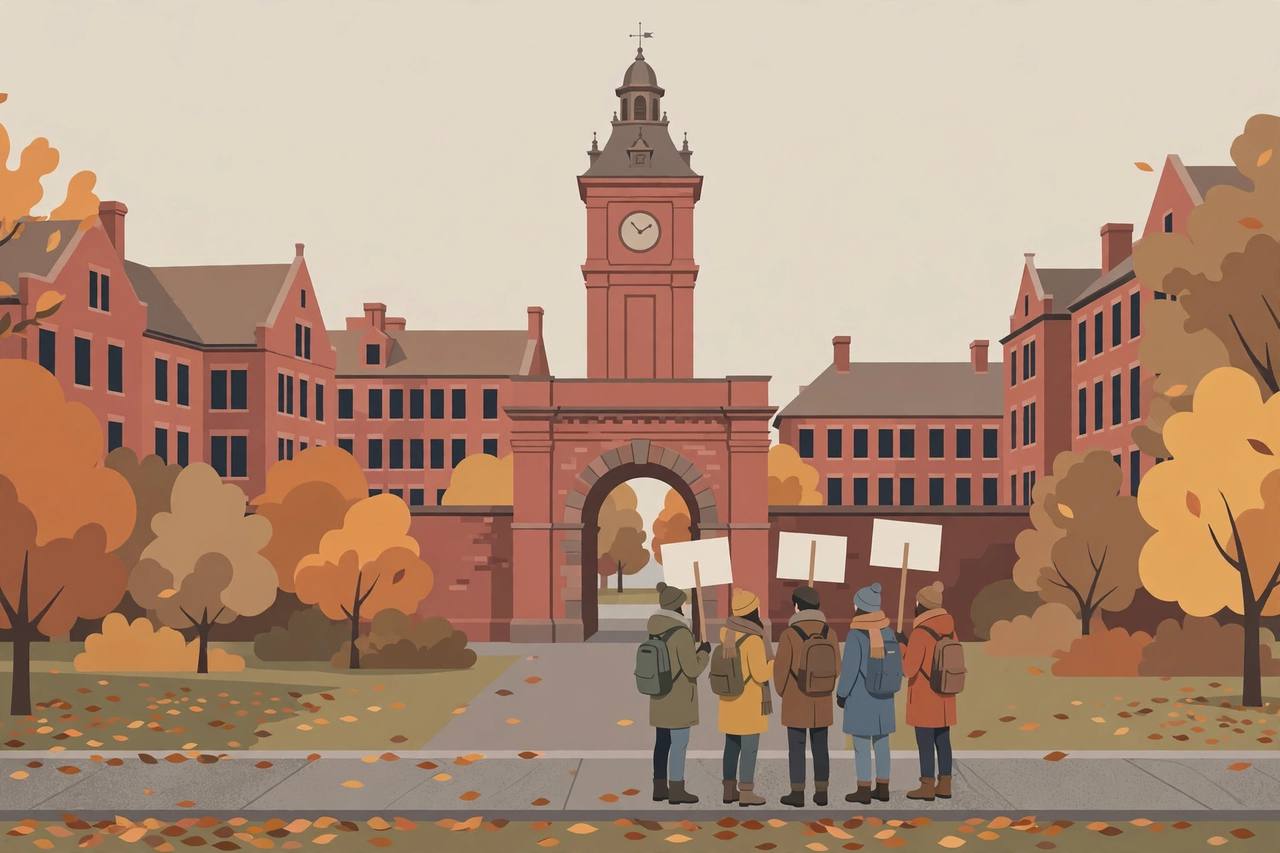
Fifty-three Democrats elected to Congress this month have told Harvard University they will skip its orientation programme for incoming lawmakers unless the university reaches a fair contract with its graduate student workers, who have been on strike since October 27.
Source: The Harvard Crimson
In a letter sent on Tuesday, November 24, the 53 members-elect wrote to Harvard President Alan M. Garber, Provost John F. Manning and Jacob Watts, the Institute of Politics' director of programs and events, that they would not cross the Harvard Graduate Students Union-United Auto Workers (HGSU-UAW) picket line to attend the Bipartisan Program for Newly Elected Members of Congress, scheduled for December 6 to 8.
What the letter says
“While we appreciate the invitation to Harvard's Institute of Politics, we will not cross a picket line,” the members-elect wrote. “So long as these workers are on strike, any trip we take to Harvard would be to stand in solidarity with our striking union siblings.”
The letter urges Harvard's administrators to “bargain in good faith and reach a fair contract” before the programme begins, and says the signatories would reconsider attending if a deal is reached. “We look forward to reconsidering our attendance once that has happened,” they wrote.
The letter was led by Representative-elect Sam Forstag of Montana and Representative-elect Claire Valdez of New York, and was posted to social media by Forstag. Among the other signatories are Frederick Haynes III of Texas, Dan Koh of Massachusetts, Hilda Solis of California, Marni von Wilpert of California, Cait Conley of New York and Chris Rabb of Pennsylvania. “I've never crossed a picket line, and I don't intend to start,” Forstag said.
A strike now in its fifth week
HGSU-UAW, which represents more than 4,000 graduate and undergraduate student workers, has been on strike since October 27. The union's three main demands are higher wages and benefits, protections for noncitizen workers, and an independent process for handling harassment and discrimination complaints. It has been bargaining with the university since March 2025.
The talks have grown tense in recent weeks. A bargaining session on November 5 ended abruptly when a university negotiator walked out, and Harvard then proposed bringing in a mediator, pressing the union again in a November 10 letter in which its managing director of labor and employee relations, Paul R. Curran, noted that mediation had been used to negotiate the union's last two contracts.
The two sides met a federal mediator for the first time on Friday, days after members of Harvard Academic Workers-UAW voted to end their weeklong strike when the university doubled its proposed raise to 7 percent. HGSU-UAW is now the only union on strike at Harvard. The parties met the mediator again on Tuesday, and are scheduled to meet again on December 1 and December 3, ahead of the programme.
The money gap
In a bargaining update reflecting both sides' positions as of November 17, the union said Harvard was still offering a 6.1 percent raise on ratification and 3 percent annual raises after that — the same offer as in its October 22 proposal, which the university says amounts to a nearly 16 percent compounded increase for doctoral teaching fellows and research assistants. The union was seeking an initial raise of 9.8 percent and annual raises of 4.5 percent thereafter.
Harvard's response
Harvard Kennedy School spokesperson Daniel B. Harsha said the programme helps incoming lawmakers move from campaigning to governing and build relationships with their colleagues. “Our invitation was extended to all newly elected Members, and we understand and respect that the decision to attend lies with each of them,” Harsha wrote, adding that Harvard “remains committed to good-faith engagement” with the union.
HGSU-UAW President Denish K. Jaswal tied the boycott to Harvard's efforts to secure federal funding. “If Harvard is going to be asking newly elected members of Congress for funding, Harvard shouldn't be surprised when those same members demand that Harvard treats its workers with dignity,” Jaswal said in a press release.
Not the first refusal to cross the line
The letter is the latest in a series of refusals by prominent figures to cross the union's picket line. Earlier this month, author John Green moved a campus event to Zoom at the union's request, and Boston Mayor Michelle Wu withdrew as Harvard Law School's Class Day speaker during the union's 40-day strike in the spring. Senators Elizabeth Warren and Ed Markey, incoming House Majority Leader Katherine Clark and Representative Ayanna Pressley have also issued a joint statement in support of the striking workers.
A programme running since 1972
The Institute of Politics has hosted the orientation for newly elected members of Congress every two years since 1972, and more than 800 members of Congress have attended over the decades. It has been cancelled only once, in 1994, when the Kennedy School called off the session after most newly elected Republicans attended a Heritage Foundation-sponsored orientation in Baltimore instead.
The union's demand for protections for noncitizen workers has taken on added weight in recent days, after a PhD student from Princeton was detained by immigration officers while returning from a conference, according to the union — a reminder of why the issue matters to international graduate workers, including the many students from India and Punjab who study and teach at American universities.
Mediation sessions are scheduled for December 1 and December 3. If Harvard and the union reach a contract before the orientation begins on December 6, the 53 members-elect say they will reconsider attending. If not, the programme will open with more than four dozen of its invited lawmakers absent — and the strike will be in its sixth week.
For now, the standoff leaves Harvard facing a choice it has resisted for more than a year of bargaining: settle with the graduate workers who teach and support its courses, or host its flagship welcome for the new Congress without them.