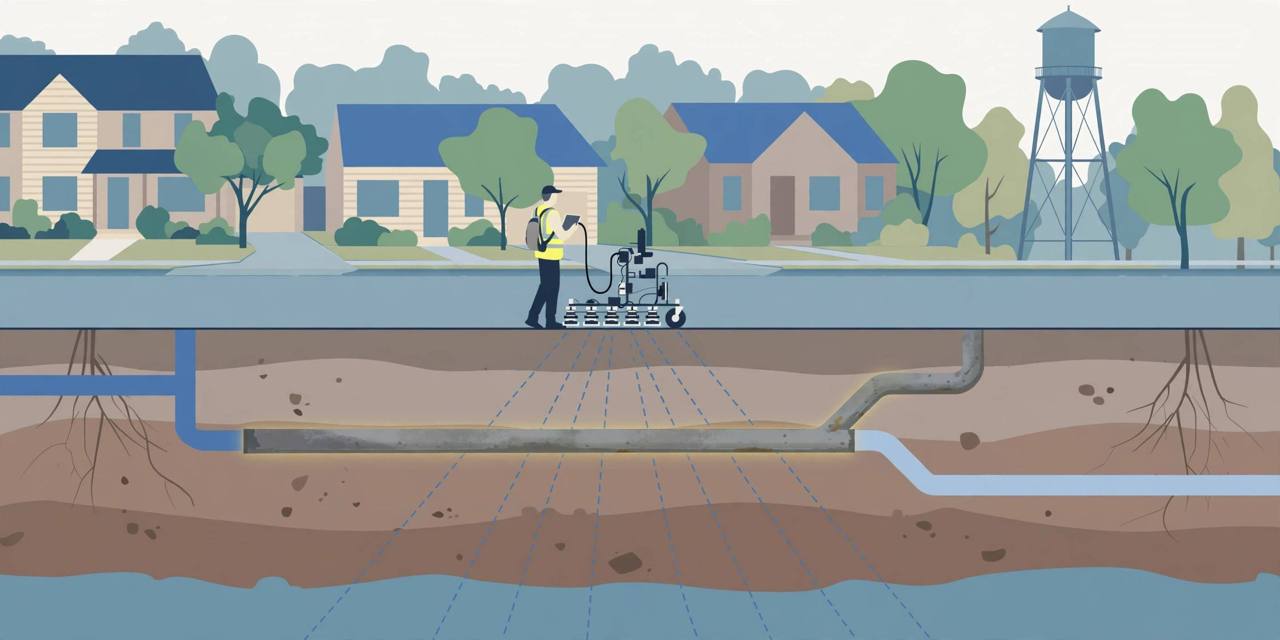
The U.S. Environmental Protection Agency will demonstrate two new minimally invasive technologies for finding buried lead water pipes next week in Edison, New Jersey — the Middlesex County township at the heart of one of the largest South Asian communities in the United States — as water systems across the country race against legal deadlines to find and replace millions of lead service lines, the agency announced on Wednesday, November 4, 2026.
Source: EPA announcement reported by NJTODAY.NEWS, Nov. 4, 2026
The event takes place on Tuesday, November 10, at the EPA Edison Environmental Center on Woodbridge Avenue, the agency said. The centre hosts what the EPA calls a test bed for lead pipe identification research — a facility built to advance technology meant to help communities find lead pipes and address lead in drinking water faster and at lower cost. Lead service lines are the pipes that connect individual homes to the water main in the street, and they are a major source of lead in tap water. Identifying where they are buried has been a costly and time-consuming first step for utilities that are legally required to replace them.
Who will be there, and what will be shown
Scheduled speakers include Teresa Booeshaghi, associate administrator of the EPA's Office of Applied Science and Environmental Solutions, and Michael Martucci, the EPA's Region 2 administrator — the region that covers New Jersey. Two academic researchers whose work is being tested at Edison will also take part: Fridon Shubitidze, director of the ElectroMagnetic Sensing Group at Dartmouth, and Ivan Bartoli, head of the civil engineering program at Drexel University. The programme includes live demonstrations of the detection technologies, a discussion of strategies for dealing with lead in drinking water, and a question-and-answer session with EPA leaders and researchers, the agency said. The demonstration begins at 10:30 a.m., with a press portion at 11:15 a.m. The Edison centre is a secure federal facility, and the EPA said credentialed reporters must RSVP in advance to attend.
Finding pipes without digging up the street
The technology on show is designed to solve the oldest problem in lead-pipe replacement: nobody knows exactly where all the pipes are. Historical installation records are often missing or inaccurate, especially in older neighbourhoods, the EPA says, so digging test pits to check pipe material street by street is slow and expensive. At the Edison test bed, EPA researchers evaluate emerging identification technologies, including minimally invasive approaches such as metal detectors, according to the agency's research pages. Dartmouth's Electromagnetic Sensing Group has already completed a first phase of testing at Edison: in March, the group deployed two versions of its 'Ultralight Electromagnetic Array' at the test bed for a week of trials, under a multi-year project funded by a $1.8 million award through the Environmental Security Technology Certification Program (ESTCP), Dartmouth Engineering reported. The work is supported by personnel from the U.S. Army Cold Regions Research and Engineering Laboratory.
'We plan to demonstrate and validate what is, to our knowledge, the only technology capable of identifying buried pipe materials — lead, copper, and galvanized — without excavation,' Shubitidze said, in Dartmouth's account of the project. 'This technology can rapidly and cost-effectively map entire water service lines, accelerate lead pipe replacement, reduce drinking water contamination, and ultimately put fewer lives at risk.' Group member Caylin Hartshorn said the electromagnetic systems replace reliance on historical records and physical inspections, and improve the ability to locate buried utilities accurately, 'reducing the costly and dangerous risks of accidental strikes.' PhD candidate Max Orman-Kollmar added: 'This project has the opportunity to remove literally millions of lead water lines still in use across the country.'
The deadlines driving the work
The demonstration sits inside a national replacement drive with hard dates. The lead contamination disaster in Flint, Michigan, prompted new requirements for lead service line inventories and replacement plans, and in 2024 the EPA's Lead and Copper Rule Improvements required drinking water systems nationwide to identify and replace lead pipes within 10 years — the EPA's research programme states that public water systems must replace nearly all lead service lines by 2034. New Jersey's own law runs faster: state mandates require public community water utilities to inventory and replace lead service lines by 2031, according to the New Jersey Department of Environmental Protection's project descriptions. EPA researchers in the Office of Research and Development received funding under the Bipartisan Infrastructure Law to develop identification strategies and provide technical assistance to communities, and the results are being used to build best practices and tools that water systems can use to cut costs, the agency says.
Why it matters in Edison and for local families
Lead at any level can cause health concerns, especially for children, the EPA warns. For a township like Edison — where many Punjabi and South Asian families own older homes in neighbourhoods built decades ago, and where neighbouring Iselin and the Oak Tree Road corridor form a commercial and residential hub for the diaspora — the practical question is the same one facing utilities: is the pipe running into the house lead, copper or galvanized steel, and who pays to replace it if it is lead? Technologies that can answer that question from the surface, without excavation, could lower the cost of the inventories every New Jersey utility must complete ahead of the 2031 state deadline, and help towns prioritise the oldest streets first. Homeowners do not need to wait for a scanner: New Jersey water providers are required to tell customers the material of their service lines, and utilities such as New Jersey American Water publish interactive maps showing the recorded material for each property in their service areas.
The demonstration runs on Tuesday, November 10, 2026, at the EPA Edison Environmental Center on Woodbridge Avenue, starting at 10:30 a.m. (press portion 11:15 a.m.; credentialed media must RSVP in advance). What to watch: whether the EPA and the Dartmouth and Drexel teams publish accuracy results from the test bed that utilities can use in their state-required inventories — the step that decides which New Jersey streets get dug up first before the 2031 replacement deadline.
Sources: U.S. Environmental Protection Agency announcement of the November 10 demonstration, reported by NJTODAY.NEWS on November 4, 2026 (speakers, times, venue, RSVP rule); EPA Office of Research and Development, 'Lead Service Line Technical Assistance in Support of the Bipartisan Infrastructure Law' (Edison test bed, 2034 federal deadline, health warning, Bipartisan Infrastructure Law funding); Dartmouth Engineering, 'New Dartmouth Engineering Technology Aims to Help EPA Eliminate Lead Water Pipes' ($1.8 million ESTCP award, March phase-one testing at Edison, 6.1–10.2 million lead lines, researcher quotes); New Jersey Department of Environmental Protection project description via HigherGov (state inventory-and-replace mandate by 2031).