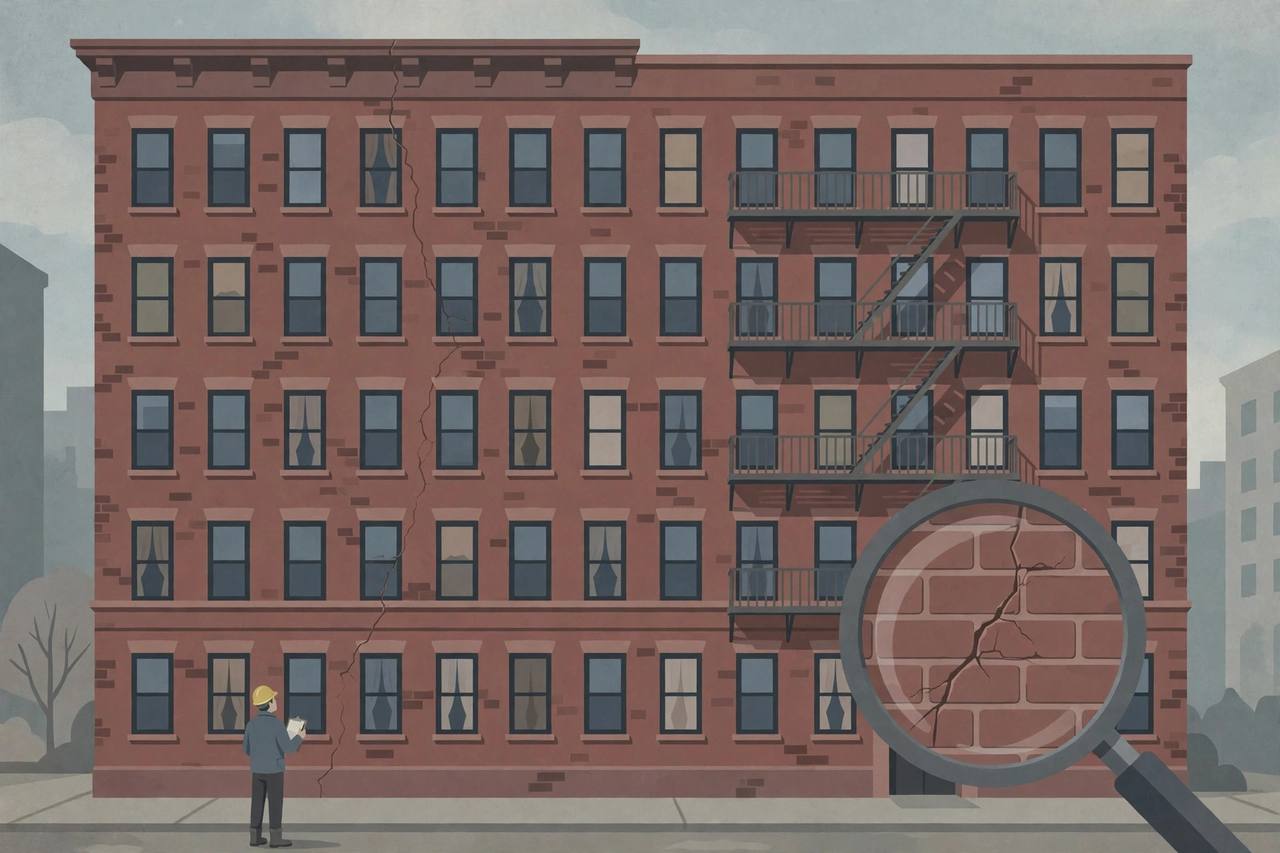
New York City building inspectors overlooked large cracks spreading across the brick facade of a Brooklyn tenement for more than a decade — and never fined the owner, issued a warning, or even recorded the building's deteriorating condition — before the building collapsed on November 11, killing eight people, the New York Post has reported.
The three-storey building at 1321 Flatbush Avenue fell into a neighbouring construction site on November 11. Read our earlier report on the collapse. Read the earlier report
What the investigation found
The Post's investigation, published on November 21, reviewed Google Earth images that show damage on the brick facade of 1321 Flatbush Avenue as early as 2011. The cracking grew more extensive in the years that followed. Yet there is no public record of the city's Department of Buildings (DOB) issuing fines or warnings over the structural condition — or even documenting the facade's decline.
The one time inspectors did act, the target was not the wall. After a site visit in May 2019, the DOB issued 13 summonses to the building's owner, Olufemi Falade — not for the crumbling brickwork, but for an illegally displayed advertising sign reading “This Could Be Your Advertisement” on the same north side of the building that later collapsed. Nine of those 13 summonses remain unpaid, leaving Falade owing $170,000 in fines, according to city records cited by the Post.
Warnings on paper before the collapse
The danger was also documented by private engineers in the year before the collapse. A geotechnical report prepared in November 2025 for work at the neighbouring lot, 2625 Bedford Avenue, warned that cracks found on nearby structures — including 1321 Flatbush Avenue — should be monitored with gauges during pre-construction surveys to see whether they were widening. A pre-construction survey filed with the Department of Buildings on March 5, 2026, described visible cracks in the collapsed building's exterior, and a plan by the engineering firm Quiver League described the facade facing the construction site as being in poor condition, with noticeable cracks. Records obtained by FOX 5 New York show the building was rated in poor condition months before the collapse.
The neighbouring construction site had its own enforcement history. In March, the Department of Buildings issued a stop-work order after inspectors found demolition under way without adequate overhead protection for neighbouring properties. The development team went ahead anyway: the one-storey building on the lot was torn down, the demolition contractor was fined $10,000 in April, and the city lifted the stop-work order in May. The building next door collapsed six months later.
The official response
No official cause for the collapse has been announced. The Department of Buildings is investigating alongside the city's Department of Investigation and the Brooklyn District Attorney's office, and Attorney General Letitia James confirmed on November 13 that the Brooklyn District Attorney has opened a criminal investigation. Mayor Zohran Mamdani said he was “incredibly troubled” by reports that the building had been listed in poor condition months before the deaths. Councilwoman Joann Ariola, a Republican from Queens, called the record a disgrace, saying inspectors had “neglected” the building's obvious structural decay for years. “The DOB saw these fractures years earlier and [did] not do anything about it, yet City Hall keeps telling us to rely on the agencies and accept less oversight,” she said.
The city has ordered the demolition of the adjoining building at 1323 Flatbush Avenue, which was left in a dangerous condition, and is now inspecting 160 construction sites connected to the companies behind the Bedford Avenue project. City officials have acknowledged that more building inspectors are needed. A resident has also filed a lawsuit alleging he warned his landlord about visible cracks near the building's entrance weeks before the disaster; those allegations have not been established in court.
The joint investigation by the Department of Buildings, the Department of Investigation and the Brooklyn District Attorney remains open, and the criminal investigation confirmed by the Attorney General is continuing. The city has not said when its findings will be released. For the families of the eight people who died, and for residents of the surrounding buildings, the central question is whether the warning signs that were on the public record were treated as a warning — or as routine.
The building, constructed in the 1930s, held apartments above a ground-floor shop, and the collapse left residents searching for housing and belongings in the hours that followed. Community organisations in Flatbush, including the Flatbush Development Corporation and the Flatbush Tenant Coalition, have stepped in to raise money and collect supplies for those displaced. The disaster has also sharpened a wider debate in New York about whether the city's building-inspection system, stretched thin by the volume of development work, is catching the warning signs in its oldest housing stock before they turn fatal.