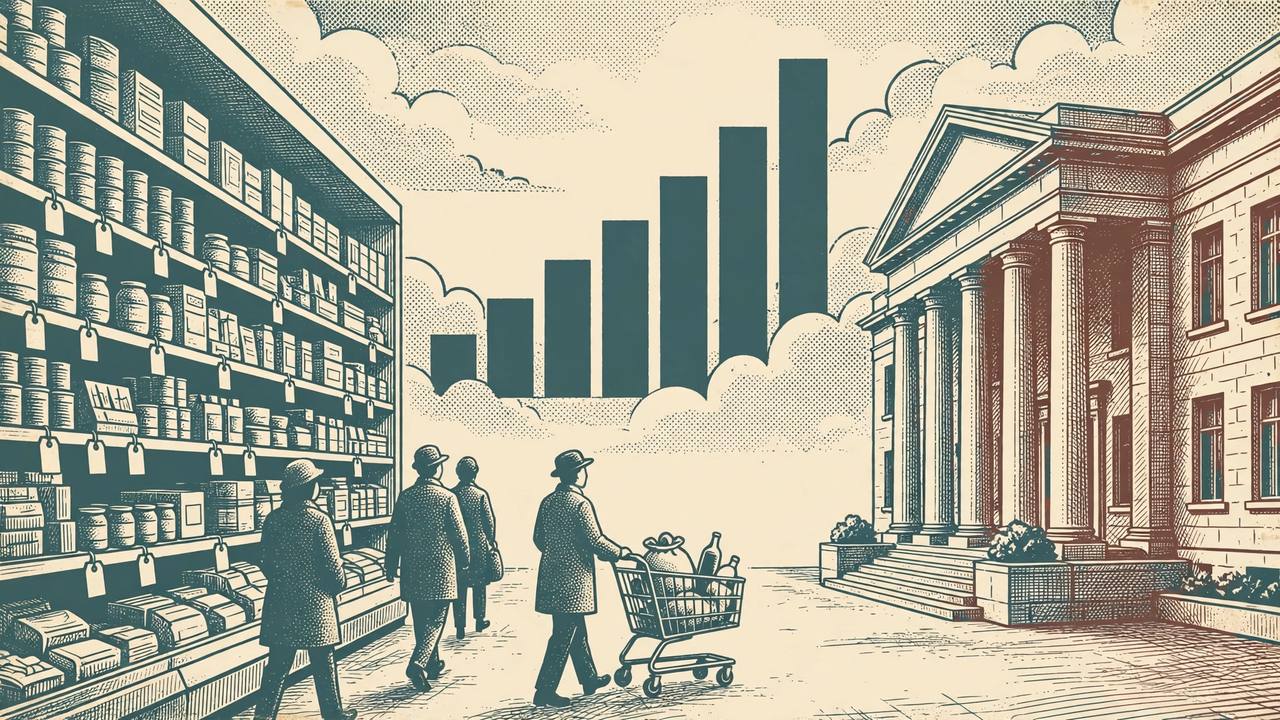
The Bureau of Labor Statistics releases the October Consumer Price Index at 8:30 a.m. Eastern on Tuesday, November 10 — the last inflation reading before the Federal Reserve's final meeting of the year on December 8-9, and a report with an unusual hole in it: for the first time, it will carry no year-over-year inflation rate, because the federal government shutdown of October 1 to November 12, 2025 stopped the BLS from collecting any price data last October, so there is no October 2025 index to compare against.
Source: Political.org, Nov. 9, 2026
Economists surveyed expect a reprieve after a hot September: headline prices are forecast to have risen 0.3 percent in October and core prices — excluding food and energy — 0.2 percent, down from September's increases of 0.6 percent headline and 0.3 percent core. September's annual rate was 3.7 percent, with core prices up 2.6 percent over the year, according to the BLS figures released on October 14. Whether October's expected slowdown is the start of a calmer run or a single blip is the central question for policymakers, because the Fed targets 2 percent inflation and its preferred gauge, the Personal Consumption Expenditures price index, is a separate release.
Source: The Bull Post (NYT-style live briefing), updated Nov. 10, 2026, 5:45 a.m. ET
What economists expect, and where prices stood
A jobs report that strengthened the case for a hike
Tuesday's report lands four days after an October jobs report that beat forecasts by a wide margin. Employers added 165,000 jobs in October against expectations of roughly 65,000, the unemployment rate edged down to 4.1 percent from 4.2 percent, and revisions added another 84,000 jobs to the previous two months, taking the three-month average to about 137,000. Private employers added 159,000 jobs while government employment edged up 6,000 after falling 18,000 in September. Average hourly earnings rose 0.4 percent in the month and 3.1 percent from a year earlier — wage growth the Fed watches closely.
Source: FXStreet analysis of BLS data, Nov. 9, 2026
The same report carried softer details underneath the headline. The number of people working part-time for economic reasons rose by 339,000 to 4.8 million, the broader U-6 underemployment rate climbed to 7.9 percent from 7.6 percent, and the average duration of unemployment reached 27 weeks, the highest since the end of 2021. The unemployment rate for recent college graduates stood at about 5.2 percent in the third quarter. And a separate BLS release offered the Fed a counterweight: nonfarm business productivity rose at a 3.6 percent annualised rate in the third quarter as output grew 3.7 percent on only a 0.1 percent rise in hours, so unit labour costs fell 0.7 percent — the economy produced more without a matching rise in labour cost per unit.
Source: FXStreet analysis of BLS data, Nov. 9, 2026
Where the Fed stands
The Federal Reserve raised its target range to 3.75-4.00 percent on September 16 — its first increase since 2023 — and held it there on October 28 by a 10-2 vote, with two policymakers dissenting in favour of a hike. Fed Chair Kevin Warsh, who took the post on May 22, 2026, has not committed to a December move and says decisions will depend on incoming data. Price pressures in the Institute for Supply Management surveys remain elevated: the ISM manufacturing index climbed to 55.5 in October and services held at 54.5, but their prices-paid readings were 75.2 and 73.0 — levels that signal firms are still passing on sharply higher costs.
Source: FXCM Markets briefing, Nov. 9, 2026
Markets have moved toward expecting another increase. The market-implied probability of a quarter-point hike at the December 8-9 meeting rose from roughly two-thirds before the jobs report to about 75-80 percent after it — CME Group's FedWatch tool put it near 77-79 percent. The two-year Treasury yield rose to about 4.51-4.52 percent and the ten-year to about 4.86 percent on Friday, while the U.S. Dollar Index gained around 0.7 percent to 102.2. Bloomberg Economics, by contrast, still forecasts the Fed will hold steady in December — a reminder that Tuesday's number can move the decision either way.
Source: Bloomberg reporting via StockBiz, Nov. 10, 2026
The 12-month CPI change is the most-cited inflation figure in America — and it will be missing from Tuesday's report. The fall 2025 shutdown (Oct. 1-Nov. 12) halted BLS price collection for more than a month, no October 2025 index exists, and a 12-month change cannot be calculated. All attention therefore falls on the month-over-month figures.
What it means for households, borrowers and truckers
For readers of this site — including the large Punjabi diaspora working in U.S. trucking, warehousing, retail and small business — the December decision is not abstract. A further quarter-point rise would keep pressure on mortgage rates, auto and truck loans, credit-card rates and small-business borrowing into 2027, while holding rates would offer the first relief signal after September's hike. Inflation itself has been driven this year by the war with Iran and an artificial-intelligence investment boom, which have stoked price pressures across the country, and diesel and grocery prices feed directly into both household budgets and owner-operator margins.
What happens next
The BLS publishes the October figures at 8:30 a.m. ET Tuesday. Producer-price figures follow on Friday, and the Federal Reserve meets December 8-9 — before the November CPI report, which is not due until December 10, the day after the meeting ends. That timing makes Tuesday's release the single most important data point left in the Fed's 2026 decision: a print at or below the expected 0.3 percent headline and 0.2 percent core would strengthen the case for holding, while another hot month like September's 0.6 percent would make a December hike — and dearer borrowing for households and businesses — very hard for the central bank to avoid.