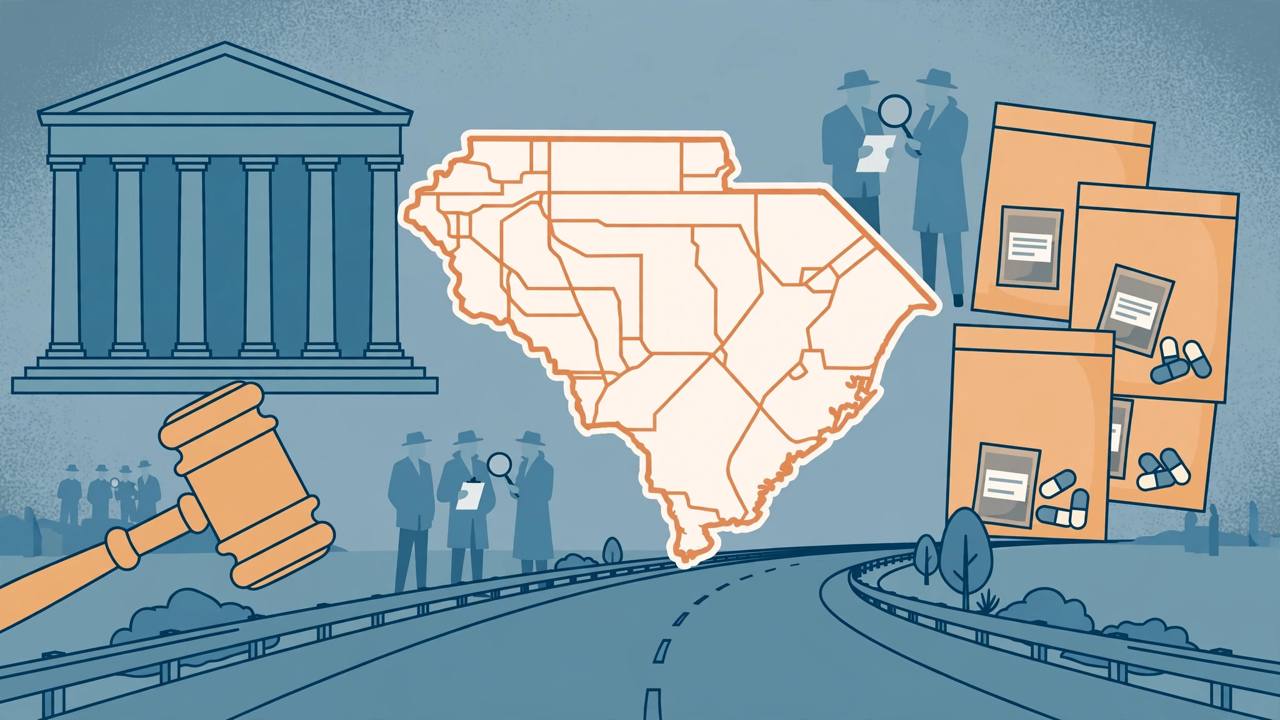
Federal prosecutors in Columbia announced on Tuesday, November 10, that 36 people have been charged in a multi-state Homeland Security Task Force investigation of a Mexico-based drug trafficking and money laundering organisation that investigators say has operated in South Carolina since at least 2011, the U.S. Department of Justice said. Nine of the 36 defendants are in the United States illegally, according to the department. All of the charges are allegations, and every defendant is presumed innocent unless proven guilty in court.
Source: Clarendon Sentinel, Nov 11, 2026
U.S. Attorney Bryan Stirling for the District of South Carolina announced the charges in Columbia and said the investigation has an impact on every region of the state. Investigators identified a large fentanyl distribution network extending across four regions of South Carolina — the Lowcountry, the Pee Dee, the Grand Strand and the Midlands — and say the organisation has been supplying the state with hundreds of kilograms of fentanyl and cocaine since at least 2021, with the narcotics transported from Mexico across the southern border.
Source: Clarendon Sentinel, Nov 11, 2026
What investigators seized
During the investigation, the Drug Enforcement Administration seized 346 kilograms of fentanyl, 70 kilograms of cocaine, 23 kilograms of methamphetamine, 34 pounds of marijuana, 43 firearms and more than $2.8 million in cash, according to the Justice Department. Agents also seized jewellery and 15 luxury vehicles, including two Rolls-Royces, a Lamborghini and an Aston Martin, and secured notice of lawsuits on 17 properties in South Carolina and Georgia with an estimated combined value of nearly $4 million.
Source: Clarendon Sentinel, Nov 11, 2026
How the charges were built, in three indictments
The 36 defendants were charged in stages, not in a single sweep. Two people were charged in an indictment in July 2025, in what prosecutors described at the time as the largest fentanyl seizure in South Carolina history; an indictment in April 2026 charged 18 members of the operation; and a 42-count superseding indictment unsealed this month, in November 2026, added 16 more defendants. Six defendants have pleaded guilty so far, prosecutors said. Arrests took place across the state, and a map presented at Tuesday's announcement listed 16 South Carolina counties as affected, including Sumter, Florence, Orangeburg and Berkeley counties.
Source: Myrtle Beach News, Nov 10-11, 2026
At the announcement, Michael Tooley, the DEA's assistant special agent in charge in South Carolina, said the organisation has direct ties to the Sinaloa Cartel. The Justice Department said members of the organisation are active in Mexico, in South Carolina and in other states, and also within the Federal Bureau of Prisons and the South Carolina Department of Corrections — an allegation that, if proven, would mean the network kept operating even from inside correctional facilities.
Source: Clarendon Sentinel, Nov 11, 2026
Who investigated, and who is prosecuting
The case was investigated by the DEA, Homeland Security Investigations, the FBI's Columbia Field Office, the South Carolina Law Enforcement Division, the South Carolina Department of Corrections, the State Transport Police and numerous local agencies, including the Florence County Sheriff's Office and the Orangeburg Department of Public Safety. It is part of the Homeland Security Task Force initiative created under Executive Order 14159, titled “Protecting the American People Against Invasion,” which the Justice Department describes as a whole-of-government partnership aimed at criminal cartels, foreign gangs and transnational criminal organisations. Assistant U.S. Attorneys Mike O'Mara and Cole Shannon are prosecuting the case.
Source: Clarendon Sentinel, Nov 11, 2026
Fentanyl is the deadliest drug in the United States, and a single seizure of 346 kilograms represents, in raw weight, an enormous supply kept off the street. For Punjabi and other South Asian families in the Southeast — including truck drivers who run the I-95, I-26 and I-20 corridors through South Carolina — cases like this one also sit at the crossing point of two live debates: drug enforcement on the highways they drive, and immigration enforcement, after the Justice Department said nine of the defendants were in the country illegally. Those nine defendants, like all the others, are charged by allegation only and are presumed innocent.
What happens next
Stirling said penalties in the case vary by defendant and charge, with some defendants facing a maximum of five or 15 years in prison and some repeat offenders facing up to life. The newly charged defendants will now face arraignments and detention hearings in federal court in South Carolina, and the six guilty pleas already entered suggest prosecutors will seek cooperation against the remaining defendants as the case moves toward trial. The Justice Department has not detailed how many of the 36 defendants remain at large, and no trial date has been announced. An indictment is only an allegation; all defendants are presumed innocent until proven guilty in court.
Source: Clarendon Sentinel, Nov 11, 2026