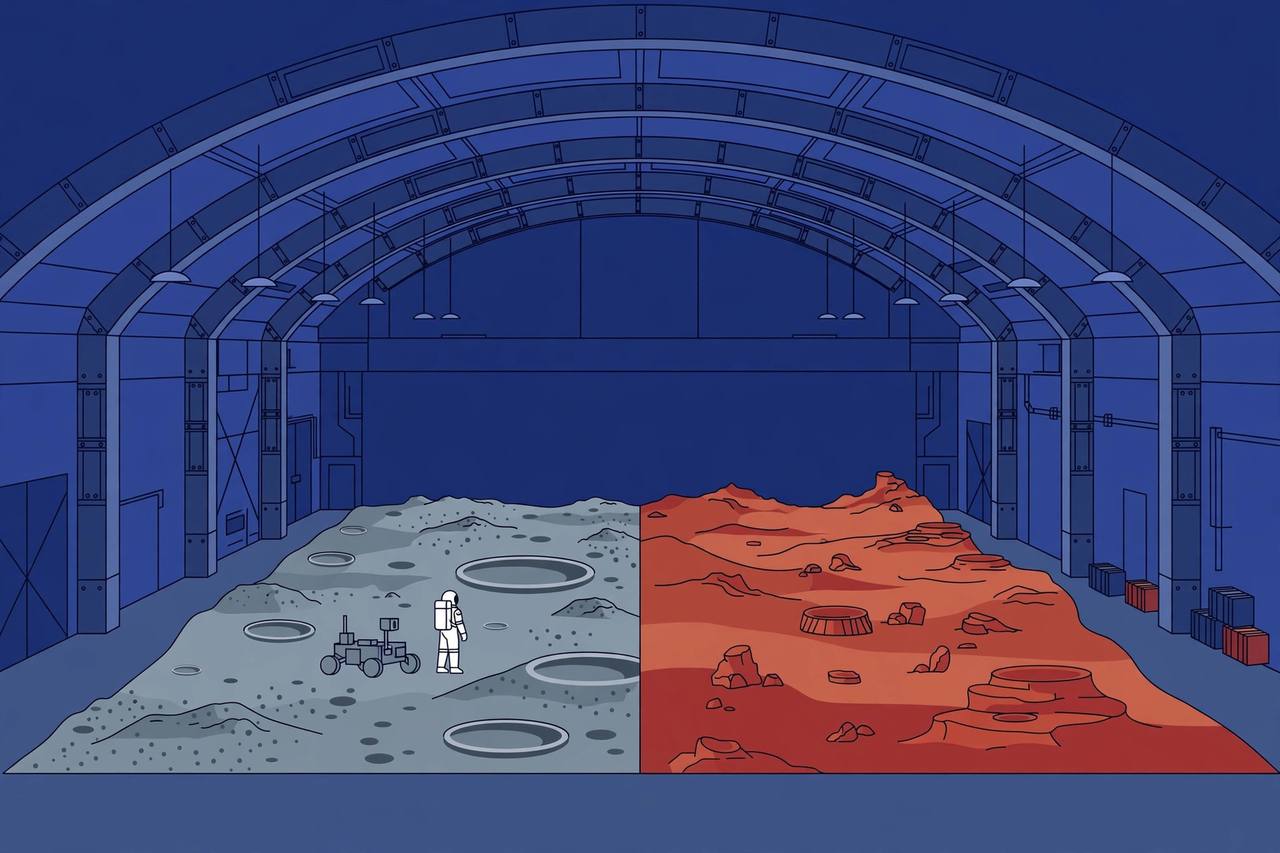
The Texas A&M University Space Institute held its grand opening on Friday, November 20, 2026, just outside the gates of NASA's Johnson Space Center in Houston — a new hub where astronauts, students and companies will test the hardware of future Moon and Mars missions without leaving Texas.
Source: Texas A&M University
The facility was built with a $200 million investment from the Texas Legislature, through the state's Texas Space Commission, which set aside $350 million for space programs in total. Construction took more than two years, and the building spans more than 400,000 square feet — about the size of two football fields.
Source: Aviation Week
The world's largest indoor Moon and Mars
The institute's centrepiece is a pair of massive simulation spaces — one recreating the surface of the Moon, the other the surface of Mars — described by the university as the world's largest indoor lunar and Martian surface simulations. Rovers, habitats, robots and spacesuits can be put through their paces on alien ground indoors, in Houston weather, at any hour.
Source: Texas A&M University
Alongside the two landscapes, the building holds high-bay laboratories, research garages and multifunctional project rooms, giving researchers, engineers and industry partners room to build and test full-size hardware side by side.
Source: Texas A&M University
NBC News' Today show visited Houston the day before the opening for an inside look at the new institute, featuring students from the Robotics and Automation Design Lab and the simulated lunar surface.
Source: Texas A&M University
Who runs it
The institute is led by Dr. Nancy Currie-Gregg, a former NASA astronaut and professor of practice in the College of Engineering, who was named director in 2023. The associate director is Dr. Rob Ambrose, an expert in space robotics and holder of the J. Mike Walker '66 Chair in Mechanical Engineering.
Source: Texas A&M University
"The opening of the Texas A&M University Space Institute demonstrates how we can pursue cutting-edge frontiers like human space exploration and national defense while remaining rooted in our commitment to public service," said Dr. Robert Bishop, vice chancellor and dean of Texas A&M Engineering.
Source: Texas A&M University
First building in Exploration Park
The institute is the first building in NASA's new Exploration Park, a 240-acre commercial property next door to the Johnson Space Center in Houston. The park is designed to bring the public and private sectors together in one location for collaborative space research.
Source: Texas A&M University
The university says the institute will support a new space engineering degree program and expanding opportunities in space engineering and space medicine, training the workforce for a growing space economy — from mission-ready testing for NASA and defence partners to startups building space hardware in Texas.
Source: Texas A&M University
Why it matters for Houston and Texas
Houston has been the home of human spaceflight for more than six decades, and the new institute anchors that role in the next era: the Moon and Mars landscapes let Texas teams rehearse landings and surface operations on home ground, while the Exploration Park is meant to pull more commercial space companies — and their jobs — into the Houston area.
Source: Aviation Week
With the doors now open, the institute moves into its research phase: testing exploration technologies on the simulated Moon and Mars surfaces, running its new space engineering degree program, and hosting industry and government partners in the first building of NASA's Exploration Park.