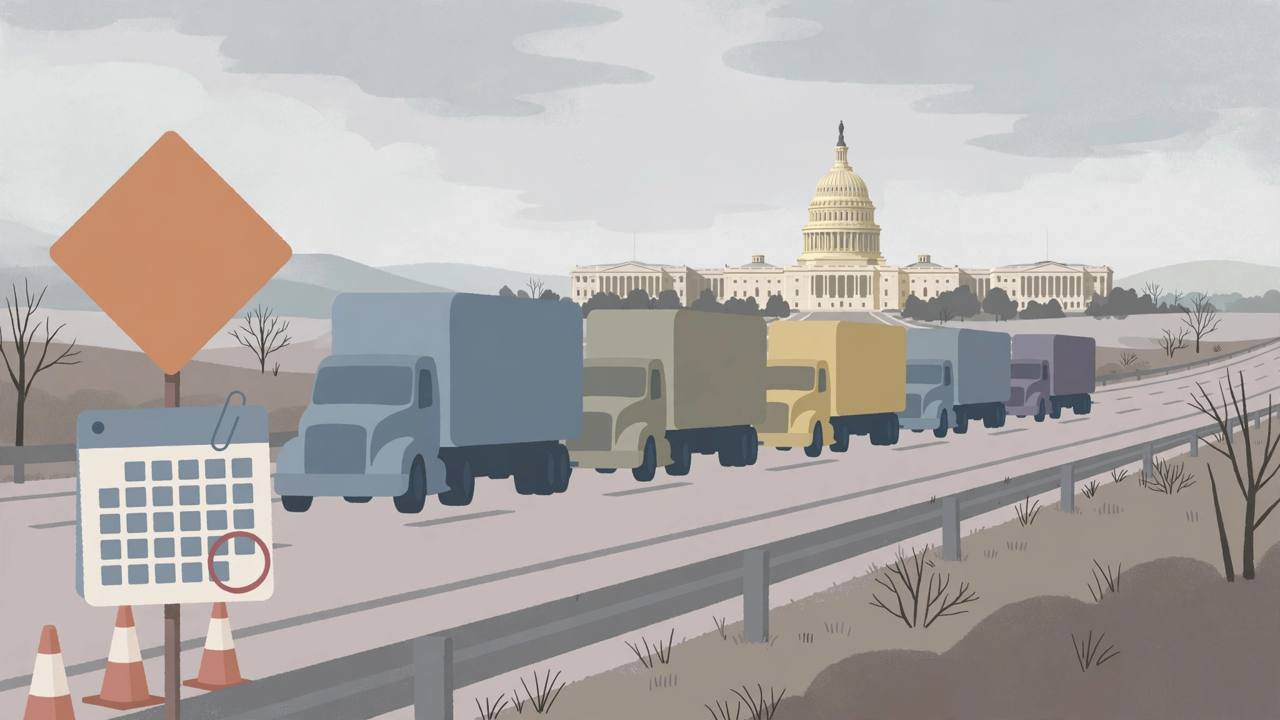
America's midterm results have redrawn the map that decides trucking policy in Washington. Democrats have taken both chambers of Congress, and with that flip, the two committees that write highway law, fund the Federal Motor Carrier Safety Administration (FMCSA) and oversee commercial driver's licence (CDL) rules will both be chaired by Washington-state Democrats in the new Congress — while the current highway law itself runs out on December 11, weeks before they take their gavels, FreightWaves and Overdrive reported.
Source: FreightWaves — 'Transportation committee in House set for overhaul post-election' (Nov. 5, 2026)
This is an analysis of what changes, drawn from the trucking trade press — FreightWaves, Overdrive and Transport Topics — in the days after Tuesday's vote. No bill has passed and no rule has changed yet. What has changed is who will hold the pen in 2027, and the industry's own leaders are already telling carriers and drivers what to expect: a likely clean extension of highway funding into next year, a rewritten highway bill, a fresh push on insurance minimums and safety mandates, and a very different congressional conversation about non-domiciled CDLs and English-language rules.
The new chairmen: Larsen and Cantwell
In the House, Transportation and Infrastructure (T&I) Committee Chairman Sam Graves of Missouri, a Republican, is retiring. Under Democratic control, the gavel passes to Rick Larsen of Washington, the committee's current ranking member, FreightWaves reported. Larsen has repeatedly signalled that safety mandates and crash reduction will anchor any Democratic transportation bill, Overdrive noted.
Source: FreightWaves — 'Transportation committee in House set for overhaul post-election' (Nov. 5, 2026)
On the Senate side, the Commerce, Science and Transportation Committee — the panel with jurisdiction over FMCSA — will see Chairman Ted Cruz of Texas replaced by its current ranking member, Maria Cantwell of Washington, FreightWaves reported. Cantwell has pushed to restore federal transportation infrastructure funding following the expiration of the Infrastructure Investment and Jobs Act, Overdrive reported.
The committees below the chairmen are changing too. Retirements are costing the House T&I Committee nine members from the two parties combined, and several Republican members were defeated, are leaving for other races, or were still in uncalled races on Wednesday, FreightWaves reported.
Source: FreightWaves — 'Transportation committee in House set for overhaul post-election' (Nov. 5, 2026)
The race trucking is watching closest: Rouzer by a whisker
The industry's immediate attention is on one uncalled seat: David Rouzer's, in North Carolina's 7th district. Rouzer, a Republican, chairs the Highways and Transit subcommittee, is described by FreightWaves as an important ally in Congress for the trucking community, and — with Graves retiring — could become the ranking Republican on the full T&I Committee if he holds his seat. At FreightWaves' publication time, his margin was slim and the Associated Press had not called the race; Transport Topics counted him leading by about 0.7 per cent, with county canvasses set for November 13 and the state canvass for November 24.
Rouzer also matters because of what he sponsored. He introduced Dalilah's Law, the CDL bill named after Dalilah Coleman, a young California girl seriously injured in 2024 in a crash involving a truck driven by a person in the United States illegally. The bill passed the T&I Committee in March but never received even a hearing in the Senate, FreightWaves reported.
Source: FreightWaves — 'Transportation committee in House set for overhaul post-election' (Nov. 5, 2026)
December 11: the highway-bill clock
The outgoing Congress returns on November 9 facing a hard date. Surface-transportation authority was extended on September 1 — by a 370–48 House vote on a Senate-passed measure — from September 30 to December 11. The five-year, $580 billion BUILD America 250 Act cleared the T&I Committee on May 22 by a 62–2 vote and has not moved since; it still lacks a House floor vote, and the Senate had not introduced a bill of its own as of the September extension. The legislation is therefore almost certain to roll over into 2027, handing drafting power to the incoming Democratic chairs.
Jim Mullen, president of the Truckload Carriers Association, told FreightWaves he expects the highway bill to be 'punted' until the incoming Congress is seated, and expects the lame-duck Congress to pass a funding extension running into June. 'I would think it'd be a pretty clean extension,' Mullen said. 'I wouldn't think there'd be any sort of policy riders.' FTR Vice President of Trucking Avery Vise made a similar judgement to Overdrive: given Tuesday's results and the narrow House margin, 'it seems unlikely that anything truly controversial would be enacted' in the lame-duck session.
Source: FreightWaves — 'Transportation committee in House set for overhaul post-election' (Nov. 5, 2026)
The American Trucking Associations, in a statement to FreightWaves, said work on the highway bill 'is an opportunity to show that divided government doesn't have to mean dysfunctional government,' but added that the current Congress still has work to finish, including bipartisan legislation to combat organised cargo theft and freight fraud.
Source: FreightWaves — 'Transportation committee in House set for overhaul post-election' (Nov. 5, 2026)
What is likely to survive — and what Democrats may rewrite
Truck parking is the industry's clearest bipartisan item. The May bill carried $750 million over five years to boost truck-parking capacity, and Mullen said the parking provisions are likely to make the cut into a new bill; Overdrive's analysts likewise expect core bipartisan priorities — truck-parking funding and a statutory framework for autonomous commercial vehicles — to survive a rewrite, though how strict the autonomous-vehicle rules are remains open. Mullen was unsure Democrats would keep the May bill's provision for a Secretary-led 'Autonomous Vehicle Accessibility Study,' citing possible labour concerns.
Source: FreightWaves — 'Transportation committee in House set for overhaul post-election' (Nov. 5, 2026)
Insurance is the expected fight. The May bill did not raise the federal minimum carrier liability cover above $750,000 — a figure unchanged for four decades — after an attempt to include a rise was stripped out. A Democratic-controlled House in 2020 passed a measure seeking $2 million, and a proposal introduced this year by Representatives Chuy García of Illinois and Derek Tran of California would lift the requirement to $5 million and index it to inflation. 'I would think it pretty likely that they would make a run at it again,' Chad Krueger of the Central Analysis Bureau told Overdrive, and Vise said carriers should 'definitely expect a push to increase insurance minimums' and possibly revived mandates such as speed limiters and trailer underride protections. The May bill's lease-purchase disclosure rules for owner-operators — requiring carriers using lease-purchase drivers to disclose compensation levels, average weekly mileage and how many drivers actually end up owning the truck — are another provision whose fate in a rewrite is unwritten.
Dalilah's Law and the non-domiciled CDL fight move to a new Congress
Dalilah's Law in its current form has no visible path under a Chairman Larsen, the trade press agrees. Committee Democrats voted against it mainly over its English-language proficiency requirements for CDL holders — Larsen said in March the provision is redundant to other regulations, and called roadside language evaluations 'inherently subjective' — and over non-domiciled CDL provisions they said would bar DACA recipients from ever driving. Democratic lawmakers have instead advocated appeal rights for sidelined drivers and preserving CDL eligibility for asylum seekers, refugees and DACA recipients. Mullen predicted Democrats are still likely to address non-domiciled drivers, 'but in a different fashion' — possibly with a provision that lets DACA holders keep credentials.
Source: FreightWaves — 'Transportation committee in House set for overhaul post-election' (Nov. 5, 2026)
The rules themselves, for now, sit with the agencies and the courts, not Congress. Regulators moved in mid-2025 when the Commercial Vehicle Safety Alliance reinstated roadside out-of-service criteria for language non-compliance, and FMCSA proposed codifying that status in August. An agency rule implemented in March restricted non-domiciled CDLs primarily to H-2A, H-2B and E-2 temporary visa holders; that restriction is under review in the U.S. Court of Appeals for the District of Columbia, where oral arguments were heard in September, and a separate challenge, Lujan v. FMCSA, questions the agency's authority to restrict the eligible visa categories at all. 'If the court were to rule against the FMCSA… that's the bigger threat to the agency's work on that particular topic, in my view, than any potential congressional unwinding,' analyst Ben Wiseman told Overdrive. Vise added that the Trump administration is likely to keep pressing on foreign drivers through enforcement and rulemaking — and that Congress cannot do much to stop that even if it wanted to.
A large share of Awaaz Punjab's US readers drive trucks for a living, many as owner-operators. Three threads in this story touch them directly: whether non-domiciled CDL eligibility and roadside English checks are rewritten in Congress or decided in court; whether carrier insurance minimums jump from $750,000 toward the $2–5 million figures Democrats have proposed, which would flow straight into owner-operator costs; and whether the $750 million truck-parking programme survives, on corridors where safe overnight parking is a daily problem. Nothing changes on the road this month — the first test is the December 11 funding deadline.
What happens next
The calendar, as the trade press lays it out: Congress returns November 9; Rouzer's county canvasses fall on November 13 and the state canvass on November 24; current highway authority expires December 11, with an extension into June the industry's working expectation; and the new Congress convenes January 3, 2027, when Larsen's first markup calendar — and whether BUILD America 250 is reintroduced as-is or rewritten — will show how much of the May bill survives. Democrats are also expected to use oversight hearings, Government Accountability Office audits and spending riders to press FMCSA leadership in ways the outgoing majority did not. Awaaz Punjab will report the extension vote and the court's non-domiciled CDL ruling as they land.