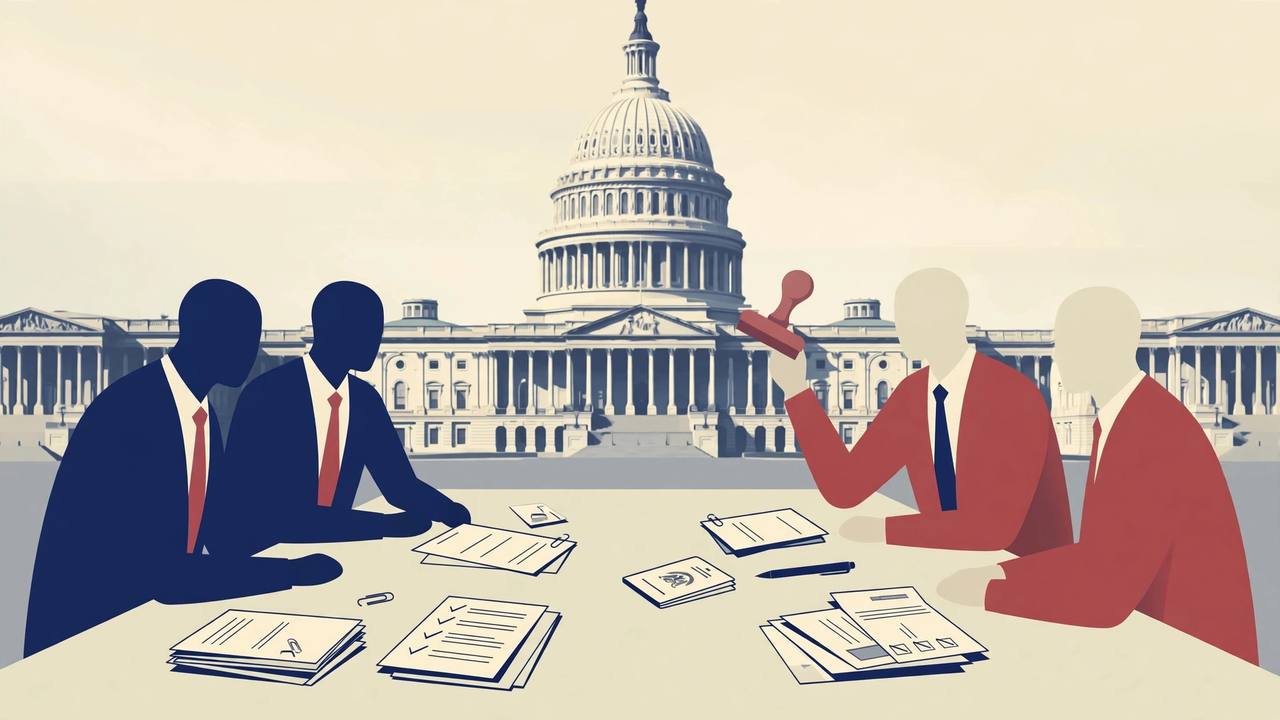
WASHINGTON — Within a day of losing both chambers of Congress in Tuesday's midterm elections, the White House has sketched the shape of the only immigration deal it says it will consider — and ruled the biggest item out. President Donald Trump told Fox News on election night that he could 'work with them on immigration' when the new Democratic Congress takes office in January, and told Politico he would 'consider doing whatever I think is appropriate and good for the country.' But a White House official told the Daily Caller that 'the Administration will never allow for mass amnesty,' and Vice President JD Vance, in a lengthy post on X on Wednesday, November 4, warned that 'anyone pushing amnesty is lying to you' — while opening the door to a different kind of enforcement deal, one aimed at employers who hire unauthorized workers.
Nothing in these statements changes anyone's immigration status or case today. They are interview remarks and a social-media post, not policy. But because Democrats will hold both the House and the Senate when the new Congress convenes on January 3, 2027, while Trump keeps the presidential veto, these first signals are the clearest available map of what a 2027 immigration negotiation could contain — and, for the Punjabi diaspora and other immigrant communities across the United States, of which doors are already closing and which one may be opening.
What Trump said on election night
In an election-night interview with Fox News anchors Bret Baier and Martha MacCallum, Trump — who told ABC News he was 'a little bit surprised' by the scale of the Republican defeat — pointed to immigration as possible common ground. 'We can work with them on a lot of things. I mean, we can work with them on immigration. I think. Immigration is a big deal. I've always felt we should be able to work on immigration,' he said, according to the Daily Caller's account of the interview. In the same answer he drew a line: 'Now, could I work with them on an open border? I don't think so.' Asked by Politico whether he would consider an immigration deal, he replied, 'I'd consider doing whatever I think is appropriate and good for the country,' ABC News reported.
Trump paired the openness with a reminder of his leverage. Democrats, he told Fox News, are 'in control, but not in control,' because they can send him bills 'and I send them back with a nice stamp veto.' Any immigration law in the next two years therefore needs both 60 votes in the Senate and his signature — the arithmetic that frames everything below.
Vance's post: no amnesty — but employers in the frame
Vice President JD Vance's first assessment of the defeat, a long post on X on Wednesday, November 4, blamed the Iran war — 'The reason we lost is the war. The president himself said so last night' — and then turned to immigration. 'In the next few months, there's going to be a lot of gaslighting. Expect to hear any number of establishment politicians say the solution to our woes is amnesty. I'm open to the idea that we should change enforcement, by focusing more on businesses that hire illegal labor, for instance. But anyone pushing amnesty is lying to you,' Vance wrote, as quoted by Fox News. That single sentence is the most concrete negotiating signal of the week: the administration's second-in-command is publicly open to shifting enforcement toward worksites and employers, while ruling out legalization by name.
The White House line, in full
Asked by the Daily Caller whether amnesty would be on the table after Trump's comments, a White House official answered by email: 'There has never been a stronger administration on immigration enforcement than the Trump Administration. Both the President and Vice President have delivered the most secure border in American history and under their leadership, ICE has shattered arrest records. The Administration will never allow for mass amnesty.' A separate source familiar with internal discussions told the Caller that 'amnesty is not on the table' in any change of immigration policy. Neither Vance nor the White House official defined what counts as 'amnesty' — the word on which any future talks will turn, since supporters of legal-status bills argue that fines, background checks and waiting periods make their proposals earned status rather than amnesty, while critics apply the label to any path to status.
Democrats come into the negotiation from the opposite direction: the Democratic National Committee approved two resolutions in August calling for changes to immigration enforcement, including one urging Congress to abolish ICE and phase out the immigration detention system, and another urging limits on Department of Homeland Security funding unless the agency ends certain operations such as workplace raids, mass arrests and actions near schools and places of worship, according to a Newsweek report cited by the Daily Caller. No Democratic leadership proposal for a 2027 immigration bill has been published yet.
Why employers are the likeliest point of agreement
Worksite enforcement is familiar legal ground. Since 1986, section 274A of the Immigration and Nationality Act (8 U.S.C. 1324a) has barred employers from knowingly hiring unauthorized workers; employers verify work authorization on Form I-9, and penalty cases are heard by the Justice Department's Office of the Chief Administrative Hearing Officer. E-Verify, the electronic check that many bills would make mandatory, is still voluntary for most private employers and runs on temporary authority — its current extension rides on the stopgap funding law that expires on December 11, 2026, according to the Congressional Research Service, which makes every funding deadline a possible vehicle for new worksite rules even if no grand bargain moves. For Punjabi-American employers and workers — in trucking, logistics, farming, hospitality and small business, the sectors where the diaspora is most concentrated as owners and as employees — a shift of enforcement weight from street arrests to payroll audits and hiring checks is the single most consequential signal in this week's statements.
The Dignity Act: the existing bill, and its new problem
The most prominent ready-made vehicle for a deal is the Dignity Act (H.R. 4393), introduced on July 15, 2025, by Republican Rep. Maria Elvira Salazar of Florida and Democratic Rep. Veronica Escobar of Texas. As summarized in coverage of the bill, it would offer people who arrived before 2020 a seven-year renewable legal status with $7,000 in restitution payments and no green card through that program, a separate path for Dreamers, tougher enforcement and asylum changes, and mandatory E-Verify. PolitiFact rated the claim that it grants 'mass amnesty' Half True — it is not a blanket pardon, but it could cover millions of people. The midterms weakened its starting position: the bill lost several Republican co-sponsors in Tuesday's voting, including Reps. David Valadao, Mike Lawler and Gabe Evans, though Salazar herself kept her seat, the Daily Caller reported. Forbes analyst Stuart Anderson has noted the structural problem: with divided government, Democrats lack the numbers to overcome either a Senate filibuster or a presidential veto.
What happens next
The current Congress governs until January; the new Congress convenes on January 3, 2027. Analysts expect the near-term fight to be oversight — the new Democratic majorities can investigate immigration enforcement — rather than a comprehensive bill, not least because much of ICE's funding is locked in through 2029, alongside continued administration rulemaking on work visas. The first hard deadline in the story is much sooner: the December 11, 2026 expiry of the stopgap funding law that carries E-Verify's authority, which will force Congress and the White House to touch worksite rules within weeks, whatever happens to any larger deal. For now, the honest summary is the one the statements themselves support: the president says immigration is negotiable, his vice president and his White House say legalization is not, and the only concrete change either side has named is tougher enforcement aimed at the businesses that hire unauthorized workers.