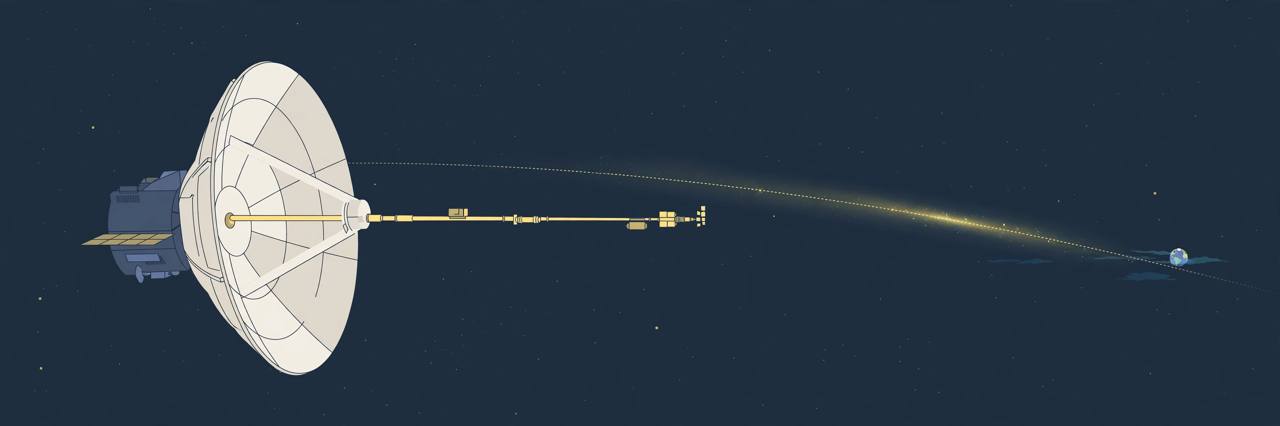
NASA's Voyager 1 spacecraft is about to cross a mile marker no human-made object has ever reached: one light-day from Earth. NASA says the probe will reach that distance on Wednesday, November 18, 2026, at 5:16:07 a.m. EST — a point so far from home that a radio signal, travelling at the fastest speed anything can travel, needs a full 24 hours simply to reach it.
Source: NASA Science
The crossing time comes from mission ephemerides calculated by NASA's Jet Propulsion Laboratory (JPL), which still flies the 49-year-old spacecraft from California. At the crossing moment, JPL's figures put Voyager 1 about 25.902 billion kilometres (16.094 billion miles, or 173.14 astronomical units) from Earth, cruising outward through interstellar space at roughly 17 kilometres per second — about 61,000 kilometres per hour — relative to the Sun.
Source: CRV Science News
What a light-day actually is
A light-day is a measure of distance, not time: it is how far light travels in 24 hours. Light moves through space at about 186,000 miles every second, and NASA gives the exact one-light-day distance as 16,094,799,096 miles (25,902,068,356 kilometres). Nothing in the universe travels faster, which is why astronomers measure the cosmos in light-time — the same yardstick produces the light-second, the light-minute and the light-year.
The comparisons show how extreme the distance is. The Moon sits 238,855 miles (384,400 kilometres) away on average, a gap light crosses in 1.3 seconds. Sunlight needs about eight minutes and 20 seconds to cover the 93 million miles from the Sun to Earth. A radio signal to Mars can take anywhere from three to 22 minutes depending on where the planets are, and Neptune — the most distant planet, an average of about 2.8 billion miles away — is four light-hours and 10 light-minutes out. Voyager 1 will be a full light-day out: six times farther than Neptune's light-distance, in a region no spacecraft has visited before.
A two-day conversation with a spacecraft
For the JPL flight team, the milestone has a hard practical meaning. Any engineering command sent to Voyager 1 — a heater adjustment, a thruster switch, a change to a science instrument — will now take a full day to arrive, and another full day for the confirming telemetry to come back. Controllers cannot intervene in real time if something goes wrong; the spacecraft's onboard fault-protection routines have to detect a problem on their own and put the probe into a safe, Earth-pointing state while it waits two days for instructions.
The signal itself is vanishingly faint. Voyager 1 transmits with roughly 23 watts of power — about a refrigerator light bulb — and by the time that signal spreads across 25.9 billion kilometres it arrives at the 70-metre dishes of NASA's Deep Space Network in Goldstone, California; Madrid, Spain; and Canberra, Australia, at a tiny fraction of a femtowatt. The data rate is about 160 bits per second, slower than an old dial-up modem by orders of magnitude, yet it still carries measurements no other instrument in existence can take.
How a 1977 probe got this far
Voyager 1 launched from Cape Canaveral in September 1977 and used gravity-assist flybys of Jupiter in 1979 and Saturn in 1980 to fling itself out of the planetary plane and toward interstellar space. In August 2012 it crossed the heliopause — the boundary, about 121 astronomical units out, where the Sun's wind gives way to interstellar plasma — becoming the first spacecraft to leave the Sun's protective bubble. It is now more than 50 astronomical units beyond that boundary, still returning direct measurements of interstellar electron densities, galactic cosmic rays and shock waves rolling outward from solar eruptions, through its plasma-wave, magnetometer, cosmic-ray and low-energy charged-particle instruments.
Keeping it alive is a power-rationing exercise. Voyager 1 runs on three radioisotope thermoelectric generators fuelled by plutonium-238, which produced roughly 470 watts at launch. Radioactive decay and ageing thermocouples cut that output by roughly four watts every year, so engineers have spent the past decade switching off non-essential heaters and subsystems to protect the remaining instruments and the thrusters that keep the big dish pointed at Earth. The remaining power is expected to sustain science operations only into the late 2020s or early 2030s — but the spacecraft itself will coast onward through the Milky Way for billions of years.
How NASA is marking the milestone
NASA is inviting the public to mark the crossing the night before it happens. After sunset on Tuesday, November 17, the agency's 'Shine Bright for Voyager's Light-Day' event asks people around the world to flash the spacecraft's call sign — VGR, in Morse code — toward the sky with phones, flashlights and even whole buildings, creating what NASA calls a symbolic wave of golden light encircling the planet. A JPL panel discussion with mission scientists follows on November 19, reflecting on nearly five decades of deep-space operations ahead of the mission's 50th launch anniversary in 2027.
Source: NASA Science
Voyager 1 is headed in the direction of a star called AC +79 3888, also known as Gliese 445, an obscure star in the constellation Ursa Minor that is more than 17 light-years away. Even at nearly 38,000 miles per hour (61,000 kilometres per hour), NASA expects the probe to pass within about 1.7 light-years of that star only in about 40,000 years. Its twin, Voyager 2, which took a different route in order to visit Uranus and Neptune, is on pace to reach one light-day from Earth in nine more years, in November 2035.
The crossing itself, at 5:16:07 a.m. EST on Wednesday, November 18, changes nothing on board — it is a mile marker, not an event the spacecraft can feel. What changes is on Earth: from that moment, every conversation with humanity's most distant object takes two full days. NASA's live 'Eyes on the Solar System' tracker and the mission's cosmic odometer will keep counting the distance upward, second by second, as the Shine Bright celebration runs on November 17 and the JPL panel follows on November 19.