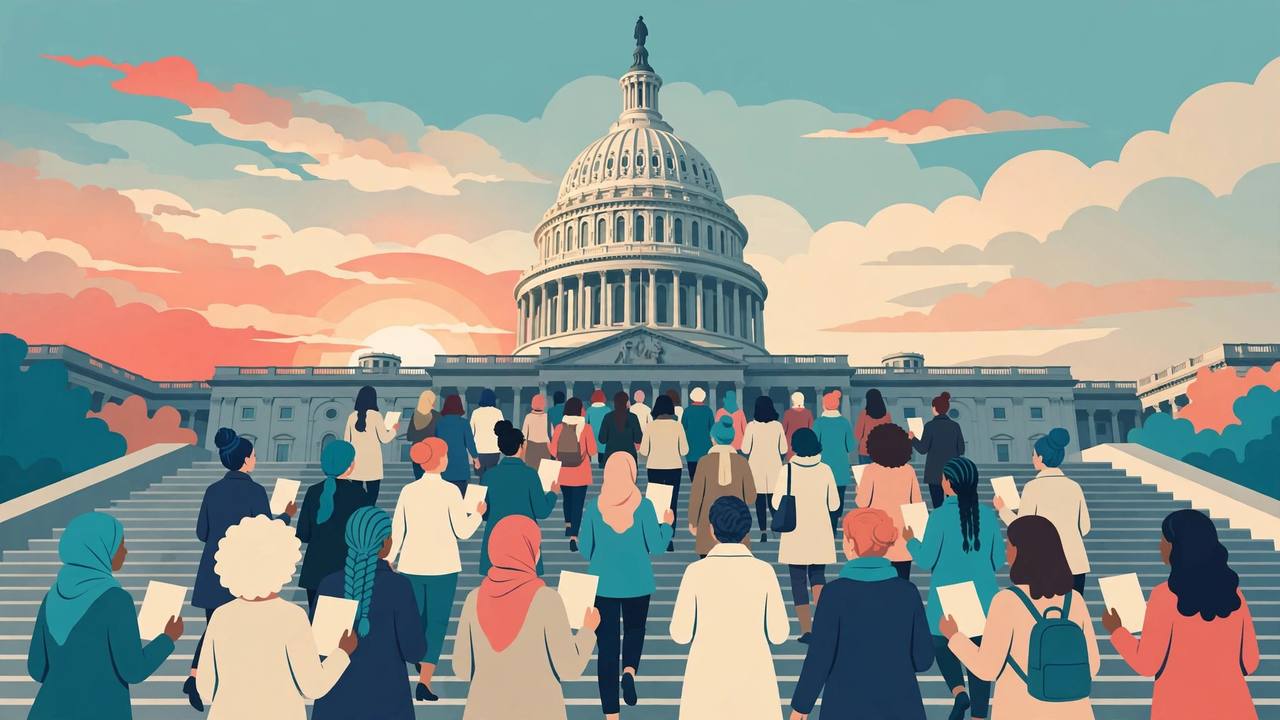
At least 100 Democratic women will serve in the United States House of Representatives next year — a record for either party — according to an analysis released after Tuesday's midterm elections by the Center for American Women and Politics (CAWP) at Rutgers University. The previous high was 95, set only in 2025. The milestone, reported early Thursday, is the headline of a wider CAWP accounting that also counts at least 116 Democratic women headed to Congress overall, topping the previous record of 111, and a record 17 women who will serve as state governors in 2027.
Source: Center for American Women and Politics (Rutgers) via BURN VOC
The numbers are floors, not finals. CAWP's count is built from races the Associated Press and other decision desks had called by Wednesday evening, and the centre noted that dozens of House races and two Senate contests were still being counted. Elect Democratic Women, a political action committee led by House members, put its own count higher — 117 Democratic women in House seats as of Wednesday evening — a reminder that the totals are moving as ballots are counted, and that different trackers are working from slightly different snapshots of the same unfinished count. What is not in dispute between the trackers is the direction: the old records have already been passed.
Democratic women did much of the work of winning the House itself. CAWP credited them with at least 10 of the party's House flips so far — the seats taken directly from Republicans that built the Democratic majority. 'Women made history because we showed up to vote,' said Representative Teresa Leger Fernandez of New Mexico, who chairs the Democratic Women's Caucus. The longer arc is steep: when EMILY's List began raising money for Democratic women in 1985, women made up less than 5 percent of the party's House caucus, and Axios noted that the number of Democratic women in the House has risen by more than 60 percent since 2016.
Source: Shansi Magazine, drawing on CAWP
The other side of the ledger
The gains are heavily concentrated in one party. Counting both parties together, at least 116 women have won House seats, including just 16 Republicans — below the all-time House record of 127 women, CAWP said. The centre said the number of Republican women in the House, the Senate and statewide executive offices will all drop after Tuesday's vote, and five Republican women lost their House seats on Tuesday. The chair of the Republican Women's Caucus, Representative Kat Cammack, told the Washington Post she was not surprised by the slide and that plenty of barriers still hold her party's women back — a candid admission, reported by the Post and cited in the post-election analyses, that the representation gap between the parties is widening, not closing.
Fifty more women remain in the 39 House races that had not been called by Wednesday evening, so the combined total can still rise toward — or past — the 127 record even as the party split stays lopsided. CAWP's analysts, including research director Kelly Dittmar, have long made the structural point that now shows in the numbers: who a party recruits, funds and places in winnable districts decides how many women it sends to Washington, and in 2026 the two parties ran that pipeline very differently.
A record 17 women will run states
The governorships produced the night's most visible firsts. At least 17 women — 14 Democrats and three Republicans — will serve as governor in 2027, beating the record of 14, CAWP said. In Georgia, former Atlanta mayor Keisha Lance Bottoms became the first woman to govern the state and the first Black woman ever elected governor anywhere in the United States. In New Mexico, Deb Haaland — a citizen of Laguna Pueblo who was one of the first two Native American women in Congress and the first Native American Cabinet secretary — will be the first Native American woman to lead a state. In Texas, Gina Hinojosa beat three-term Governor Greg Abbott to become the state's first Latina governor, despite being outspent five to one on television advertising, according to AdImpact figures cited in the reporting. Amy Klobuchar in Minnesota and Republican Marsha Blackburn in Tennessee will each be the first woman to govern her state.
A Senate first — and a Senate decline
The Senate delivered a genuine first alongside a step backwards. In Minnesota, Peggy Flanagan — Ojibwe, an enrolled member of the White Earth Nation — became the first Native American woman ever elected to the United States Senate, in a chamber that has existed since 1789; the Associated Press called her race a few minutes after midnight. Yet overall, CAWP said at least 23 women will serve in the Senate next year, down from 27 now, after two Republican women incumbents lost their seats. In Alaska, Mary Peltola, who is Yup'ik, led Republican Senator Dan Sullivan by about 600 votes on Wednesday with roughly a quarter of ballots still uncounted — a race no one had called, and one that could add another Native woman to the Senate or narrow the decline.
Source: Shansi Magazine, drawing on CAWP and AP
Who sits in Congress and in governors' mansions shapes the issues Punjabi-American families follow most closely — immigration law and enforcement, small-business and trucking regulation, health care and education funding. A House in which one party's caucus is approaching half women, and a map with a record 17 women running states from Georgia to New Mexico to Texas, means those debates in 2027 will be led, chaired and negotiated by a noticeably different set of office-holders than any previous Congress has had.
What happens next
First, the count finishes: dozens of House races and two Senate contests were still open on Wednesday evening, including the Alaska Senate race, and CAWP's totals will be revised as the remaining calls land. The new Congress is sworn in in January 2027, when the record 100-plus Democratic women formally take their House seats, and the 17 women governors take office in their states on their own inauguration schedules. The open political question the numbers leave behind is the Republican one Cammack named: whether the GOP treats its falling share of women in office as a recruitment problem to fix before 2028, or whether the gap CAWP measured this week becomes a fixed feature of American politics.