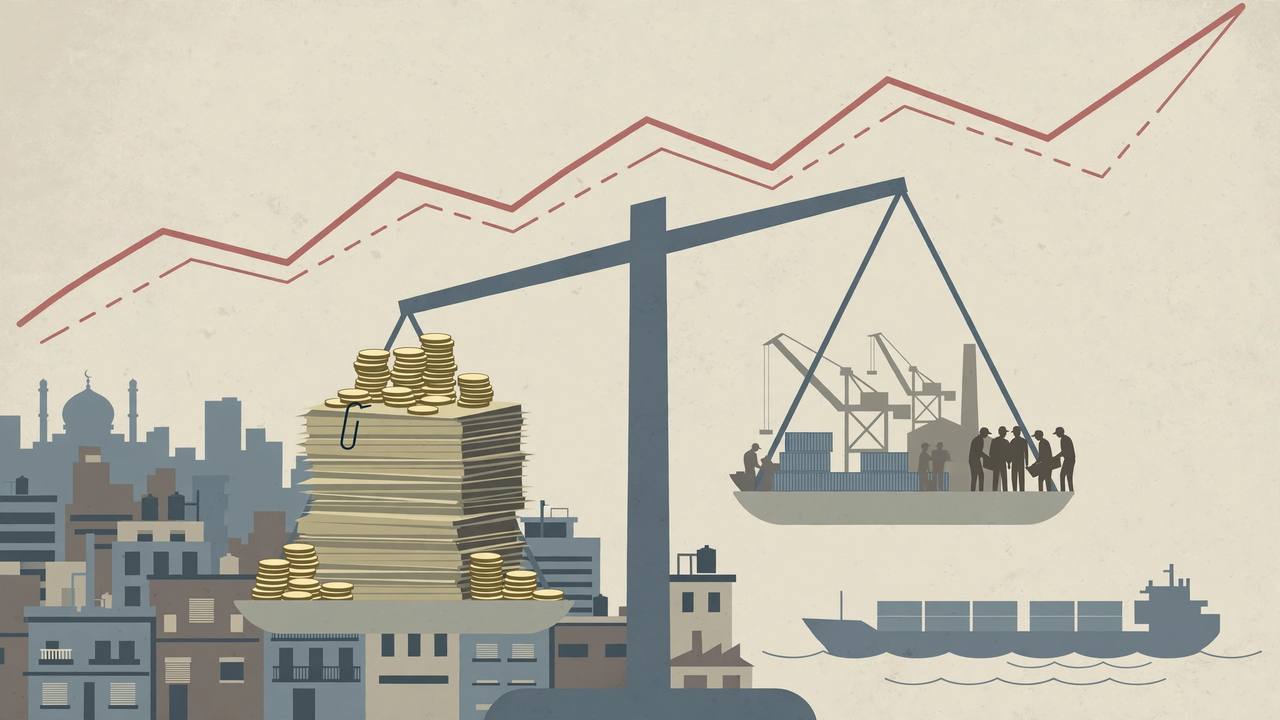
Bangladesh's external debt reached $113.44 billion at the end of 2025, as the outstanding debt stock increased 8.6 percent from a year earlier, according to the World Bank. Released on November 5, the International Debt Report 2026 shows the country's external liabilities have nearly tripled over the past decade, climbing from $38.77 billion in 2015, The Business Standard reported on Sunday, November 8. The per-capita figure is calculated by dividing the total external debt by a population of 175.7 million, as reported by the World Bank, representing an average macroeconomic share rather than an individual citizen's personal liability.
Source: The Business Standard, Nov 8 2026 — Every Bangladeshi carries $646 in foreign debt: World Bank
$113.44 billion — yaani $11,344 crore dollars in desi counting; at an exchange rate of Tk 125 per dollar, the total is equivalent to about Tk 14.18 lakh crore. The country's total debt stock comprises $89.51 billion in public and publicly guaranteed debt, $9.87 billion in private non-guaranteed debt and $14.06 billion in short-term debt, The Business Standard reported. The latest Bangladesh Bank data separately show gross external debt stood at almost $115 billion as of June 2026.
Who Bangladesh owes
Multilateral lenders remain the largest source of Bangladesh's external financing: the country owed $51.14 billion to multilateral institutions at the end of 2025, including $22.64 billion to the World Bank's International Development Association (IDA) and $17.52 billion to the Asian Development Bank, with other multilateral creditors at $10.99 billion. Bilateral creditors accounted for another $32.64 billion — Japan was the largest bilateral lender, with outstanding loans of $12.72 billion, followed by Russia with $9.02 billion. Annual repayment obligations have climbed sharply, reaching nearly $4.5 billion in the last fiscal year, according to the Economic Relations Division (ERD).
The report's indicators show external debt stood at 210 percent of Bangladesh's exports in 2025 — more than twice what the country earns in a year from foreign trade and other income — while the debt-to-GNI ratio rose to 24 percent. Debt servicing took 16 percent of Bangladesh's export earnings in 2025, 3.1 percentage points less than the year before, The Daily Star reported via the Centre for Policy Dialogue. In the World Bank's regional data, India holds the largest external debt stock in South Asia at $763.52 billion, followed by Bangladesh at $113.44 billion and Sri Lanka at $57.66 billion.
'Manageable for now' — the economists' warning
Economists say the debt is manageable for now, but exports are small, borrowing costs are rising and grace periods are shortening. Prof Mustafizur Rahman, a distinguished fellow at the Centre for Policy Dialogue (CPD), said the debt-to-GDP and debt-to-export ratios are rising gradually, and that Bangladesh needs to reduce its reliance on foreign borrowing. Zahid Hussain, a former lead economist at the World Bank's Dhaka office, said Bangladesh still does better than Pakistan and Sri Lanka on these indicators but trails India. The shared warning in the Dhaka reporting is specific: Bangladesh could face repayment trouble if borrowing keeps growing at this pace and the money is not put to proper use.
Source: The Daily Star via CPD, Nov 8 2026 — Mustafizur Rahman and Zahid Hussain comments
The same World Bank report put the external debt of all developing countries at a record $9.4 trillion in 2025. Awaaz Punjab's report on the global figures is here: Developing Countries' Debt Hits a Record $9.4 Trillion, World Bank Says
What is solid
- The World Bank's International Debt Report 2026, released November 5, puts Bangladesh's external debt at $113.44 billion at end-2025, up 8.6 percent in a year and up from $38.77 billion in 2015 — reported by The Business Standard, The Daily Star and JustEnergy News.
- The debt stock is mostly public and publicly guaranteed ($89.51 billion), with $14.06 billion short-term; multilateral lenders hold $51.14 billion, led by the World Bank's IDA ($22.64 billion) and the ADB ($17.52 billion).
- Debt servicing took 16 percent of export earnings in 2025, down 3.1 percentage points from the year before — reported by The Daily Star.
What is only claimed
- The $646-per-person figure is an arithmetic average across 175.7 million people, not money any individual Bangladeshi owes or must pay — every source reporting it states this caveat.
- Whether the debt path becomes a repayment problem is economists' judgement, not a finding of the report: CPD's Mustafizur Rahman urges less reliance on foreign borrowing, while the same reporting describes the current indicators as manageable for now.
Why it matters beyond Dhaka: Bangladesh is South Asia's garment-export success story, and its borrowing paid for the mega-projects — power, ports, bridges and the Rooppur nuclear plant — meant to keep that growth going. The test the economists are setting is whether export earnings grow fast enough to service a debt stock that has tripled in ten years, at a moment when repayment instalments on several mega-projects are coming due. What happens next is in the numbers: the next Bangladesh Bank quarterly debt release, and whether Dhaka's new borrowing slows, will show whether the $113 billion line keeps climbing at 8.6 percent a year or bends.